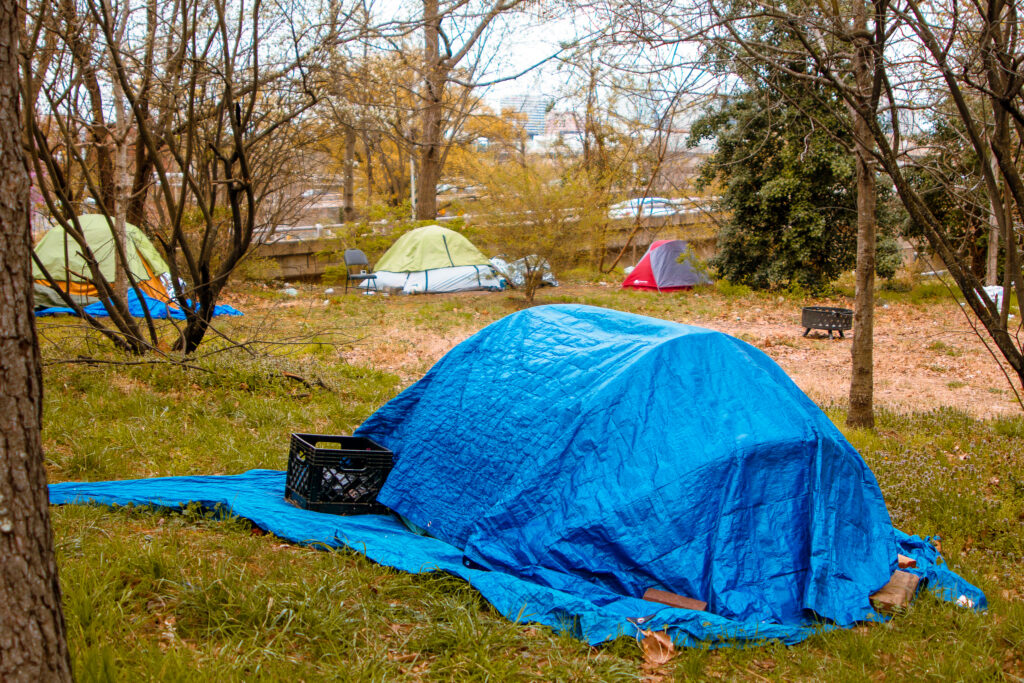
On any given day, there are more than 5,000 people experiencing homelessness in D.C., and almost 800 of them live outside.
Housed Washingtonians may not always understand why some people experiencing homelessness live in tents, encampments, or other arrangements outside, rather than staying in the city’s homeless shelters. But many people say they’ve had negative experiences in shelters, leading them to feel safer on the street.
“To the uninitiated, if somebody asked me, ‘Well, why don’t they just stay in a shelter?’ I’m like, ‘Have you ever been in a shelter?’” Andy Wassenich, director of policy at Miriam’s Kitchen, a homeless outreach organization, said.
The majority of people experiencing homelessness in the District do stay in shelters or transitional housing, which city officials maintain is the safest option, offering protection from the elements and a central place to access services. The District has worked in recent years to open new options that respond to some of the reasons people say they avoid shelter, though concerns around fear of violence, restrictions on belongings, or crowded conditions are still common.
“[Shelters are] the last option. I’d rather sleep outside, and I’ve done that plenty of times,” John Chambers, who has stayed at a shelter in D.C. a few times before, said. “The number one is just how dangerous it is… People are at their worst, really, at the shelters. I was at my worst, I was going through a real bad time, and really needed some help, and I didn’t get it there. So if I had to stay outside and do it on my own, I would do it that way.”
Where do I feel safe?
One early morning in March, Melvin Tibbs woke up at 801 East Men’s Shelter to find his phone out of battery. Another resident was using his charger without permission. According to Tibbs, an argument ensued, and the other man stabbed Tibbs in the neck with a sharp piece of metal.
It was a “stupid confrontation for nothing,” Tibbs said, but it hospitalized him. Now, he told Street Sense, he wants to avoid homeless shelters.
“I’d sleep outside instead of being up in the shelter, man, because it shouldn’t be like that. Why you touching people’s stuff?” Tibbs said. “I’m just trying to get some help. That’s what I thought I was in there for. I was trying to get myself out of there.”
People experiencing homelessness in D.C. may stay away from shelters because they’ve experienced, witnessed, or heard about violence there. Chambers was at 801 East in March and said he witnessed Tibbs’ stabbing. Just a few years earlier, in 2023, Chambers himself was stabbed by another resident there, he said.
“I’ve seen people have guns there, knives there. It’s the wild, wild west,” Chambers said of 801 East. Weapons are prohibited in city shelters, a spokesperson for the D.C. Department of Human Services (DHS) wrote to Street Sense. 801 East is the only shelter Chambers has stayed in, but after experiencing violence there, he tries to avoid shelters altogether. People living outside commonly tell Street Sense they’re put off by shelters entirely after a bad experience at one location.
All staff in shelters are trained in crisis intervention, according to the DHS spokesperson, but Tibbs, Chambers, and others say they feel staff are not equipped to intervene or prevent violence and can react poorly when conflict breaks out. At a February oversight hearing for DHS, Remy Smith said that, at SHINE, a shelter for LGBTQ+ young people, staff did not respond to instances of violence and harassment.
“There were multiple times I witnessed verbal and physical fights between people in the building, and when these were reported to the staff, it was met with, ‘Hush. Don’t say anything,’” Smith said.
Different experiences with violence may shape where someone feels safest. As Wassenich said, “Safety is relative.” While those living in shelters may have concerns about staff or other residents, people living outside can face harassment from strangers passing by. Nationally, about 13% of violent attacks against people experiencing homelessness occur in shelters, while most occur outside.
Earlier this year, Jacques Santee told Street Sense they had been assaulted by someone trying to stab them while they were sleeping in their tent in the Capitol Hill neighborhood. In other cases, attackers have targeted multiple people experiencing homelessness: in 2024, a group attacked four people sleeping in an encampment in Silver Spring, Maryland, and two years earlier, a man shot five people experiencing homelessness in D.C. and New York City, killing two.
The Trump administration’s federal takeover of D.C. and crackdown on homelessness last August also led to more encampment closures and increased fear around safety for some residents living outside. While it’s rare for federal or city law enforcement to arrest someone sleeping outside, the presence of officers can make people feel uneasy.
Weather is another element of safety, particularly during periods of extreme heat or cold. During the record cold of this past winter, four people likely experiencing homelessness died from hypothermia.
During the winter, D.C. opens temporary hypothermia shelters to increase bed capacity and keep people out of the cold. Demand for shelter is highest in the winter, suggesting some people sleep outside in temperate months, but go into hypothermia shelters during the cold.
“It’s so cold out here sometimes, or it’ll be so hot. You never really know what you get here. I wanted to be out of the weather, and not deal with that,” a resident at the Community for Creative Non-Violence (CCNV), D.C’s largest shelter, told Street Sense. The person asked to remain unnamed for privacy reasons.
What can I have?
Many shelters have restrictive policies around who can stay, what they can bring, and more. Josh, who introduced himself by his first name only, has been experiencing homelessness for 14 years. He’s stayed in shelters before and described going to a shelter as a “pile of work.”
“There’s so many hoops you gotta jump through, and so many different people you gotta talk to, and this person wants you to go somewhere else and do something, and then fill out this paperwork,” Josh said. “To jump through these hoops and spend all my time and resources to do that is just insurmountable.”
Many shelters restrict residents to only a couple of bags worth of items, and certain items may be banned. These rules are one of the “biggest barriers” to accepting shelter for many people, Wassenich said. “Whatever possessions that you happen to have, when you’re living on the street, that’s all you have.”
Josh, who lives outside in Navy Yard, said he doesn’t want to go back to a shelter in case he can’t bring all his possessions inside.
“The problem with the shelters is, the moment you come in, they say, ‘Okay, you can’t have that, you can’t bring this in here, you gotta toss that in the trash or store it somewhere,” Josh said. “Once you have no property, pretty much, they’re forcing you to be a beggar, to depend on other people, and that’s what I’m trying to avoid. That creates the problem they’re supposed to be there to try to mitigate.”
Some say they fear losing their belongings or having them stolen while living in close quarters. Bernard and his cousin Darnell, who introduced themselves by their first names and who live in an encampment in Navy Yard, both said they left shelters because residents stole or tried to steal their belongings.
“I already don’t have a lot. What I do have, I plan on keeping,” Darnell said. “I’m not trying to go to sleep and wake up without it, and now it has to be a confrontation.”
People experiencing homelessness may lose their belongings or have them stolen while living in encampments, too, if they have to leave them unattended to go to work or get meals. Those in encampments also face closures, when the city clears tents and other set-ups where people experiencing homelessness are living. If a resident is present during a clearing, they may move their belongings, but if they are not, the city encampment team may throw them out. While residents typically get at least seven days’ notice before an encampment closure, the city sometimes closes encampments with little warning, leading residents to lose possessions, including IDs and medications. In the last two years, D.C. has closed 200 encampments.
People who live outside say encampment closures are frustrating and inconvenient. “Why they coming to take my stuff, when I ain’t coming to take their house?” asked Bernard.
Who do I live with?
The city funds just over 1,100 low-barrier shelter beds for singles that people can walk up to the same day, with hundreds more beds spread across CCNV, higher-barrier shelters, family shelters, and temporary housing. In low-barrier shelters, residents can face crowded conditions and a lack of privacy when sleeping in communal rooms. Data from a recent week this April shows low-barrier shelters in the District operating at more than 98% capacity, with fewer than ten beds vacant some nights, though occupancy rates vary throughout the year.
With so many people in one space, Darnell and others worry disagreements with staff and other residents in shelters will escalate into conflict.
“I have a distinct memory of somebody saying to me, when offered the opportunity to go to the shelters, ‘Nah man, I’m trying to stay out of jail. If I go to a shelter, I’m going to get arrested, I’m going to get in a fight, and I’m going to go back to jail,’” Wassenich said.
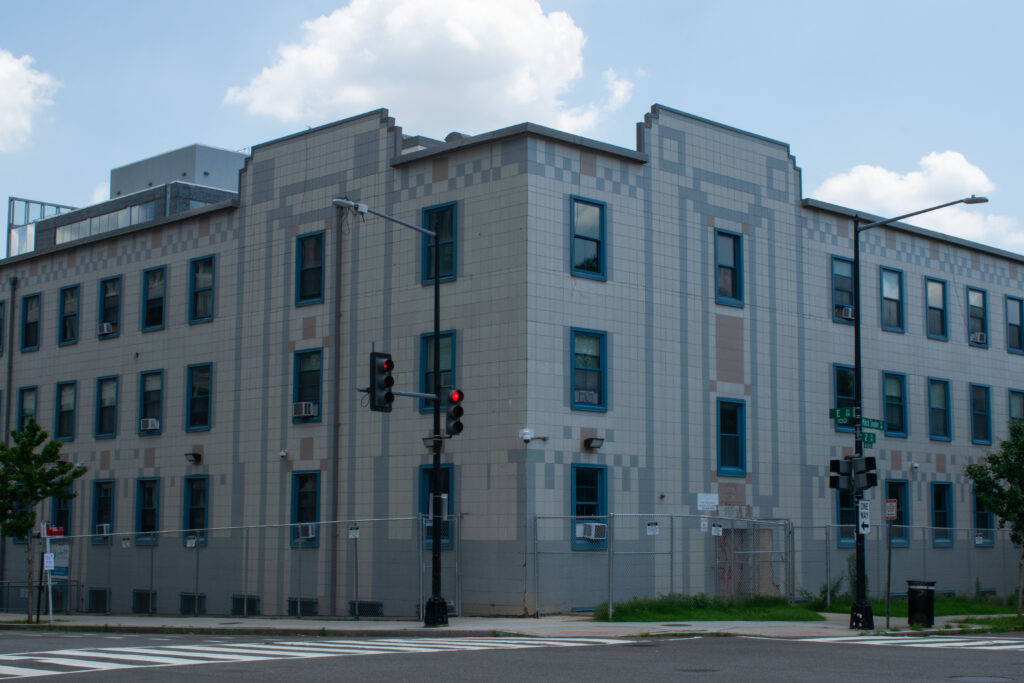
Crowded facilities can also create cleanliness problems residents say are often not addressed. Apollos Robinson, an artist and vendor at Street Sense staying at the 801 East Men’s Shelter, said he was written up after reporting bed bugs and bringing one to the front desk.
“I set a bed bug on the desk. It’s okay for me to lay in the bed bugs every day, but if I lay one on the front, it’s not okay for it to be there?” Robinson said. “I don’t have nobody in my corner there.” Some people may avoid shelters because of drug use in or near the buildings — while shelters generally prohibit drug use on the premises, many former shelter residents said it is still prevalent. “With the drug use that goes on there, if you’re in recovery, I wouldn’t recommend shelters,” Chambers said.
However, experiences vary: while some may avoid shelters due to drug use inside, others may avoid living outside for the same issue.
“It goes both ways. Some people feel like their sobriety is at risk if they go into a shelter,” Wassenich said. “I’ve also heard the opposite argument: ‘I need to get off the street or go to shelter, because there’s too many people around me with drugs.’”
For couples or adult families experiencing homelessness, restrictions on who can stay in a shelter also form a barrier.
Families with minor children can access an emergency shelter program that keeps them together; if they live outside, they face a higher risk of the city placing children in the child welfare system. But families without minor children generally cannot access the same program. Most low-barrier shelters, where residents sleep in rooms with many others, are single-gender or separate men and women.
“If you are a mixed-gender couple and you are unhoused, our low-barrier shelters are not an option for you. You will be split up, you can’t stay together,” Wassenich said.
The city recently opened two non-congregate shelters, where residents have semi-private rooms and mixed-gender families or couples can stay together. But non-congregate shelters are an option not all people experiencing homelessness have access to: residents have to be referred to the shelter and meet certain qualifications.
In addition to splitting up families, shelters may force people experiencing homelessness to surrender their pets. Nationally, about 10% of people experiencing homelessness have service animals or pets, though former DHS Director Laura Zeilinger testified restrictions on pets did not prevent a notable number of people from entering shelters. D.C. has no pet-friendly shelters, as a 2024 bill mandating DHS create one by October of this year remains unfunded.
Where can I get the help I need?
Having a central location to sleep, get food, and be connected with other resources and services can be a major draw for shelter residents.
“Outside, it’s hard to keep your stuff together all the time. I have to go three, four miles for laundry, go somewhere else for food, somewhere else to shower. It’s hard. I’m used to being in my home,” the CCNV resident said.
But others say that the resources offered in shelters don’t meet their needs. Josh, for example, has diabetes and said not being able to cook his own food while staying in shelters is a “serious medical hardship.” He prefers staying near the Whole Foods in Navy Yard, where he can grocery shop and prepare meals in the food court microwave.
Residents also said shelters do not always meet identity-related needs. At an oversight hearing in March, DHS Director Rachel Pierre said anyone can go to a shelter that aligns with their gender identity. But even at SHINE, a shelter designed for LGBTQ+ youth, Smith, a trans man, said staff were not supportive.
“My last month at the shelter, they decided to place me in a room strictly full of women,” Smith said at the February DHS hearing. “I told them it was making my mental health deteriorate, and they just told me that comfort isn’t an option sometimes, and I have to deal with it because my only options were to stay in the shelter or be homeless.”
Language access is another barrier. Shelters frequently lack bilingual staff, making it difficult for some residents to report concerns or seek help, though the city offers free access to translation through a Language Line.
At the February hearing, Heyden Rosendo testified in Spanish he was physically attacked at two different shelters. A translator interpreted his testimony: “He had struggled to report this to supervising staff due to language barriers, and he felt that there wasn’t proper training and trauma-informed approaches.”
There are numerous reasons why a person experiencing homelessness may prefer to live outside or in an encampment instead of in a shelter. D.C. has tried to respond to some of these concerns over the last decade, renovating older shelters and adding new options with more privacy. But some people still prefer not to stay there. Wassenich said it’s important to understand these varied experiences and meet them with respect.
“Freedom of choice is important. Folks who are unhoused and homeless, they still have rights. They still have the ability to state what they prefer. They still have dignity.” Wassenich said. “One of the ways, I believe, that you help people turn it around, is by giving them some level of comfort and agency.”
This article originally appeared in Street Sense’s April 22, 2026 edition.