
This article is part of Street Sense’s 2025 contribution to the D.C. Homeless Crisis Reporting Project in collaboration with other local newsrooms. The collective works will be published throughout the week here.
Following a year of delays, D.C.’s E Street shelter opened its doors to residents Sept. 22, according to the D.C. Department of Human Services (DHS). The new, dorm-style shelter expands on the District’s goal to offer non-congregate shelter options for people experiencing homelessness, encouraging more people to move into shelter and acting as a stepping stone toward permanent housing.
The opening of the E Street shelter comes as local government officials and community advocates discuss whether the city is underutilizing the District’s only other non-congregate shelter option, the Aston. As heightened federal oversight in D.C. leads to encampment clearings and Congress threatens escalated enforcement against visible homelessness, advocates worry the city isn’t adequately addressing the growing demand for high-quality shelters.
Non-congregate shelters, also known as bridge housing in D.C., are a high-barrier shelter option that offers residents semi-private rooms and personalized case management throughout their stay. Residents have to be referred to the shelter and meet some qualifications, often proving they’d struggle in communal shelters. This differs from low-barrier shelters, where people can walk in the same day, but do not have a designated space and sleep in rooms with many other residents. After pandemic-era non-congregate shelters closed in 2023, advocates began pushing for the city to replace them with permanent options.
The newest shelter, located at 25 E St., currently has 14 residents and will work toward a full capacity of 190 on a “rolling basis,” according to DHS.
DHS delayed the opening of the E Street shelter twice from the initially proposed date of November 2024, which officials published in July 2023. Most recently, in March, officials at an Interagency Council on Homelessness meeting said the opening was delayed until summer 2025, citing failed building inspections and ongoing renovations. After fears of another round of setbacks, DHS officials announced the shelter opened in mid-September at a 6E Advisory Neighborhood Commission (ANC) meeting held Sept. 25.
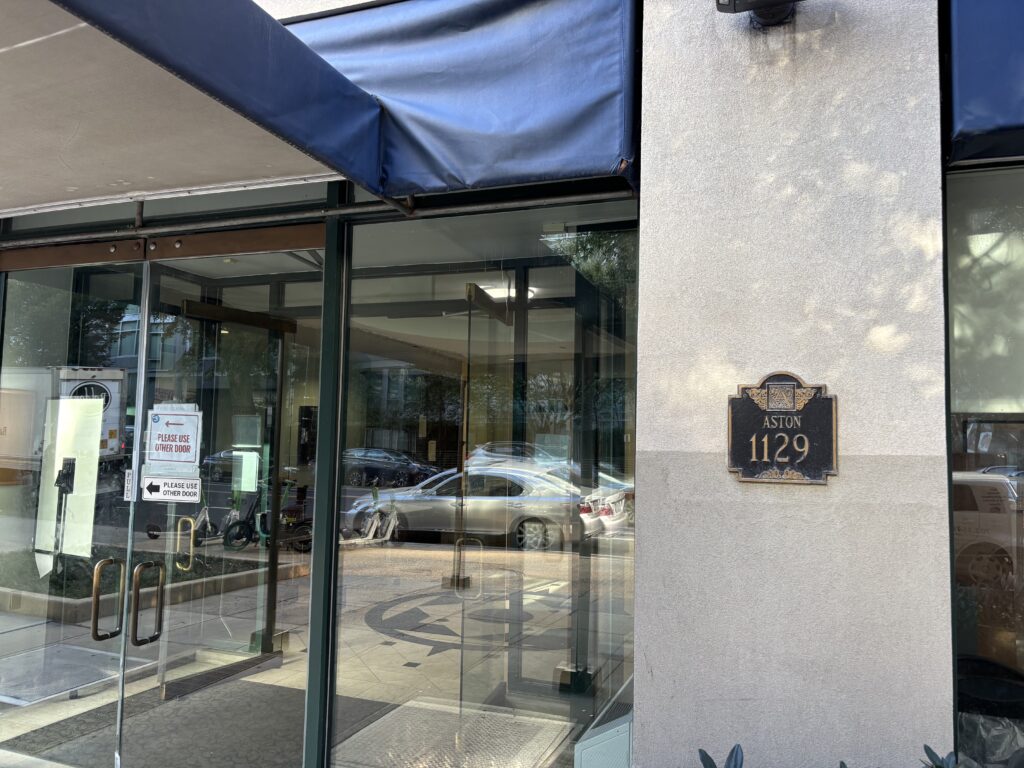
The opening of the city’s first non-congregate shelter, the Aston, was also plagued with delays, partially because of pushback from local community members. The Aston, located in D.C.’s West End neighborhood, opened its doors to residents in November of 2024. District officials planned for the shelter to house 190 people, but DHS lowered the number to 100 by the time it admitted the first 50 residents.
The 100-resident capacity is included in the Aston’s Good Neighbor Protocol, an agreement made between DHS, shelter organizers, and local community members. The protocol, created in October 2024 by the Aston Community Advisory Team (CAT), set guidelines about maintenance, security, and resident conduct.
Now, nearly a year after the shelter started welcoming residents, community advocates like local ANC representatives and members from The Way Home campaign, a coalition of organizations aiming to end homelessness, have spoken out to urge District officials to raise the capacity of the Aston back up to 190, following reports of the facility nearing its current cap.
In June, the 2A ANC, which oversees the neighborhood where the Aston is located, approved a resolution proposed by Commissioner Sean Youngstone urging Ward 2 Councilmember Brooke Pinto to “communicate her support” to expand the capacity of the shelter. The resolution also calls for the D.C. Council to allocate additional funds beyond the facility’s current budget to increase resources and employees at the Aston to accommodate the additional residents. ANC 2C passed a similar resolution in solidarity with 2A over the summer, advocating for “full use” of the Aston facility to serve residents.
In an email to Street Sense, DHS said it was “aware” of the resolutions, adding that a capacity increase would require approval from Pinto and the mayor’s office.
Youngstone said expanding the capacity of the Aston to 190 would not mean the shelter would be full at all times; rather, it would allow for the potential of expansion when beds are in high demand. He said it is “deeply unfortunate” that one of the city’s most “high-quality” shelters is not housing residents to its full spatial ability.
“I think that’s a little ridiculous,” Youngstone told Street Sense. “I think it’s a waste of city resources, and I think, especially given the budget climate we’re in right now, for the city to have that real estate and not to be using it just feels so unfortunate.”
Officials at the Aston say ongoing construction in many of the facility’s residential rooms, insufficient dining room space, and a lack of staff would make it difficult for the shelter to accommodate an increase in resident capacity without more resources, according to recent reporting from The GW Hatchet.
Jim Malec, another ANC commissioner representing 2A, said he voted “no” on the resolution because he felt like raising the number to 190 would break promises the ANC made to their constituents ahead of the shelter’s opening, when officials said they would not increase the capacity past 100.
According to Malec, Pinto has not indicated “any interest” in revisiting the Aston’s Good Neighbor Protocol. Malec added that ANC resolutions do not carry any “great weight” in influencing action from the council or the mayor’s office.
“If [Pinto] feels the circumstances have changed and that we should move from what was initially promised to a higher number, then that responsibility is on her to come back to the community and say, ‘I know I told you it was going to be 100, but here’s why I think we should revisit that decision,’” Malec said.
In an email to Street Sense, Pinto wrote she is “pleased” to see success at the Aston as residents transition from the shelter to permanent housing. Pinto’s office did not immediately return a follow-up about whether the councilmember supported expanding the facility capacity.
“Helping move neighbors into stable indoor housing has always been a priority for me,” Pinto wrote in the email.
Advocates from The Way Home campaign also issued a statement in September urging Pinto to support expanding the capacity of the Aston. The campaign organizers cite the recent surge in federal police and military presence throughout the city as a reason to “urgently maximize” the shelter space made available to unhoused residents in the District.
“With over 700 people living outside in dire need of dignified shelter, it’s imperative that both bridge housing sites reach capacity as soon as possible,” the letter reads.