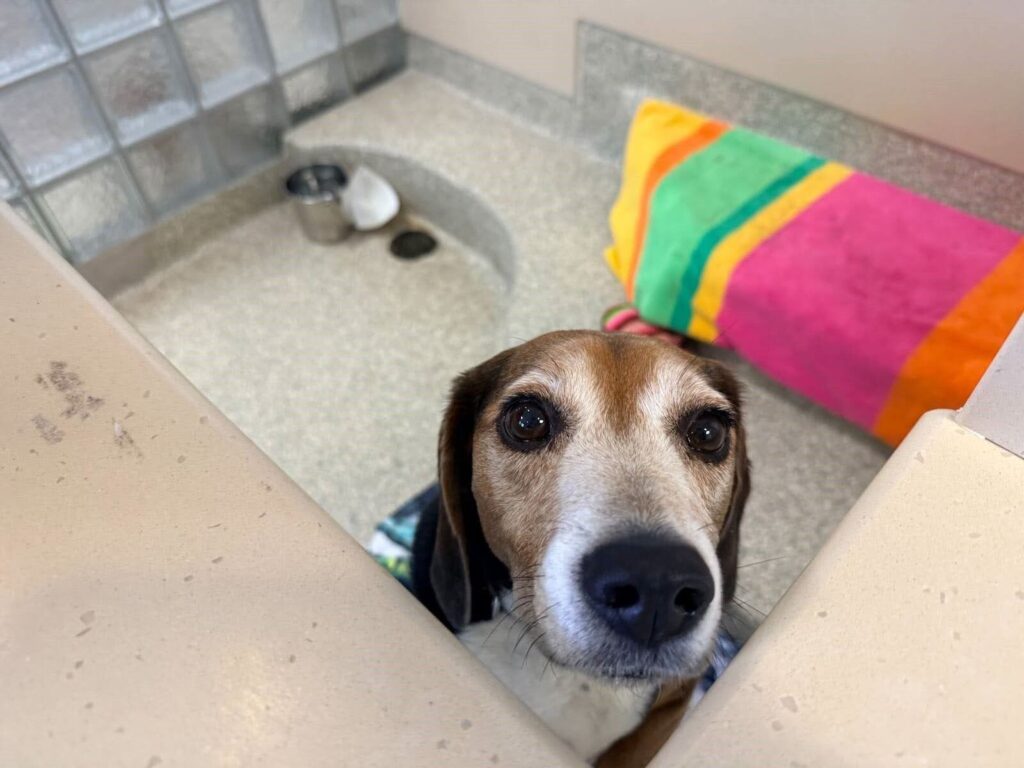
Pet owners experiencing homelessness in the District may still have to abandon their furry companions to access shelter, as a D.C. law passed over a year ago to create a pet-friendly homeless shelter remains unfunded.
Passed unanimously by the D.C. Council in 2024, the Pets in Housing Amendment Act aimed to lower barriers for entry into shelters and housing for D.C. pet owners. The act, dubbed Roscoe’s Law, capped pet rental fees, eliminated breed discrimination in the District, and mandated D.C’s Department of Human Services (DHS) develop a low-barrier pet-friendly shelter. But the law, which would cost $2.4 million to implement, was never funded, preventing DHS from finishing the shelter by the deadline of October of this year.
Currently, there are no individual, emergency, family, or domestic violence pet-friendly shelters in the District. Kelly Whitter, director of public affairs for the Humane Rescue Alliance, called this absence a “shame,” as D.C., a place she describes as being full of animal lovers, does not account for pet owners experiencing homelessness.
“The fact that we don’t even have a designated emergency shelter during extreme temperatures for pets and their people — it’s an unacceptable gap in the system,” Whittier said.
Pet surrenders in the U.S. climbed significantly in 2025, according to the American Society for the Prevention of Cruelty to Animals (ASPCA). The total number of cat surrenders rose by 34,000, while dog surrenders increased by 10,000. Surrenders comprised 30% of shelter intakes for dogs and cats in 2025. According to the National Alliance to End Homelessness, 10% of the U.S. homeless population has pets.
Whittier was a member of the People + Paws Coalition for Affordable Housing, the group that successfully pushed for the approval of the Pets in Housing Act. She hopes the District will fund the law within the next fiscal cycle to minimize the separation of homeless pet owners and their companions. Finding funding may be challenging in a tight budget year, when childcare and health care programs are expected to be on the chopping block.
Whittier said a lack of housing should not be seen as a variable in measuring how much an individual cares for their pet. In her experience, many individuals and families facing homelessness are heartbroken when surrendering their animal companions.
“If you feel as though you’ve been rejected by your family, isolated from society, judged at every turn for your choices, who doesn’t judge you? Who doesn’t love you unconditionally? Who is there for every step of the way? It’s your animal. It’s your companion,” Whittier said.
To founder and executive director of DC Voters for Animals, Max Broad, the stalled development of a pet-friendly shelter is “frustrating.” He argued the District has inflated its past projections for the resources needed to develop and maintain an emergency shelter that accommodates pets.
In a 2024 memorandum, D.C. Chief Financial Officer Glen Lee said the District lacked funding to fully implement the then-bill. A pet-friendly shelter would cost the District more than $600,000 annually, totaling $2.4 million over the next four years. Existing funds weren’t “sufficient” to satisfy the entirety of the bill, according to Lee, and the city has not funded the bill since.
In a 2024 hearing before the act’s passage, former DHS Director Laura Zeilinger said she did not believe bringing pets into shelters was a major issue for people experiencing homelessness, according to reporting from Street Sense. She said shelter staff did not report a large number of people who would have gone in if not for their pet, and did not advocate for funding for the shelter.
Today, DHS told Street Sense, individuals experiencing homelessness are still allowed to bring only documented service animals and emotional support animals with them into emergency shelters. The agency did not comment on the pet-friendly shelter required by the new law. The city has recently piloted other new models to respond to concerns people say keep them out of shelter, such as a lack of privacy or the inability to move in with an adult of a different gender.
Finding shelter while owning a pet is “just another constraint” for those experiencing homelessness, Broad said. He wants the District to prioritize finding low-cost, common-sense options that allow pet owners to stay with their animals, regardless of how many need a designated shelter.
“I think every individual that we can help find a home and every person’s life that we can make just that little bit easier, especially for people who are having such a hard time, matters,” Broad said.
D.C. Mayor Muriel Bowser is expected to introduce her proposed budget for the 2027 fiscal year in mid-April. The council will then review and revise the budget before passing it. The mayor’s office declined to comment on the budget until its release, including on whether Bowser would propose funding for the shelter.
The council’s unanimous passage of Roscoe’s Law in 2024 gives Whittier hope the act will receive funding soon. She said the District must invest in spaces for homeless pet owners and support legislation to remove barriers to housing and shelter.
“So many people are one crisis away from experiencing homelessness, being so particularly vulnerable. And they have pets. These [pets] are family,” Whittier said.
This article originally appeared in Street Sense’s April 8, 2026 edition.