The D.C. Office of the Chief Medical Examiner (OCME) is investigating the possible hypothermia deaths of four individuals believed to be part of D.C.’s unhoused population. The four died in the days after the January winter storm.
Chief Medical Examiner Francisco Diaz told Street Sense the cause of the four deaths will officially be determined once OCME receives the final toxicology report results. The sub-freezing temperatures in late January also led to three deaths in Fairfax County, including one man found inside a tent, according to D.C. News Now.
In D.C., the deaths included a 40-year-old Hispanic man found in the 5300 block of Georgia Avenue NW, a 68-year-old Black woman found in the 1700 block of Columbia Road NW, and a 61-year-old Black man found in an alley off the 1100 block of 9th Street NW, according to the OCME.
A fourth person, a 73-year-old Black man, was transported to Cedar Hill Regional Medical Center by Emergency Medical Services and pronounced dead later that day. OCME did not provide the names of those who died.
Hypothermia occurs when the body loses heat faster than it can produce it, causing an individual’s core body temperature to fall below 95 degrees Fahrenheit, according to the American Red Cross. The approximately 750 people who sleep outside in the city each night are more susceptible to hypothermia due to their prolonged exposure to the cold.
“Hypothermia is an extremely painful death,” said Rachelle Ellison, the executive director of The People for Fairness Coalition and advocate on the D.C. Interagency Council on Homelessness. “People think you just go to sleep and don’t wake up. That’s not it.”
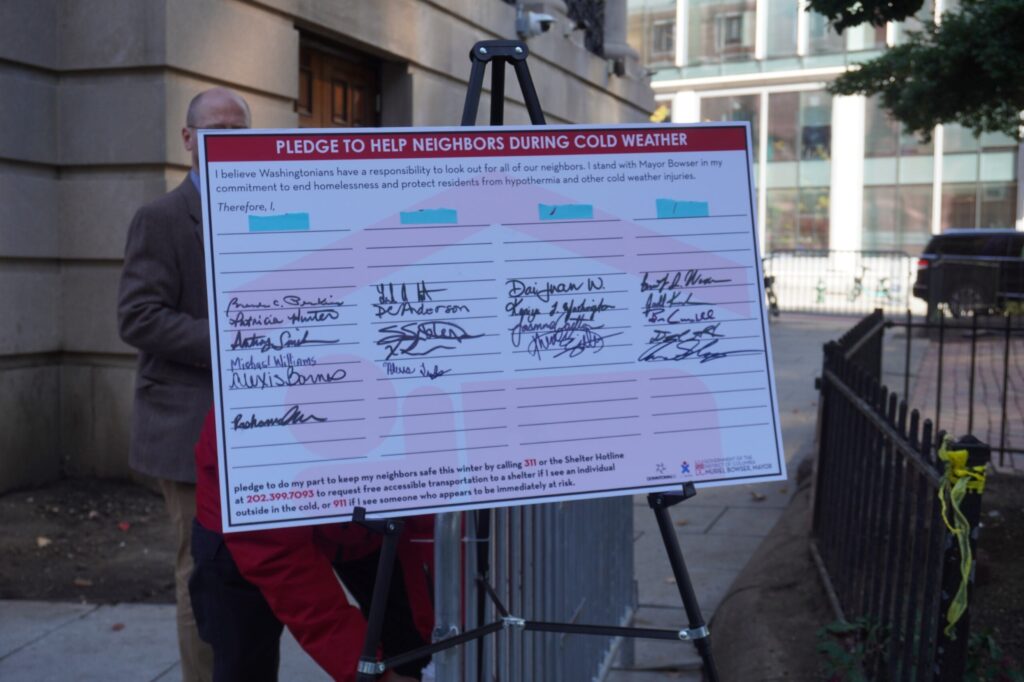
D.C. experienced its longest stretch of freezing temperatures since 1989 after the Jan. 25 snowstorm unloaded several inches of snow and ice on the District and the surrounding area. While these freezing temperatures persisted, shelters throughout D.C. increased capacity and extended operating hours — a standard part of the District’s winter plan — to accommodate more individuals experiencing homelessness seeking shelter.
Hypothermia is a concern every year, but four deaths in less than a week would be more than in recent winters. Despite snowfall and freezing temperatures, D.C. recorded zero deaths from hypothermia or cold exposure in the winter of fiscal year 2025, the first time since 2020. In 2021 through 2024, between two and three people died of hypothermia each year.
Still, in meetings, local homeless services leaders praised D.C. government agencies and other local groups that serve unhoused individuals for their collaboration during this year’s historic cold spell. Ellison was in contact with an individual who was refusing to go into a shelter despite temperatures being well below freezing, and when she alerted other agencies, such as the Department of Human Services (DHS) and Pathways to Housing, they were quick to jump in and help.
“I’m really grateful for that collaboration and the fast pace that they’re moving at DHS to try to open beds as much as possible in this extreme cold weather,” Ellison said.
While the response from the city was swift, Ellison said she ran into problems with the city’s FD-12 process, which can be used to involuntarily take people into hospitals when they pose a danger to themselves, including sleeping outside in freezing weather. Ellison said when she tried to get a couple of individuals taken off the streets, it took too long. She reached out to FD-12 one man, and said he did not get taken to a hospital for about 48 hours.
“It just took a little bit longer than I had liked, because at a certain point you say, okay, this person is not going to accept any help and they have a nice, warm bed, where they can be fed three meals a day,” Ellison said.
She thinks there was more collaboration this winter because the city is taking threats to its unhoused population more seriously. “The National Guard being here, ICE going around, people are more protective of the most vulnerable population,” Ellison said.
Editor’s note: Rachelle Ellison is also an artist/vendor with Street Sense.
This article originally appeared in Street Sense’s Feb. 25, 2026 edition.