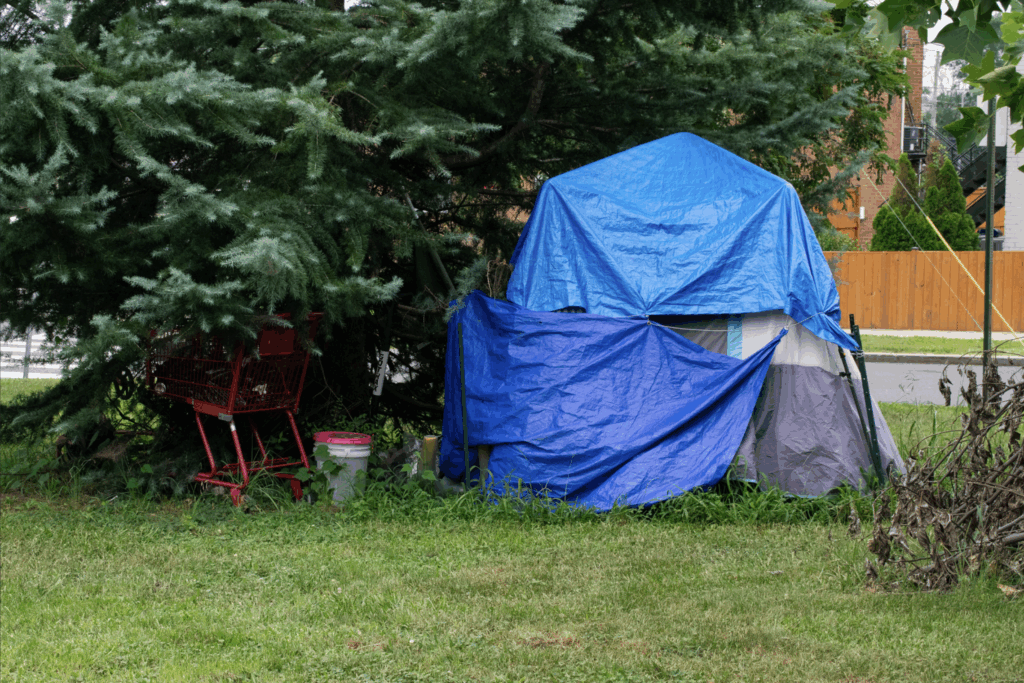
On Sept. 10, President Donald Trump’s executive order to temporarily take control of D.C.’s police force expired. The same day, the U.S. House Committee on Oversight and Government Reform met to discuss a set of bills seeking to exercise Congress’s authority over D.C., many of which advanced the president’s agenda to make D.C. “safe and beautiful,” including cracking down on homelessness and crime in the District.
While many of Congress’s D.C.-related bills focus on crime prevention and law enforcement more broadly, the Clean and Managed Public Spaces Act specifically targets homelessness by increasing the penalties for people camping outdoors on public property. If the bill is passed, people camping outside could be fined up to $500 and/or jailed for up to 30 days. Advocates against the bill argue that punitive measures like fines do not address the root causes of homelessness and trap people in cycles of poverty.
This bill is part of an increasingly common trend to criminalize homelessness and abandon housing-first approaches. Last summer, the Supreme Court ruled in Johnson v. Grants Pass that enforcing penalties for sleeping outside did not constitute “cruel and unusual punishment.” Then, this July, Trump issued an executive order encouraging all levels of government to enforce camping bans, utilize involuntary commitment to move people off the streets, and end support for housing-first policies. According to the American Civil Liberties Union, in the year following the Supreme Court’s Grants Pass ruling, cities across the country passed a total of 220 bills criminalizing homelessness, similar to the one proposed for D.C.
Of the other 13 pieces of legislation the committee discussed, only one passed without significant debate. The bill, sponsored by Del. Eleanor Holmes Norton, D-D.C., would allow the D.C. Council to electronically send legislation to Congress.
The rest of the Republican-introduced bills, including the Clean and Managed Public Spaces Act, were highly contested, with votes largely split along party lines. All bills passed the committee, and the House of Representatives will vote on each individually. As of Sept. 23, four of the bills have passed the House and are headed to the Senate. One would lower the age at which D.C. youth can be tried as adults to 14, another would lower to 18 from 24 the maximum age someone can have youth offender status, and a third would repeal restrictions on law enforcement’s ability to conduct high-speed chases. The last bill would put D.C. judicial nominations solely in the hands of the president.
D.C.’s Home Rule Act, established in 1973, gave residents the right to vote for the mayor, D.C. councilmembers, and advisory neighborhood commissioners, who oversee the city and govern on local matters. While Congress maintains some control over the District, home rule grants a level of autonomy for D.C.-elected officials who govern the over 700,000 residents who do not have voting representation in the federal government.
In the committee meeting, Norton introduced letters from the D.C. Council, Mayor Muriel Bowser, and D.C. Attorney General Brian Schwalb expressing opposition to the 13 bills, with the council calling them “an unprecedented attack on the autonomy and home rule of our local government.”
A week later, on Sept. 18, Bowser, Schwalb, Council Chairman Phil Mendelson, and former Deputy Director of the White House Office on Gun Violence and Prevention Gregory Jackson Jr., testified before the committee. In their statements, each argued the federal government was breaching D.C.’s autonomy and emphasized the ways they believe Congress could more effectively support the District, including funding bridge housing for people exiting homelessness, confirming judicial nominations, and aiding in efforts to increase law enforcement retention.
In his testimony, Mendelson said, “It is frustrating to watch this committee debate and vote on 14 bills regarding the District, without a single public hearing, with no input from District officials or the public, without regard for community impact, nor a shred of analysis, including legal sufficiency or fiscal impact.”
What would the Clean and Managed Public Spaces Act do?
Sponsored by Rep. William Timmons, R-SC, the Clean and Managed Public Spaces Act would increase the potential fine for camping on public property to $500. The bill would also allow police to arrest people for camping, resulting in a jail sentence of up to 30 days. It defines a camp as “any material to set up, maintain, or establish a temporary place of abode,” meaning it could potentially apply to people who sleep outside but not in traditional tent encampments.
Under the current D.C. Municipal Regulations, the unauthorized use of public spaces, such as camping, is illegal and punishable by a fine of up to $300. A person cannot be arrested solely for living outside, but police can arrest them if they are suspected of having committed a crime, or refuse to leave an encampment, according to the office of the D.C. Attorney General.
The city routinely conducts encampment clearings to dissuade people living outside from setting up structures, although arrests are rare. However, people experiencing homelessness have recently been arrested for other charges, such as having open containers or fare evasion.
The Clean and Managed Public Spaces Act has yet to pass through the House and Senate. While it is likely to pass the Republican-majority House, the Senate may prove more difficult, given that some Democrats would need to support the bill. In fact, Senator Tom Cotton, R-AR, introduced a nearly identical bill at the end of July that has yet to pass the chamber.
What did the representatives argue?
Timmons and his allies asserted the bill would restore order to the city, with Chairman James Comer, R-K.Y., referencing Trump’s August executive order, which required the removal of encampments across D.C.
In his statement during the meeting, Timmons argued, “allowing individuals to sleep in tents on the streets is not compassion, it is neglect.” He went on to say the bill would allow law enforcement to connect people living in encampments to services, which outreach teams already do, and that arrests could result in a conditional discharge, not criminal penalties. That caveat is not reflected in the text of the bill. In a press release following the meeting, Timmons’ office wrote the bill could also encourage federal law enforcement to step in “when D.C. refuses to act.”
Committee Democrats argued against the legislation because of what they deemed to be an overreach into local governance, as well as the bill’s disciplinary measures and its lack of acknowledgement of the role of services in tackling homelessness in D.C. Ranking Member Robert Garcia, D-CA, called the bill “wrong and immoral” and criticized its failure to address causes of homelessness, like housing supply, service capacity, and affordability.
Rep. Maxwell Frost, D-FL, similarly condemned the bill and emphasized the need to address the housing shortage and increase access to services, saying, “It does cost more, and it is harder, but it doesn’t mean we shouldn’t do it.” Rep. Summer Lee, D-PA, called the bill “lazy and dishonest policymaking,” arguing the intent of the bill was not to solve homelessness but to punish those experiencing it.
After about 45 minutes of debate, the committee passed the bill without amendments, voting on party lines with 25 in favor and 20 against.
How are D.C. providers and advocates responding?
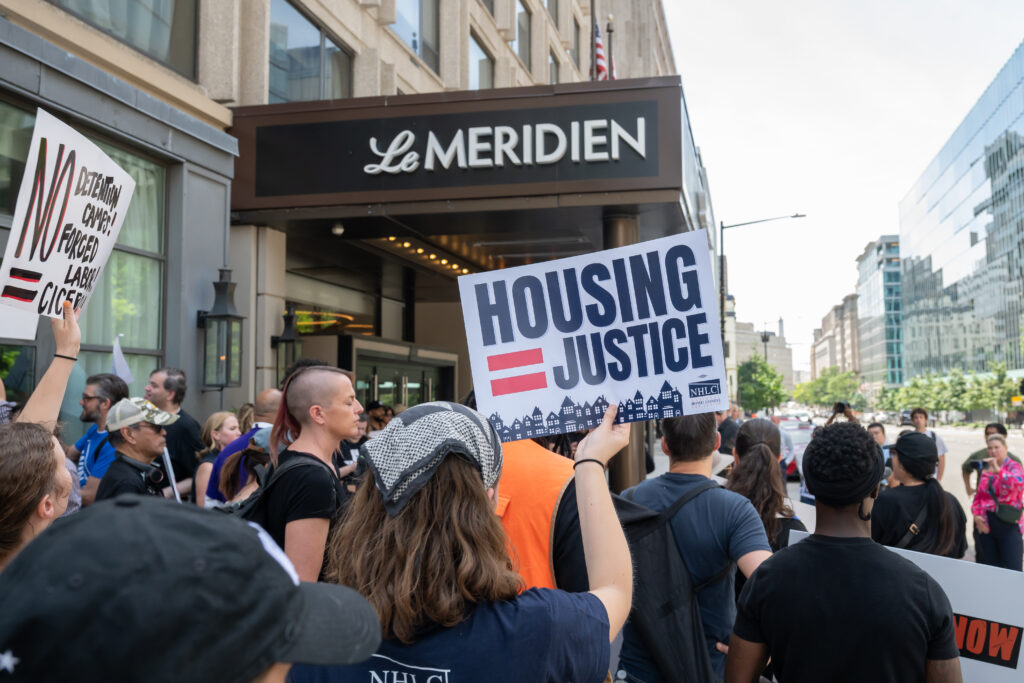
Throughout the committee meeting, Democrats continually criticized Republicans for attempting to enact laws affecting the city without the input or approval of D.C.’s leadership and residents. A Sept. 9 call-to-action from the National Homelessness Law Center (NHLC) called on people in and outside of D.C. to contact their representatives to oppose the bill, stressing D.C. has no voting member of Congress.
According to NHLC Campaign and Communications Director Jesse Rabinowitz, hundreds of people across the country have engaged with this effort. Rabinowitz also told Street Sense the center has been lobbying representatives, including Frost and Lee, to advocate against the bill.
“The average rent in D.C. is over $2,300 a month for a one-bedroom, and that might be pocket change for Donald Trump and other billionaires, but for a lot of people, that’s too much money to afford. Housing is too expensive, and the solution to homelessness is housing and support, not handcuffs and deploying the National Guard to D.C.,” Rabinowitz said.
The director of policy at Miriam’s Kitchen, Andy Wassenich, emphasized that criminalization furthers the issue of homelessness by trapping people in cycles of incarceration and poverty. Organizations such as the National Alliance to End Homelessness have long held that the solution to homelessness involves many facets, including but not limited to increasing access to affordable housing and quality services and treatment.
“Punishing individuals for being homeless is counterproductive,” Wassenich said. “It’s not what people need. They need to be lifted up, not hammered down.”
This article originally appeared in Street Sense’s Sept. 24, 2025 edition.