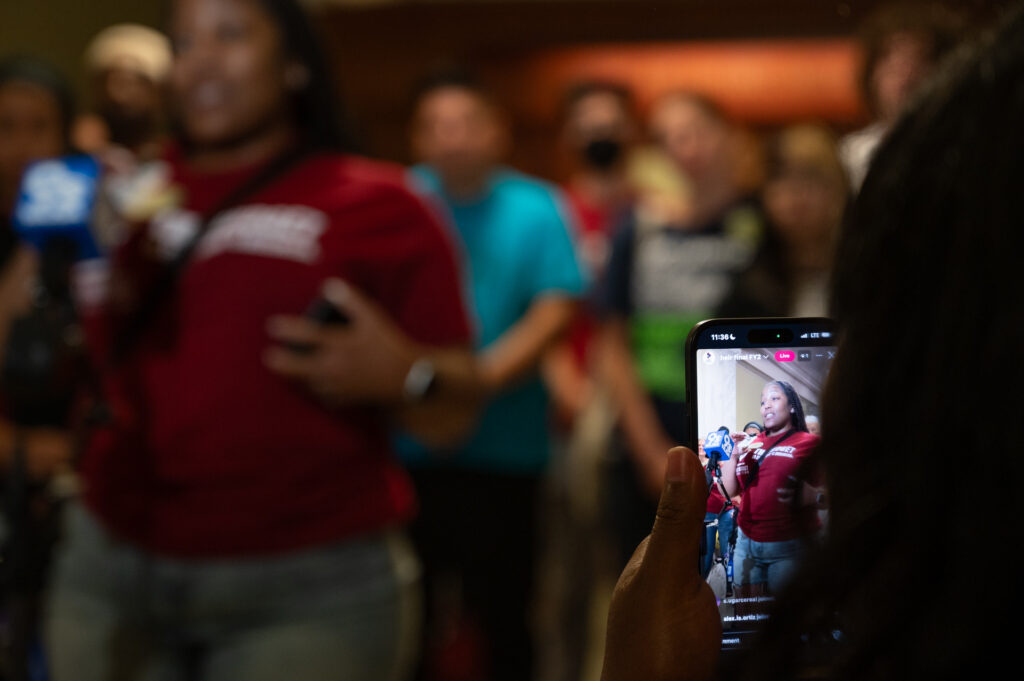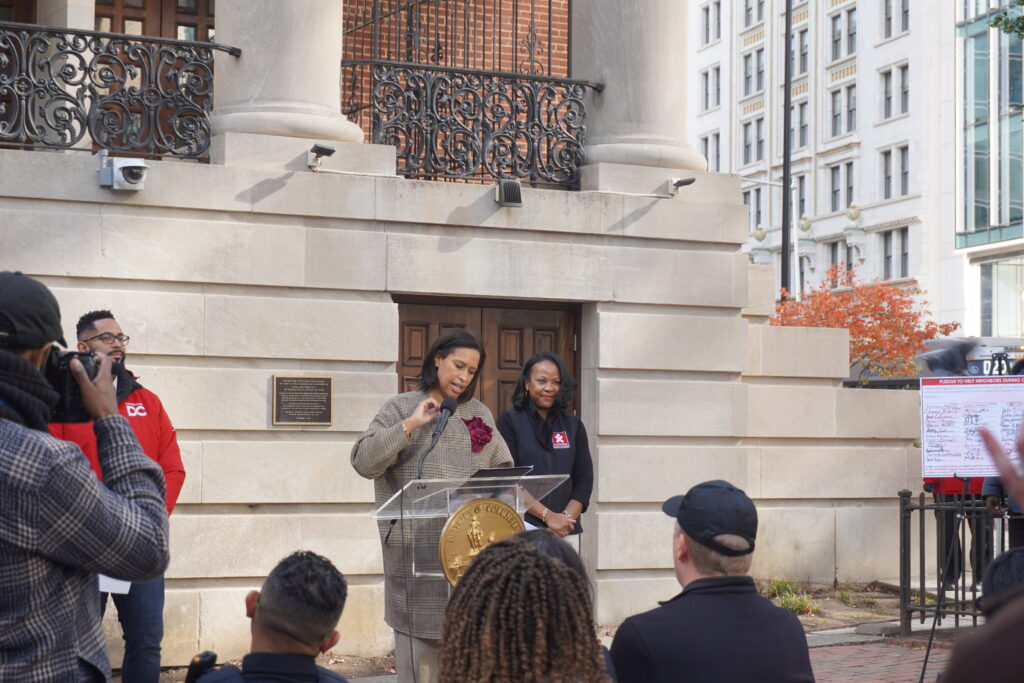
After a two-week delay, D.C. Mayor Muriel Bowser announced her 2027 fiscal year proposed budget, totaling $21.1 billion. The budget, which Bowser presented to the D.C. Council at the Martin Luther King Jr. Memorial Library on April 10, aims to grow the District’s economic opportunities in a tough financial period.
To maintain a balanced budget during a year of economic downturn, the city has to either raise taxes or cut millions from last year’s spending. Bowser’s budget opts for cuts from several city services, including existing homeless services programs, limiting the resources available for people experiencing homelessness to move into housing.
Several cuts are centered in the D.C. Department of Human Services (DHS), for which Bowser is proposing a 7.5% drop in funding from the 2026 fiscal year. Bowser did not propose funding any new Permanent Supportive Housing vouchers for the upcoming fiscal year, meaning D.C. residents who don’t already have vouchers won’t be able to use the resource to exit homelessness. The Way Home Campaign, a coalition of homeless service providers and advocates, is asking for the city to fund over 2,000 new vouchers for families and individuals.
Bowser also proposed cutting Rapid Rehousing by $3.2 million, which would prevent any new residents from accessing the subsidy. The program, which provides a year-long rent subsidy and security deposit alongside case management, supported 111 individuals and 654 families as of early March.
Another key proposed cut is an $11 million decrease to the Temporary Assistance for Needy Families (TANF) employment program, which provides career training, resources, and job placements to TANF recipients. The program is being cut to prioritize more effective workforce development programs, according to Director of the Office of Budget and Performance Management Jenny Reed.
“We took a very hard look at all of our workforce development programs this year… one of those programs that we saw that is not working particularly well is our TANF employment program,” Reed said at the budget presentation. “We do need to focus more on those programs that are delivering outcomes for residents.”
Under Bowser’s budget, the city’s Emergency Rental Assistance Program (ERAP), which supports low-income residents with preventing eviction and providing security deposits and first-month’s rent, would also lose funding for the third year in a row. ERAP would see a $1.6 decrease in its overall budget, with just $7 million available for those seeking rental assistance.
Other proposed changes in DHS funding include a drop of over $18 million for the Homelessness Service Continuum, which provides a variety of resources to District residents, including temporary shelter, case management, and crisis intervention. Under the mayor’s budget, the program would lose $3,234,000 in its family-focused services, $753,000 in individual-focused services, and $14,783,000 in general services. It’s not yet clear what programs these cuts, if they took place, would impact.
Bowser also proposed a $4,411,000 drop in funding for Permanent Supportive Housing, and a $685,000 decrease for domestic violence-focused services.
Outside of DHS, other agencies with programs addressing homelessness and housing affordability would face cuts in the mayor’s proposed budget. The Deputy Mayor for Health and Human Services, which works closely with the D.C. Interagency Council on Homelessness and the city’s homeless services, would see a near-18% drop in funding.
Additionally, the Housing Production Trust Fund (HPTF) would see a significant hit, receiving just over $60 million in new funding compared to its usual $100 million. This is the lowest infusion the fund has received since 2016, when Bowser committed to providing $100 million annually to the HPTF. This comes after D.C. Councilmembers Brianne Nadeau and Robert White proposed The Housing Production Omnibus Act of 2026, a bill restructuring the fund, which is currently being heard in the D.C. Council’s Housing Committee.
Despite the proposed cuts, city officials said the budget aims to provide growth in support for D.C.’s homeless residents through one- time grants and investment in opportunities considered more effective and cost-efficient. For example, City Administrator Kevin Donahue said most families presenting as homeless enter through the Homelessness Prevention Program, which is getting a $1.5 million boost.
“We’ve added some money to the Homelessness Prevention Program, and I think that the discussion really is an incredibly cost-effective way of having families and individuals not end up in much more expensive parts of our system that we cannot sustain financially,” Donahue said.
The mayor also proposed a $25 million investment into another non-congregate shelter, providing temporary shelter and case management to those experiencing homelessness. This investment marks the third bridge housing site in the District, joining The Aston and E Street. Under the proposed budget, $3 million would also be set aside to invest in existing bridge housing.
The next step for the proposed budget is a series of council hearings, which began on April 20 and will go through May 12.
This article originally appeared in Street Sense’s April 22, 2026 edition.