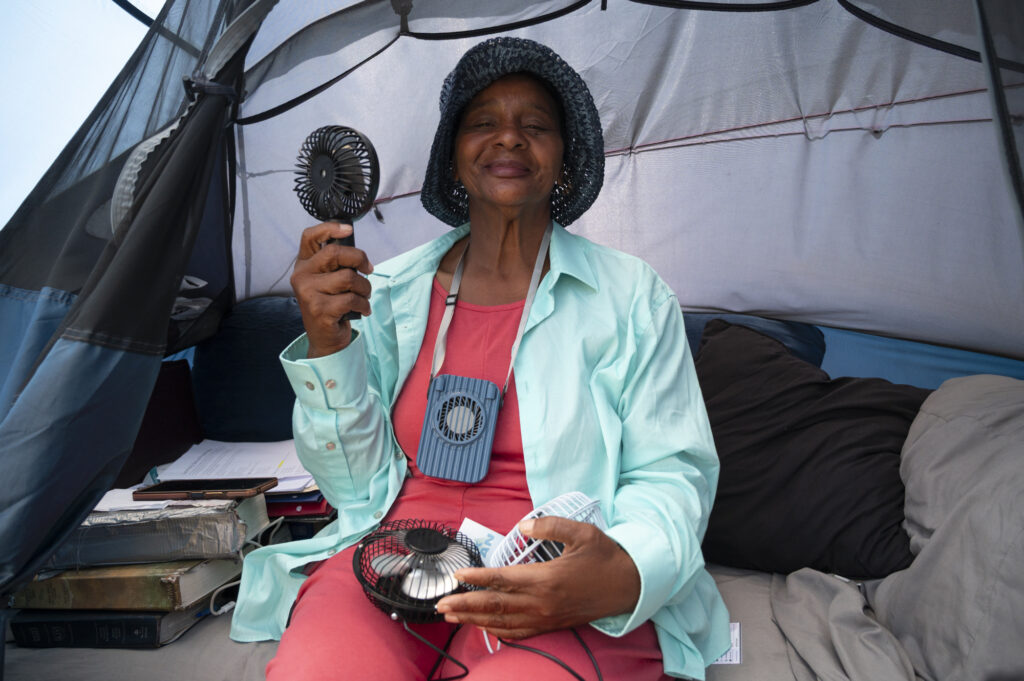
By the time Barbara Pierce wakes up on some summer mornings, the heat inside her tent is already overwhelming.
The 62-year-old, who lives outside and has diabetes, said the hot weather can leave her dizzy, drained, and exhausted.
“It’s very, very, very uncomfortable,” Pierce said. “If I pick up an object inside my tent, it’d be like it just got off a stove.”
During the summer, finding relief from dangerous temperatures can become a daily challenge for people who live outside.
According to the Environmental Protection Agency, extreme heat is one of the deadliest forms of severe weather in the United States. People who spend much of the day outdoors, including people living outside and staying in shelters, face increased health risks during periods of extreme heat because they have fewer opportunities to escape the dangerous temperatures. To reduce those risks, the District activates its Heat Plan each summer, opening locations where people can stay cool.
D.C.’s Homeland Security and Emergency Management Agency (HSEMA) issues Heat Alerts when the heat index is expected to reach at least 95 degrees and Extreme Heat Alerts for 105 degrees or higher. The alerts activate D.C’s network of cooling resources, which includes public libraries, recreation centers, day centers, public pools, and low-barrier shelters. Many of the resources, like libraries and shelters, are also open year-round.
During these alerts, outreach teams also distribute water and cooling supplies, conduct welfare checks, and help connect people with transportation and other available services.
Many of those resources become part of people’s daily lives during the summer. Thomas Wilson, for example, has developed his own routine to deal with the heat. During the hottest parts of the day, he moves between Adam’s Place Day Center, a nearby library, and occasionally, his storage unit.
“When it’s super hot, I try to go around the day center as much as possible because it’s a good temperature,” Wilson said.
D.C.’s day centers are open all year, but especially draw people trying to stay cool in the summer.
Michael Green said he regularly uses the New York Avenue Presbyterian Church and the Downtown Day Services Center to cool off during hot weather, explaining the summer heat has been “rough” this year.
“They let us sit up in [the church], and then they let us get cool so that we won’t overheat,” Green said.
The day center also provides food, water, showers, and help in obtaining identification documents. But, Green said, there are not enough similar places around the District to escape the heat.
“It’s a lot of homelessness out here, and there’s a lot of people that need shelter,” Green said.
D.C. also operates year-round shelters. According to a May shelter census, low-barrier shelter space was sometimes available as temperatures increased, but availability changes daily.
On average in May, the District reported 109 vacant beds for single adult men and six vacant beds for single adult women in its low-barrier shelter system. LGBTQ+ shelter beds were full.
Challenges with the Heat Plan
While many of the places people experiencing homelessness use to keep cool are included in the District’s Heat Plan, multiple people said they don’t seek out official cooling centers, just familiar places to escape the heat.
Wilson, for one, uses libraries and day centers to keep cool, but he said he did not realize many of the District’s other cooling centers, often at recreation and community centers, were intended for adults experiencing homelessness.
“I know they be opening up the cooling centers, and I thought mostly kids be utilizing it,” Wilson said. “I never thought to take advantage of it myself.”
This is a common misunderstanding among individuals experiencing homelessness, said Alexis Johannessen, outreach director at the h3 Project, a nonprofit providing outreach.
“They might know about the day centers or the shelters, but they might not necessarily think of places like the library or a recreation center as a cooling center,” Johannessen said.
Awareness was not the only challenge residents described. Green said access also becomes more difficult when cooling locations begin closing for the day.
“I don’t know what we gonna do,” Green said when asked about when cooling locations closed, often at 5 p.m.
Johannessen echoed Green’s concerns, saying District could benefit from having more cooling locations open later into the evening, when day centers are closed. When cooling locations close for the evening or on holidays, outreach workers often shift their focus to distributing water, encouraging people to seek shade, and helping them find whatever indoor spaces remain available, according to h3.
By the time Adam’s Place closes at 5 p.m., the hottest part of the day often isn’t over, and temperatures can still remain in the 90s. Wilson said that’s when finding water becomes more difficult.
“Only when the day center open,” Wilson said after being asked how often he can get water. “Once the day center closed, then it becomes a task.”
How to stay safe during extreme heat
Residents can sign up for text or email updates through AlertDC to be notified when the District issues a Heat Alert or Extreme Heat Alert. A full list of cooling locations is available in the District’s Heat Plan. When it feels over 95 degrees, select day centers extend their hours, and low-barrier shelter lobbies remain open as cooling spaces.
If you or someone you know needs shelter, transportation, or a welfare check during a heat emergency, call the Homeless Services Hotline at 202-399-7093 or dial 311. The hotline is open daily from 8 a.m. to midnight.
People should also watch for signs of heat-related illness. Symptoms of heat exhaustion can include dizziness, headache, nausea, heavy sweating, weakness, or confusion, according to the Centers for Disease Control. If symptoms don’t improve after moving to a cool place and drinking water, or if someone loses consciousness, becomes confused, has a very high body temperature, or shows other signs of heat stroke, call 911 immediately. Heat stroke is a life-threatening medical emergency.
This article originally appeared in Street Sense’s July 1, 2026 edition.