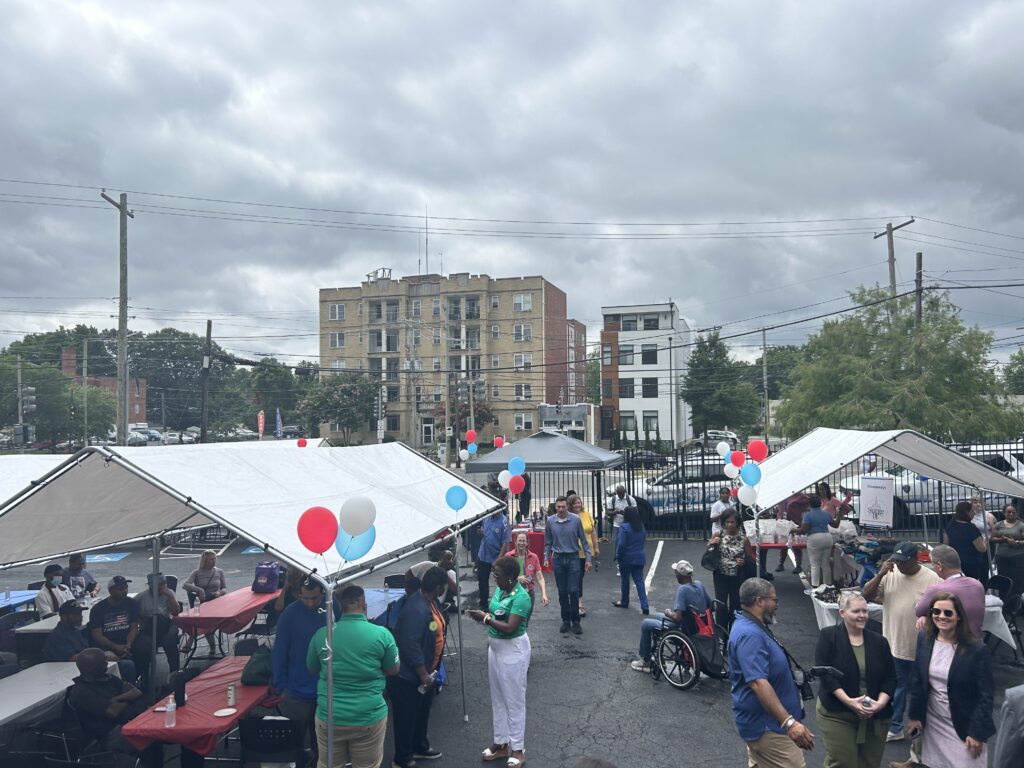
Energy was high and people were grooving to the DJ’s music outside the Department of Veterans Affairs’ Franklin Street Clinic on July 15 during the VA’s first ever surge event for unsheltered homeless veterans in D.C.
Veterans huddled under white tents and bunches of red, white, and blue balloons, partaking in breakfast sandwiches and coffee and receiving clothes and toiletry items. Some entered the building to meet with service providers and community partners, hoping to walk away with a path toward housing.
This surge event was part of the VA’s recently-launched “Getting Veterans Off the Street” initiative, through which every VA medical center across the country will host at least one outreach event before Sept. 30 to support efforts in moving unsheltered veterans into temporary or permanent housing.
“It’s very important to serve those who served us,” said Lucy Butler, a member of a Prince George’s County team that works on housing voucher programs for veterans, about why she was volunteering at the event.
Even with overwhelming bipartisan support to end homelessness among veterans, accessing resources can still be a challenge, and people fall through the cracks or run up against red tape, meaning thousands of veterans are still living on the streets. According to the U.S. Department of Housing and Urban Development (HUD)’s 2024 Point-in-Time (PIT) Count, the number of unsheltered veterans dropped from 15,507 in 2023 to 13,851 in 2024 nationally. Veterans make up about 5% of all individuals experiencing homelessness in the U.S. as of January 2024.
While veterans were the only population to report a continued decline in homelessness between 2023 and 2024 nationally (2025 figures aren’t yet available), the VA believes surge events are still required to respond to the issue in D.C. and across the country.
In D.C., the number of veterans experiencing homelessness decreased by 7% from 2024 to 2025, according to the 2025 PIT Count, which found 199 veterans experiencing homelessness on one night in January. On average, 39 unsheltered veterans each month on D.C.’s by-name list, a record of individuals experiencing homelessness within the community thus far in 2025. The year began with 216 unsheltered veterans in D.C., according to pamphlets handed out at the event, and the Community Partnership for the Prevention of Homelessness aims to reduce that to 183 individuals by the end of the year.
Andreas Williams, the team lead for the event and an outreach social worker for the VA, worked for months with his team and their partner organizations to prepare for the surge event, combining resources in one place.
The day began with a small program in which Williams and another team lead, Ilana Marmon, explained to attendees the purpose of the event was to connect as many veterans as possible with permanent housing plans. Paul Lawrence, deputy secretary of the VA, then spoke, saying it was everyone’s responsibility to help veterans find housing.
“For our veterans in the audience, please don’t think about today as charity or handouts. These are benefits you’ve earned,” Lawrence said. “This is what we’re supposed to do at the VA: look out for you and assist you.”
Inside the center, different offices featured organizations offering Supportive Services for Veteran Families (SSVF), veteran employment assistance, VA eligibility and enrollment, and HUD’s Veteran Affairs Supportive Housing. HUD-VASH is a program that gets many veterans off the streets through housing vouchers, but its requirements for recipients to not have a permanent residence and have an income at or below 80% of the area’s median can mean those in danger of being on the streets but not yet experiencing homelessness might not qualify.
While these programs all exist year-round, the event offered a one-stop shop of resources, removing barriers for some attendees. Quandrea Patterson, the executive director of the U.S. Vets D.C. office, said their team brought veterans in their transitional housing program to the event to connect them with resources to move toward permanent housing.
“It’s a real-time solution to a real-time problem,” Patterson said.
H. Lansdown, an unsheltered veteran, said it was beneficial the event brought housing counseling services together, so he did not have to run around the city to various offices. Lansdown had been awaiting his voucher to move into permanent housing for the past month, but said the process was moving steadily.
Many of the programs featured at the event receive the SSVF grant, an important tool for low-income veterans seeking support. The VA created the SSVF grant to help organizations provide case management and supportive services to rehouse veterans experiencing homelessness and prevent veterans from becoming at-risk.
Locally, Friendship Place’s Veterans First program is an SSVF program that follows a housing first model. It pairs each veteran with a case manager to support them in securing housing, along with resources for paying for food, gas, transportation, and finding employment.
“No matter what the income, what the barriers, what the credit score, whatever, the goal is to get the person into housing and then we can work on other things as well,” said Maame Owubah, a program analyst in the veteran services division at Friendship Place.
To prepare for the surge event, the Friendship Place team made sure they had space available in their programs and contacted as many veterans as possible so they could receive support specific to their needs.
One of the biggest concerns facing unsheltered veterans in D.C. is the lack of assistance for those with higher needs, according to Owubah. Because some veterans entering Friendship Place’s programs need more support, Owubah said they stay in the program longer, while those looking for initial help are left to wait. Furthermore, Owubah said Friendship Place’s program is not prepared to assist those with serious mental health concerns.
“I remember when I was in outreach, there were so many veterans you would want to assist but couldn’t because there’s just no capacity,” Owubah said.
C’Na Robinson, a veteran who has gone through Friendship Place’s program twice, said his case managers helped find housing for he and his two children. Robinson said he felt seen by his case managers, receiving encouragement and support from them on days when he was ready to give up during the difficult process of finding a home.
“This helped me out. My mental health is way better because I don’t have to worry about where I’m going to lay my head at and things of that nature,” Robinson said.
Still, not all veterans feel they are receiving the support they need from these programs. A veteran in the Northern Virginia area, currently living in a rundown hotel with her daughter and two grandchildren, was frustrated while attempting to move. She had to leave her former residence by July 31, she said, and she sought support from veterans organizations for the security deposit and moving expenses.
The veteran, who requested anonymity due to mental health challenges, said she struggled to find support because she wasn’t actively experiencing homelessness, one of the requirements for many programs.
“There is no compassion for veterans in that situation where you bring in enough income to pay rent, but you’re actually living below the poverty rate,” she said.
The number of times she was bounced back and forth among organizations eventually led her to give up seeking help. She decided instead to take out a high-interest loan to attempt to pay the rent on her own for the apartments she applied to and is now waiting for a response back from.
“From an organizational standpoint, the VA and other organizations like that need to put a human factor in their process,” she said. “It’s not just does a veteran meet X,Y, and Z? It’s what is going on with the veteran, how did they end up in this position, and how can we help them to avoid it in the future?”
Though she didn’t attend the surge event, she hopes there will be more similar efforts, where information about every available program is in one place. The VA surge event in Richmond is scheduled to happen Aug. 15.
This article originally appeared in Street Sense’s Aug. 13, 2025 edition.