Some mayoral hopefuls described their visions for combating homelessness in a March 31 forum hosted by the National Coalition for the Homeless.
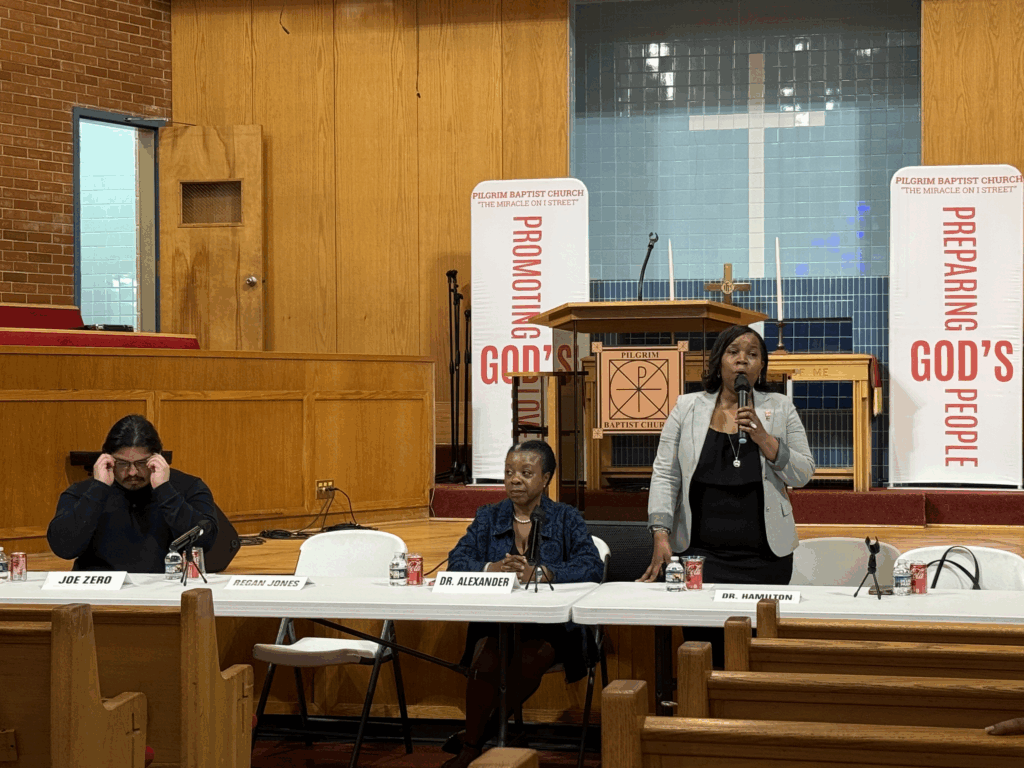
All candidates were invited, but the two frontrunners and most high-profile candidates, former At-large Councilmember Kenyan McDuffie (D) and Ward 4 Councilmember Janeese Lewis George (D), did not attend, nor did the majority of the other candidates. The three attendees were Myrtle P. Alexander (I), an educator and entrepreneur, Rhonda L. Hamilton (I), a small business owner and self-described mental health advocate, and Joe Zero (I), who is also a Street Sense vendor and artist.
The forum was held at Pilgrim Baptist Church in Northeast Washington and moderated by Kelvin Lassiter, a policy analyst for the National Coalition for the Homeless. Lassiter asked the candidates about ending encampment sweeps, building more affordable housing, revising the shelter system, reviving public housing, and their plans for seniors, the fastest-growing demographic of unhoused people nationally.
The mayoral election will be held on Nov. 3, with the party primaries on June 16. The frontrunners for the Democratic nomination are McDuffie and Lewis George. McDuffie has pledged to reform Rapid Rehousing to prevent premature exits, make accessing government resources easier through street outreach and “one-stop service centers,” and create “smaller, trauma-informed non-congregate facilities” to provide support to D.C.’s homeless population. Lewis George, a self- described democratic socialist, says she wants to “strengthen and expand” D.C.’s rent stabilization programs and build more affordable housing, including launching “Dignified Homes DC,” which she describes as “publicly owned, mixed-income housing with stable and affordable rents.”
At the forum, Lassiter asked about candidates’ commitment to ending encampment sweeps — a perennial debate in the District, especially as clearings spiked last summer with the federal takeover of D.C.’s law enforcement agencies. Hamilton explicitly said she would end sweeps, and Alexander criticized their lack of “dignity.” Lassiter subsequently asked how the candidates planned to create a clear path to housing without disrupting people’s lives.
“Absolutely, there would be no sweeps,” Hamilton said. She called a recent encampment sweep near a construction site under the M Street SE overpass “callous decision-making” and said D.C. needed more “empathetic” leadership. She also said she wanted greater involvement of church communities in providing shelter. “We have so many churches in the District, and yet in the depth of winter, many of the doors are closed,” Hamilton said. “What I’d like to be able to see is that our clergy community would galvanize and come together in order that we have more homeless missions in our church setting.” (While some churches have served as winter shelters in the past, the city pivoted to open other sites this year.)
Alexander said with the amount of money D.C. receives in tax revenue, “we should not have one homeless person in the District.” She said she plans to turn vacant buildings into housing, a proposal she shares with Hamilton.
“Everyone deserves dignity,” Alexander said. “Where is the dignity when you take up someone’s belongings and dump them? That’s everything they possess.”
Zero said people may need “a small push,” like one month of subsidized or traditional housing, to get on their feet. He also emphasized workforce training, especially in technology and electricity, as part of his plan to get people off the streets. “If we can get people in these jobs that would be helping, we’re able to provide them with a way to sustain themselves,” he said.
Zero also stated his support for universal basic income (UBI), a policy where all citizens receive a certain amount of money from the government every month, intended to help pay for basic necessities. Under Zero’s UBI proposal, D.C. residents who have been in the city for longer than 10 years would receive $400 a month.
Lassiter’s second question to the assembled candidates was about their commitment to expanding affordable housing through adaptive reuse, or letting existing buildings be used in a capacity differing from their original purpose, like office to residential conversions, which all three candidates supported. Lassiter asked the candidates about how many affordable housing units they’d aim to produce.
Hamilton answered first, re-stating her plan to turn vacant buildings into housing for D.C.’s homeless residents and to utilize church communities and peer advocates to help people “trust the process.”
Zero said if he were the mayor, he would try to make deals with the federal government to get back unused federal land and buildings that could then be part of an adaptative reuse plan. He also said he wanted to bring “people who want to be here” back to D.C. Zero outlined his plan for a “digital civic system” website or app where all Washingtonians would easily be able to access housing resources. “People that need it most, need it now,” he said.
Alexander said D.C. does not have a homeless problem, but a “management” problem. “Why are we so top-heavy and bottom-scarce?” she asked. Alexander said her administration would conduct an audit of the budget on day one to put an end to rampant “duplication of efforts” without results. She said her administration would be able to house homeless people within a year.
Responding to questions about revising the shelter system, all three candidates continued to emphasize the main themes of their campaign. Zero mentioned how his planned “digital civic system” would facilitate easy access to resources for D.C. residents and his vision for improving the flow of the shelter system. Alexander reiterated her support for “bringing back the Bible” and the “traditional family” as justification for her belief that “families must stay together.”
“If we can’t accommodate our residents and our citizens as a family,” Alexander said, “who are we as United States, who are we as Washington, D.C.?… If the head is sick, the whole body is full of worms.”
Hamilton said “our shelters are not safe” and the conditions were “not acceptable when we are building stadiums,” a reference to the construction of a new RFK Stadium in Southeast, which has caused controversy for its use of billions of dollars in the city budget.
“We must audit our moneys,” said Hamilton. “We must house our citizens. We have the money to do so.”
Editor’s note: One candidate, Joe Zero, is also a Street Sense vendor. Street Sense is covering his campaign the same as all others, and no one involved with the campaign worked on this story.
This article originally appeared in Street Sense’s April 8, 2026 edition.