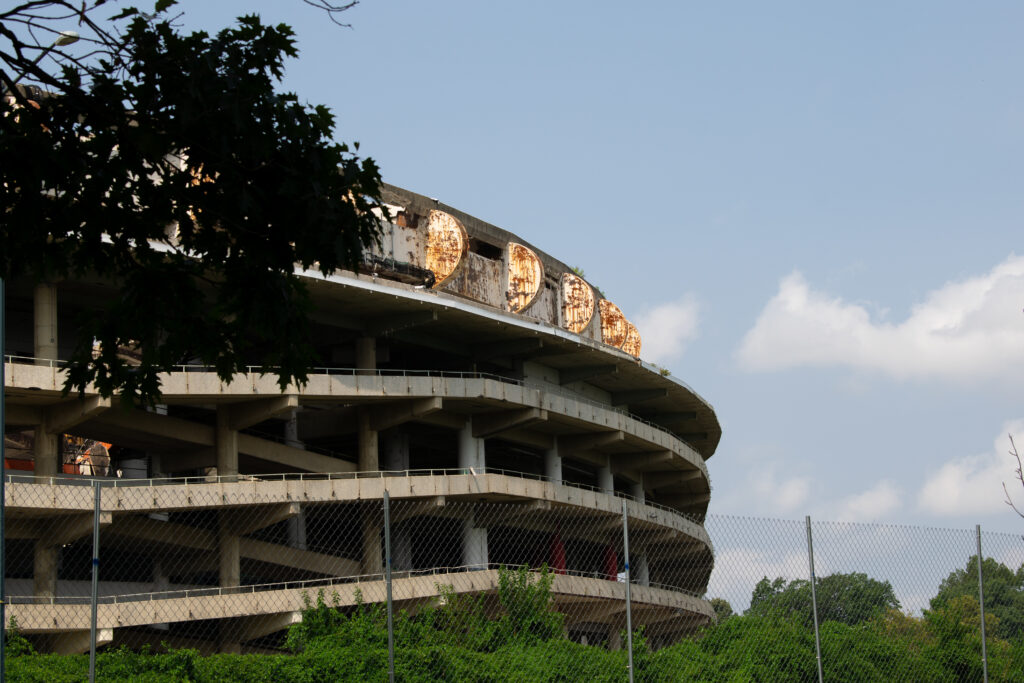
The D.C. Council approved a historic $3.7 billion deal to redevelop the RFK Stadium campus and invest in affordable housing and other projects in the surrounding area at its meeting on Sept. 17. The deal remained largely unchanged from the version the council voted on in August after a slew of amendments aimed at increasing accountability for housing development deadlines and anti-displacement efforts failed.
The deal passed on an 11-2 vote, with Councilmembers Robert White and Brianne Nadeau voting no and Councilmember Matthew Frumin supporting the bill, a switch from his August vote. During the vote, White introduced several amendments — all of which failed — seeking to implement funds to prevent residents in the area from being displaced, harsher penalties if the team fails to provide promised amenities like affordable housing by the stipulated deadlines, and a doubling of the $50 million community benefits agreement, which reserves funds for community investment projects.
The debate around the deal to bring the Washington Commanders home has plagued the council since D.C. Mayor Muriel Bowser announced it in April. It has centered around whether the significant public investment — estimated at over $1 billion — provides an opportunity for economic growth for the city or unfairly subsidizes a billionaire franchise with money some advocates say could be better spent on building affordable housing.
The deal pledges to create 6,000 units of housing, 30% of which will be affordable, but advocates have argued that, without a stadium, the number of new units could be much higher. According to the deal, D.C. will pay $500 million for the infrastructure of the stadium, over $350 million for parking garages, and $202 million for a transit study and utilities. The Commanders will contribute $2.7 billion.
“This will be the largest economic development project in D.C. history, it will supercharge our Growth Agenda, and we’re ready to deliver for our city — our businesses, our people, our project,” Bowser wrote in a statement after the vote.
The final deal includes an amendment from Councilmember Wendell Felder, who represents Ward 7, where the stadium is located, to direct about $2 million in stadium revenue to rental assistance, displacement prevention, and other programs each year to residents in economically underdeveloped areas in Wards 5, 6, 7, and 8. The fund will aid residents needing legal representation in eviction proceedings, subsidize low-interest loans for the rehabilitation of blighted properties, and offer grants to small businesses.
“This amendment guarantees meaningful and sustainable investment will flow into communities most impacted by the RFK Stadium redevelopment,” Felder said at the meeting.
The council also voted to force the team to adhere to stricter environmental guidelines.
White’s failed amendments pushed for firmer penalties if the team failed to meet housing development deadlines and would have funded displacement prevention grants for residents affected by the development. Advocates and lawmakers have raised concerns that developing the area could raise rents and push residents out of their homes.
“If we’re going to subsidize this project, the very least we can do is demand accountability,” White said, as he introduced an amendment to add a $10 million penalty every time the team misses a deadline.
As the master developers for the site, the Commanders will pay $1 per year in rent for nearly three decades in exchange for building affordable housing on the site — functionally waiving rent on the property for the team. In the current version of the deal, the team will have to start paying higher rent if it misses deadlines, which are phased in between 2030 and 2040.
This latest version also builds in extra time for development zoning approvals, intended to ensure the team does not have to pay rent penalties if housing is late due to zoning delays.
Bringing the Commanders home has been a longtime goal for Bowser. Nearly a decade after she was first elected into office, it became feasible after Congress, in December 2024, passed the Robert F. Kennedy Memorial Stadium Campus Revitalization Act. It gave the District permission to build on the land. Since Bowser and the Commanders announced a preliminary deal in April, the council has reviewed, amended, and voted on a deal at a fast-tracked pace amid pressure from the team and the mayor.
Councilmembers debated the merit of changes to the bill until minutes before the vote, drawing ire from Bowser and Commanders President Mark Clouse, who wrote a letter to the council expressing his dismay at the possibility of eleventh-hour changes.
“Less than 24 hours before the final vote, the Commanders organization was presented with a list of unworkable and impractical new last-minute demands by Councilmembers, which we simply cannot agree to as it jeopardizes the deal,” the letter, first reported by NBC4’s Mark Segraves, reads. Many of the demands, like the penalties for failing to deliver affordable housing, did not make it into the final deal.
In late July, the Council Budget Office released its analysis of the deal, finding that without the stadium, the area could support 5,000 additional housing units, with 1,500 being affordable, an alternative some advocates latched onto.
A few council members, including Christina Henderson and Charles Allen, both initially skeptical of the deal, said they felt comfortable voting for the deal on first reading after the Commanders made key concessions.
The deal enables the city to receive sales tax revenue garnered through parking garages and merchandise sales, and creates a $50 million community benefits agreement, through which the team agreed to build a grocery store and youth sports academy in the area.
The team also agreed to ensure 51% of the construction jobs go to D.C. residents, provide $15 million in contracts for local small businesses, and implement traffic mitigation measures, including leaving space for a potential Metro station near the stadium.
This article originally appeared in Street Sense’s Sept. 24, 2025 edition.