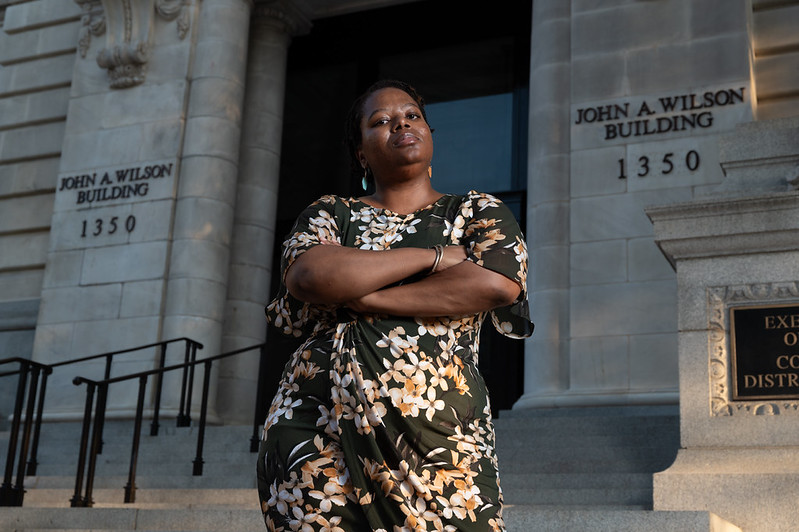
After unsuccessfully lobbying the D.C. Council to restore its funding, the D.C. Commission on Poverty has been left reeling, wondering how it will fulfill its legally mandated obligations without funds, staff, or a full slate of commissioners. To top it off, Commission Vice Chair Khadijah Williams stepped down from her role this month after moving out of the District, just nine months into her three-year term.
Since its creation, D.C.’s Commission on Poverty has struggled to fulfill its mission of working and advocating for those living in poverty in D.C. Instead, commissioners say they have spent time legitimizing the commission to the same D.C. agencies it is meant to collaborate with. Some commission members and poverty policy experts say the D.C. government’s lack of financial support and urgency to appoint commission members reflect a greater failure to support Washingtonians in poverty.
The poverty commission was created in 2021 and has been active since late 2022. The commission is the only body that focuses solely on reducing poverty and was created to bring together D.C. agencies that work with poverty, including the Department of Human Services and the Department of Health, to foster collaboration and bring the voice of those with lived experience into the conversation.
Since 2022, the commission has gone through leadership changes and continually had vacant positions, sometimes preventing it from reaching a quorum. Former Chair Marla Dean stepped down from the commission in June 2025, and current Commission Chair Elijah Moses, who also works as the executive director of Wise Young Builders, was voted into the role that September. Under previous leadership, the commission had also struggled to hold its legally required community listening sessions and released its report on how D.C. could end poverty more than a year late.
Now, there’s concern the largely advisory body will continue struggling to make a meaningful impact on the District’s response to poverty as it lacks funding and a trusted reputation within D.C. government. Approximately 117,000 people, or 17.3% of D.C.’s population, are living in poverty, according to the most recent U.S. Census data.
Since she was officially appointed vice chair in November, Williams said she and Moses have been working to develop the structure of the commission, which Moses said needed restoration when he took over last fall. Moses said the commission has been working to finalize a work plan that will eventually be released to the public and outline the work the commission is responsible for.
“We’ve had to rebuild. We didn’t have any structure coming in, and that took away from our responsibility to build out the commission, do the work,” Williams, who also works as a Senior National Director for LIFT, Inc., told Street Sense.
There is an energy and eagerness to work within the body, said Cesar Toledo, the executive director of the Wanda Alston Foundation and a new member of the commission
“We have a lot of diversity, and I think that combination blends perfect,” Toledo said. “This is a recipe for a good working group.”
But Toledo and Williams say that energy does not extend to the agencies that are supposed to work with the commission.
When she joined, Williams introduced a few D.C. agencies to the poverty commission, because those agencies did not know it existed. Her short time as vice chair was spent building relationships and figuring out how to redefine and refocus the goals of the commission so it can best help those living in poverty and center people with lived experience.
Williams also commissioned a report on what helps similar bodies perform well. The report was presented to the commission at its April meeting and recommended the commission implement changes like publishing a public meeting schedule for each year and engaging donors to support the body.
Commissioner Isaac Harris, who joined the commission in January, said his first year has been off to a slow start. Harris said since the commission failed to secure District funding, it has had a few meetings, but not a lot of work has been done.
“I’m guessing there’s not much we can do without a budget,” Harris said.
In fiscal year 2025, the Commission on Poverty was allocated $87,000, which Williams said was used in part to pay for a staff member, but its budget was reduced to $0 in fiscal year 2026 and fiscal year 2027. The commission is required to have at least three full-time staff members supporting its work, according to its founding legislation, but it is currently supported by just one staff member who works for the commission part-time but primarily serves in another D.C. government role.
With no funding for the upcoming fiscal year, Harris said commissioners have been disheartened, and morale is low. He said as an advocate and someone with lived experience in poverty, the issues those in poverty face have been the same year after year, with little improvement. If he were experiencing poverty now, Harris said, he would probably leave the city and see whether there was more opportunity for help elsewhere.
“I would go into somewhere, Maryland, Virginia, and see what’s going on with them, because clearly you don’t want me to live in D.C.,” Harris said.
Even when it had a budget, the commission struggled to fulfill its legally mandated obligations, such as producing a report on how D.C. could cut poverty in half by 2026. The commission released the report late after working on it for nearly two years, with commissioners stating it was “outdated” and did not fully represent the views of the commission. The report also did not provide an idea about how the recommendations could be funded or which government agency could be tasked with implementing them, which Williams, who was not on the commission at the time, said could have been a consequence of the committee’s limited resources.
“If the commission had the infrastructure it needed, and the credibility across the council and the mayor’s office, in practice, what I believe would happen is there would be one-on-ones and conversations to talk through the recommendations and figure out the best way to implement them,” Williams said.
Moses agreed, saying the commission would be better organized and could demand more attention from the D.C. government if it were allocated its legally mandated budget to fund staff members and an executive director. But, he said, he understands the D.C. government has a lot of responsibilities, including other agencies that work with poverty, and the commission is not at the top of their list.
“There are quite a few responsibilities to manage, and I don’t think it helped that the commission wasn’t well organized to be more vocal earlier,” Moses said in an interview with Street Sense.
Besides the lack of funding, Williams said the commission has struggled to get applicants appointed to the commission. The commission was designed to comprise of 11 at-large members and eight ward representatives with lived experience, all appointed by the mayor.
It is unclear how many members are on the commission, as the list on the website has not been updated since November.
Williams said candidates have had to wait months and sometimes years to hear back from the Mayor’s Office of Talent and Appointments (MOTA), which handles mayoral nominations, while trying to get on the commission, and candidates she felt were qualified have reported being ignored altogether.
MOTA did not respond to multiple requests for comment.
Brittany Pope, an economic security advisor with Bread for the City, applied to be on the commission in 2022 and was interviewed by the executive director at the time. It took her a year to hear back no open positions existed for at-large members, though positions for individuals with lived experience were vacant. Filling the lived experience positions has been a long-standing problem. Williams has advocated for the commission to make the role paid, which she said would attract more applicants, but she has not been able to secure the funding.
Despite the setback, Pope still wanted to join the commission and reached out to Williams, a friend of hers, to inquire about open positions in 2025. Pope secured another interview with commission leadership in October 2025 and was told to apply through MOTA again, as positions would soon be opening.
“He made it sound like things are gonna be shifting soon. The barriers are gonna be figured out, and if you apply again, then we’ll get you on,” Pope said in an interview with Street Sense. “That was last October of 2025, and I applied again. I let that contact person know I submitted my application and I haven’t heard back.”
Pope said the work she does with Bread for the City is directly in line with the Commission on Poverty’s mission to find unique ways to end poverty in D.C. She has been a part of many programs, including the Thrive East of the River, which gave families impacted by COVID-19 shutdowns in Wards 7 and 8 $5,500 of unconditional cash.
Pope said the organizational and structural challenges the commission has been facing could be alleviated if organizations like Bread for the City, which are already entrenched in the work of reducing poverty in D.C., could join the commission easily and share their expertise.
“We could have facilitated this work because we’re on the ground working with these community members,” Pope said.
Moses agreed the commission cannot end poverty on its own and is operating “adjacent” to work already being done in D.C. to reduce poverty. He wants to build relationships with existing organizations.
“There are quite a few programs that either help reduce poverty, that improve the conditions of those living in poverty, and while the commission is one component of it, there are entire agencies that are dedicated to rendering those services,” Moses said.
Ed Lazere, another D.C. poverty expert and the legislative advocacy director at the United Planning Organization, also attempted to join the commission. He applied in the summer of 2024, but after an interview with MOTA staff, he did not hear back.
“I think just in general, there wasn’t a lot of urgency anywhere beyond perhaps the members of the commission themselves who were eager to support its goals,” Lazere said.
Lazere said responsibility for uplifting the commission falls partially onto the D.C. Council, which created it. Councilmembers Anita Bonds, Trayon White, and Brianne Nadeau, who were among the council members who introduced the legislation that created the commission, did not return requests for comment about the commission’s progress and why it was not funded.
The failure to fund the commission and the amount of time it takes for people to be appointed speak to how seriously the D.C. government is taking the commission, Lazere said.
“The mayor did not seem to prioritize making this commission, supporting this commission, and encouraging it to fulfill its mission and come up with recommendations. Didn’t look to it for thoughts and recommendations as the mayor was thinking about policy and budget ideas. It’s clearly a sign that it was not taken seriously,” Lazere said.
Even as a member of commission leadership, Williams has struggled to get support. She recently moved to Virginia after a decade in the District due to unforeseen circumstances. She reached out to MOTA to inquire about the commission’s requirement that members live in D.C. and see if she could continue her work.
Williams said she didn’t get a response. On Aug. 7, she stepped down from the commission herself.