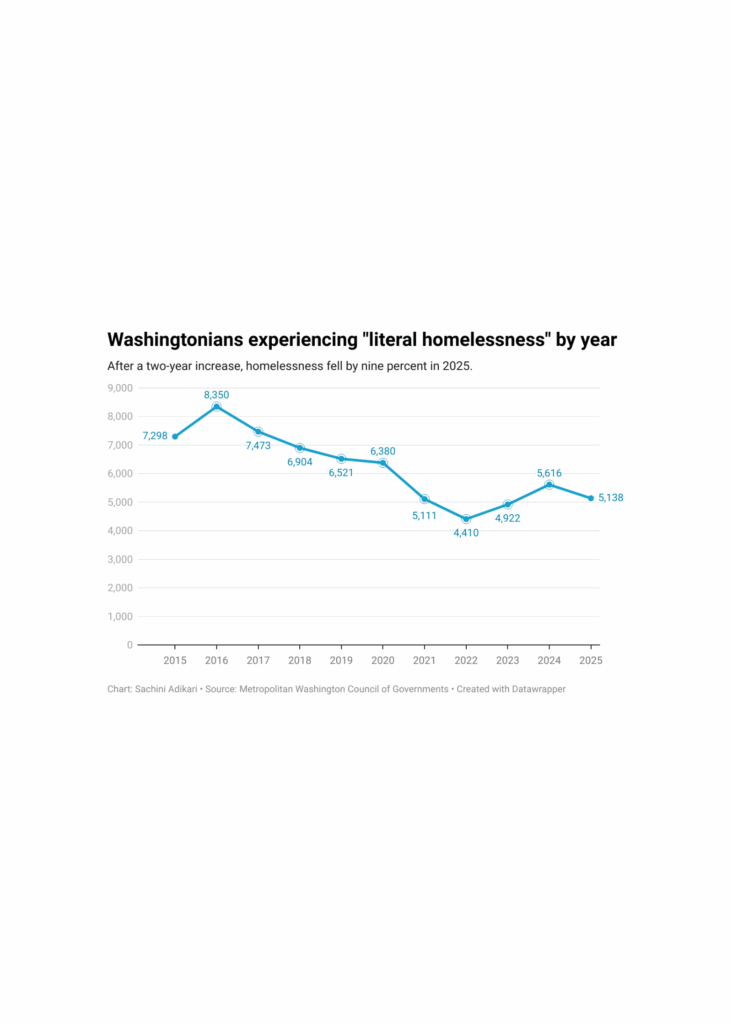
After two years of homelessness increasing in D.C., it decreased by 9% in 2024, according to the 25th annual Point-In-Time (PIT) Count. But housing advocates say the true scope of homelessness is higher than reported, and the progress the city has made is in jeopardy with few new investments for homeless services in the proposed fiscal year 2026 budget.
The annual PIT Count results were released on May 14, two weeks before D.C. Mayor Muriel Bowser shared her fiscal year 2026 budget proposal, which called for million-dollar budget cuts to many homeless services, homeless prevention services, and the Department of Human Services as a whole. These cuts could undermine any progress the city made towards decreasing homelessness in the last year, service providers said, as fewer people would be able to access programs that can help them exit homelessness.
The 2025 PIT Count, conducted in January, found 5,138 people were experiencing homelessness on one night in the District, down from 5,616 people in 2024, according to a report from the Metropolitan Washington Council of Governments (COG). While the number of people counted this year was a decrease from 2024, it comes after two years of increases, and suggests more people are experiencing homelessness now than were in 2021 through 2023.
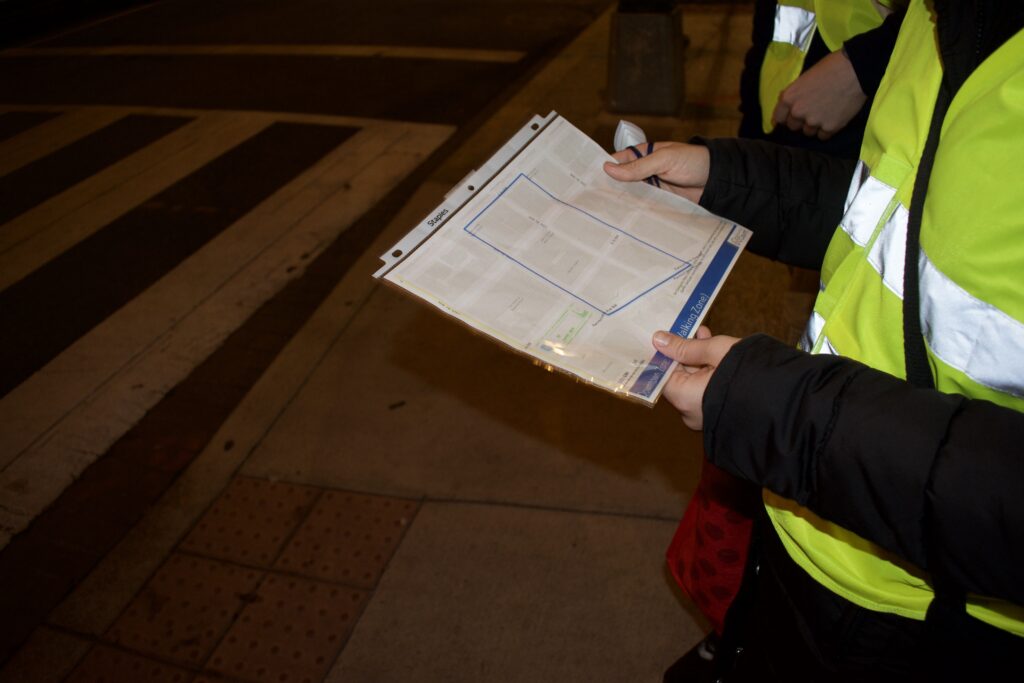
The PIT Count is a federally mandated survey of people experiencing homelessness nationwide. This year, service providers and volunteers conducted the survey on Jan. 22 in Virginia and on Jan. 29 in D.C. and Maryland, due to the presidential inauguration. Volunteers surveyed people who are unsheltered and living outside or staying in emergency shelters.
The survey’s results offer a chance for D.C. officials to see what progress the city has made toward ending homelessness and decide how much money the city will commit to homeless service programs over the next year.
“We’ve got to have increased investments and sustained investments in housing to sustain reductions,” Christy Respress, the president and CEO of Pathways to Housing D.C., said. “It’s a very straightforward math problem.”
Understanding the PIT Count
The PIT Count is a snapshot from one day each year, and it is likely not a fully accurate count of all people experiencing homelessness, according to the United States Government Accountability Office (GAO). The PIT Count is conducted throughout a single night, which the GAO says makes the report an undercount, as it does not count people who experienced homelessness at another point during the year.
In past years, data from the city’s Homeless Management Information System (HMIS) has captured at least twice as many individuals experiencing homelessness over the year as are surveyed in the PIT Count. HMIS measures the total number of people who access the homeless services system through shelters, outreach workers, or other programs.
Makenna Osborn, a policy attorney at Children’s Law Center, said she takes the PIT Count with a grain of salt because many families are not captured in the survey. The PIT Count uses a narrow definition of homelessness set forth by the Department of Housing and Urban Development, which excludes, for instance, people experiencing homelessness but staying with a family member.
“Especially for families, they are sometimes not captured in the Point-In-Time results because they may be staying with friends or family, doubled up, or staying in their car,” Osborn said. “Families with children are especially careful about not being visible in their homelessness,” she said, adding families may be afraid they could be reported to child services for being homeless.
The Office of the State Superintendent of Education (OSSE) also shares an annual report on the number of D.C. public school students experiencing homelessness that suggests family homelessness is higher than what the PIT Count captures. OSSE has not yet released a dataset for the 2024-2025 school year, but the report from the 2023-2024 school year counted 8,458 students as experiencing homelessness. In comparison, the 2024 PIT Count had a significantly lower number, recording 1,034 children experiencing homelessness.
The PIT Count also does not include people who receive longer-term housing support, such as families in the city’s Rapid Rehousing program, according to Brit Ruffin, the director of policy and advocacy at the Washington Legal Clinic, who uses the report as a base number. People in programs like Rapid Rehousing may eventually need access to other homeless services, like long-term vouchers, but the PIT Count doesn’t measure that need.
“It does not count people who are in Rapid Rehousing, which is really a tactic that we feel the administration is using to kind of shuffle people out of the shelter into Rapid Rehousing and then not have to count those people as homeless,” Ruffin said.
Trends from 2025
The decrease in homelessness in D.C. in 2025 came mainly from a decrease in family homelessness. The 2025 PIT Count saw an 18.1% decrease in family homelessness in D.C., falling from 1,656 people in 2024 to 1,356 in 2025. Families represent 36% of all people experiencing homelessness in the metropolitan Washington region, which includes D.C., Maryland, and Virginia.

Meanwhile, the number of single adults in the District experiencing homelessness decreased by 4.5%. However, the number of individuals experiencing chronic, long-term, or repeated homelessness increased by 44 in 2025. Andy Wassenich, the director of policy at Miriam’s Kitchen, a local nonprofit working to end chronic homelessness, said this is concerning because Miriam’s Kitchen and other programs have been working to bring that number down.
“The idea about homelessness is that it is rare, brief, and non-recurring,” Wassenich said. “If you’ve been homeless for 12 months or more, it’s none of those things.”
D.C. has the highest proportion of homeless “transition age youth” in the metropolitan area, according to the PIT Count. The report defines the group as individuals between the ages of 18 and 24 who may face challenges on their path to a “successful adulthood.” The District counted 367 single transition-age youth as experiencing homelessness in 2025, a decrease from the 410 in 2024. There was an overall 13% increase in the number of single transition-age youth experiencing homelessness between 2021 and 2025.
While Wassenich said it is positive to see a decrease in homelessness in the PIT Count, he said that doesn’t necessarily mean that fewer people need help. Miriam’s Kitchen has not seen a decrease in people seeking services, he said.
“In our meals program, we’re still serving lots of meals, more than we have in previous years, and on outreach, we’re still seeing a lot of people and serving a lot of people,” Wassenich said.
It’s also not clear how much of the decrease comes from people moving into housing programs, like the city’s Permanent Supportive Housing program, which had many openings in past years but now has few new vouchers, or from individuals moving around the region.
While D.C. saw a 19% decrease in homelessness from 2020 to 2025, with 6,380 unhoused individuals in 2020 to 5,138 people experiencing homelessness in 2025, Maryland’s Montgomery County saw a 32% increase, with 366 more people experiencing homelessness. Since 2021, homelessness in the region has increased by about 1,500 people.
The 2025 PIT Count reported 9,659 people experiencing homelessness in the Washington metropolitan region, just a 1% decrease from last year’s report, which counted 9,774 people, suggesting some people may be leaving D.C. but still experiencing homelessness in a nearby county.
The increase in homelessness in other parts of the Washington metropolitan area was surprising to Respress, who said officials need to continue looking at homelessness in the D.C. area as a regional issue.
“Unlike many other places, the D.C., Maryland, Virginia community, the DMV, really needs to continue to look at solutions to tackle homelessness across the region,” Respress said.
Additionally, increasing encampment closures can both force people out of the city and between different jurisdictions and make it more difficult to find people living outside, which could also lead to an undercount.
“Efforts have ramped up around the supposed beautification of D.C., and the executive order that came federally as well,” Ruffin said. “And so we know that people are not wanting to be on the street, we know that people have continued to be displaced around D.C. with less notice.”
Wassenich shared this sentiment, saying the city’s frequent encampment clearings make it difficult to see the true scope of homelessness in the city, as people are constantly moving around.
“When you have 40 people together in an encampment like we did a year plus ago at 21st and E, you saw those 40 people, and it was easy to keep track of them,” Wassenich said. “When those 40 people are now at 40 different locations, more or less, a lot of them are housed, but when you disperse them, it gets a lot harder to keep track of where people are and maintain relationships and services for them.”
D.C. officials first announced a change in how the city enforces its no camping policy in early February after President Donald Trump’s initial remarks about encampments in D.C. Soon after, the Office of the Deputy Mayor for Human and Health Services (DMHHS) expanded reasons for encampment clearings beyond health and safety.
In March, Trump targeted encampments near the U.S. Department of State, stating that if Bowser did not clean them up, the administration would “be forced to do it for her!”
From March through mid-June, DMHHS regularly closed homeless encampments across the city, conducting up to four closures some weeks. The city can now also close encampments with less notice, reducing the timeline for required notice from 14 to seven days.
Progress threatened
Bowser’s fiscal year budget proposal, released in late May, proposed cuts to many social services, including health care, welfare, and some housing programs. It included few new housing vouchers for people experiencing homelessness, which have been key to people exiting homelessness in the city, cut rental assistance, which can prevent homelessness, and reduced funding for the city’s Rapid Rehousing program.
With little new funding for homeless services, the District could see an increase in family homelessness within the next year if officials do not continue to invest in housing resources like they did in 2022 and 2023, according to Osborn.
Many families exit homelessness through Rapid Rehousing. There are currently 2,851 families in Rapid Rehousing, Osborn said, many of whom will be removed from the program in the near future with little access to housing vouchers due to budget cuts. Osborn explained that because of the increasing cost of living, more families are rent-burdened and that if the city does not invest in housing vouchers in fiscal year 2026, the District will see an increase in family homelessness. The first approved version of the budget, which the D.C. Council passed on July 14, includes 180 new vouchers for families and 156 vouchers for people exiting Rapid Rehousing.
Meanwhile, Wassenich said Bowser’s budget provides “almost nothing” for single individuals experiencing homelessness, including no new vouchers. He said he wishes there were more of a reflection after the PIT Count was released to pinpoint efforts used to end homelessness and advocate for certain policies.
If a budget similar to the one the mayor proposed passes, Ruffin said she does not expect another decrease in homelessness next year.
“We’re just not seeing any kind of trends in policy that would result in an actual decrease in homelessness in D.C., when last year, the numbers showed it was a 14% increase in homelessness overall, and a 39% increase in family homelessness,” Ruffin said.
The budget cuts to housing programs are reflected in the daily lives of individuals experiencing homelessness as they lose trust in service providers, according to Respress. Even though a person may meet the criteria for certain services, they may not receive them due to budget limitations, Respress said, leaving many people confused as to why they continue to experience homelessness, when it seems like there are programs available to help them.
“The frustration is not just frustration, but the trauma of remaining on the street for people without a clear answer as to how long, or when, or how we can help them end their homelessness,” Respress said. “It’s incredibly stressful for people.”
This article originally appeared in Street Sense’s July 16, 2025 edition.