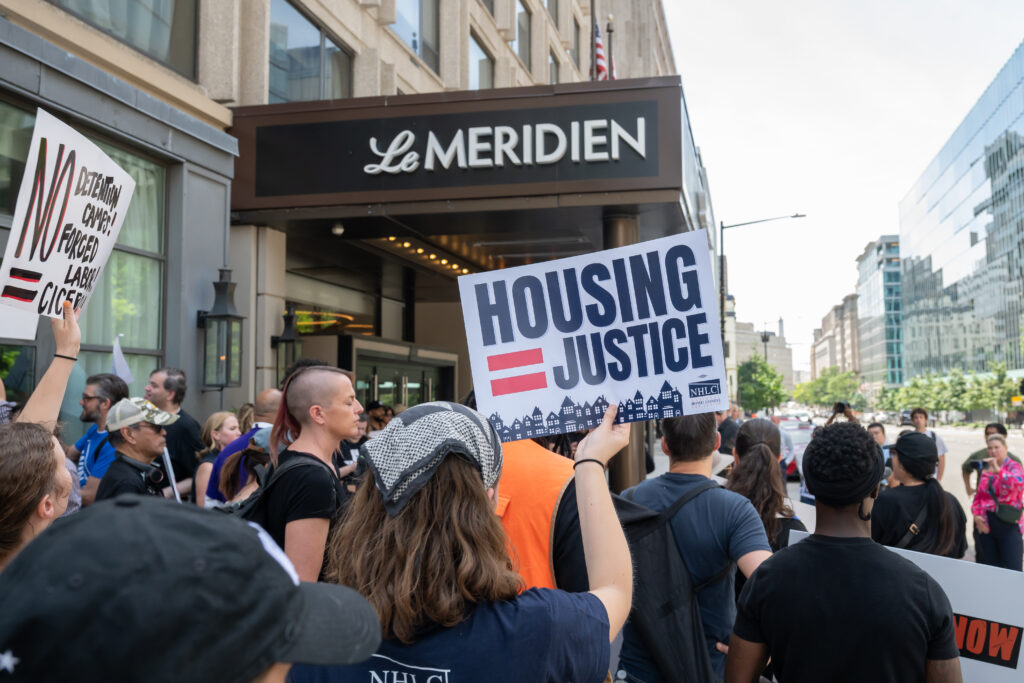
Local and national housing advocates protested against the Cicero Institute’s Homelessness Policy Conference and the think tanks’ influence over homeless policy on outside the Le Meridien Hotel June 5.
In Grants Pass v. Johnson, the Supreme Court upheld a city’s ability to arrest people for sleeping outside without available shelter space for the unhoused, allowing for more punitive legislative measures across the nation, including several pushed by the Cicero Institute.
The Cicero Institute is a conservative think tank founded by billionaire surveillance tech entrepreneur Joe Lonsdale. Its lobbying arm is a key architect of model legislation that has been passed in states such as Kentucky, Florida, Texas, and, more recently, Louisiana, that ban camping and further criminalize homelessness. Housing advocates such as the National Coalition for the Homeless, The National Homelessness Law Center, VOCAL Kentucky, and Miriam’s Kitchen organized a protest outside of the group’s policy conference, where these laws that criminalize sleeping outside and then force those arrested to work unpaid labor for the state to pay for rehabilitation are drafted.
“Cicero’s homeless policies have had a horrendous effect on homelessness in D.C.,” said Andy Wassenich, the director of policy at Miriam’s Kitchen. “Our shelters are full, our treatment centers are full. Our behavioral health organizations are overwhelmed, and we don’t have any housing solutions right now.”
Along with helping organize the rally, the National Homelessness Law Center released a report tracking the connections between the Cicero Institute and businesses that would profit off the increased criminalization of homelessness, like Palintir, also founded by Lonsdale, which sells data analytics software to governments for policing and surveillance, and a private prison known as Social Purpose Corrections. The fear from housing advocates is that the bills and policies being discussed at Cicero Institute’s conference will continue to spread, and more states will jail people for sleeping outside.
Lindsey Krinks, co-founder of Open Table, a nonprofit homeless outreach organization based in Nashville, attended the rally. She recounted her own state’s experiences with Cicero Institute’s policies enacted in 2022, when the chief policy strategist for the institute testified in favor of a bill that made sleeping on public property a felony.
“That means that Tennesseans that are just simply existing can now get up to six years in prison, a $3,000 fine, and the loss of voting rights,” Krinks informed the crowd.
With Cicero’s involvement with and support of the for-profit prison model and companies like The GEO Group, advocates worry they treat homelessness like a crime without caring about proven solutions. Krinks believes that if the current administration puts Cicero’s policies into legislation, anyone opposing them could falsely be charged with “sleeping in public” and lose the ability to vote.
“And that’s authoritarianism for you folks. They don’t care about you. They don’t care about your story or your circumstances,” Wassenich stated before handing the mic off to the next speaker as the protest continued through the early afternoon.
This article originally appeared in Street Sense’s June 17, 2026 edition.