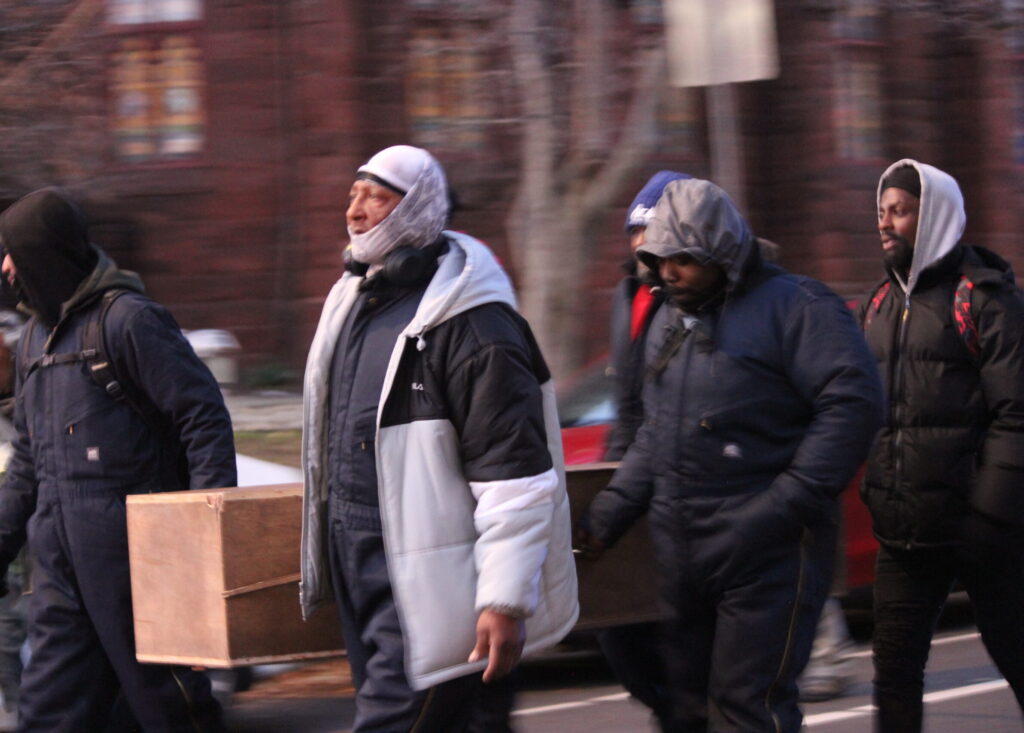
On a dreary Saturday evening in December, a small yet energetic procession followed pallbearers and a single coffin out of the Luther Place Memorial Church to Freedom Plaza. The somber and symbolic service was part of a weekend-long annual vigil beginning on Dec. 19, honoring those who died while unhoused in the District in 2025.
At least 78 people died while experiencing homelessness in Washington, D.C., over the last year, according to the People for Fairness Coalition (PFFC), a group of unhoused and formerly unhoused people who advocate for and provide outreach to homeless community members and organize the vigil every year. The vast majority, 69, were matched to a housing resource, but were still sleeping outside or in shelters when they died, stuck in the city’s long voucher and subsidy process.
For over a decade, PFFC has gathered advocates for ending homelessness in the District on the longest night of the year to remember those who’ve lost their lives in what many consider preventable deaths. Over the past few years, the death toll has fluctuated. In 2022, 104 people died while experiencing homelessness in D.C., according to data from the D.C. Office of the Chief Medical Examiner (OCME). In 2023, 101 people died. The vigils in 2023 and 2024 were held in remembrance of 90 and 120 people, respectively — the list for the vigil is assembled by the community, but the actual death toll reported by the medical examiner can be higher. In 2024, though, it was the opposite, as OCME only confirmed 43 deaths. The official 2025 death toll couldn’t be confirmed by the time of publication.
Unhoused individuals in the United States face about 3.5 times the mortality risk of people who are housed, with those in shelters facing a similar mortality risk as those at unsheltered locations, according to a 2024 study that tracked 140,000 people for over a decade.
In 2023, the leading cause of death for those who died while experiencing homelessness in Washington, D.C., was opioid overdose. The 2024 study also found drug overdose was a leading cause of death for those experiencing homelessness under 45, while for those experiencing homelessness aged 45-64, heart disease and cancer were the leading causes of death. People experiencing homelessness are generally more vulnerable to health concerns, as they may lack access to care or safe places to recover.

The vigil began on Dec. 19 with an advocacy day at the Wilson Building, where members of PFFC met with councilmembers and presented demands for changes to the next city budget to better support the unhoused.
Dana White, the advocacy director for Miriam’s Kitchen, illustrated the importance of political action during their speech at the service in Luther Place Memorial Church the next day, Dec. 20. “Policy can be a weapon or a lifeline,” said White. Equal parts advocacy and remembrance, the vigil was more than just a symbolic gesture.
Advocating for changes to D.C’s budget to better support those who are unhoused is especially necessary now, attendees said. At one point during the fiscal year 2026 budget process, the mayor’s proposed cuts totaled a $100 million hit for social safety net programs like Temporary Assistance for Needy Families, Medicaid, and the Emergency Rental Assistance Program. By the end of budget season, some funds were restored, but it was still the lowest level of financial support to homeless services in recent years. This fiscal year’s budget funded no new housing vouchers for individuals, which means if a single adult becomes homeless this year, there’s no voucher to help find them a home.
During the budget process, Ward 5 Councilmember Zachary Parker proposed an eleventh-hour tax on the city’s wealthiest residents to fund vouchers for individuals, but it was defeated in a 7-5 vote.
At-large Councilmember Robert White discussed some of the legislation he spearheaded regarding voucher oversight during his speech at the vigil. Some of these efforts include increased transparency and community input at the District of Columbia Housing Authority, adding more community seats to the agency’s reform board. White’s legislative hits demonstrated the impact of the political will to fight homelessness, though he stressed they did not make up for the loss of life.
“Now I want to be careful, because policy cannot capture grief, but policy is one of the ways to prevent more grief,” White said.
These words held extra weight for the Street Sense community. After the vigil but before the year was out, Laticia Brock died. Brock was a Street Sense vendor who lit up every room she was in and always showed love to her tent family, died. It’s a name that hurts for the Street Sense community to see added to the list, like so many names before her.
This year’s service also hit extra hard for PFFC co-director Rachelle Ellison, who emceed the whole event. One of her close friends, Charles Evans, passed away in late 2024 and had his name added to this year’s list. Ellison never apologized for the tears and emotions she showed as she spoke at the vigil in remembrance of one of the people she considers family and stood by her, not only on the road to housing, but also to recovery.
“Each person we are remembering here tonight is more than a statistic,” White said at the vigil. “It’s a person. It’s someone’s family, someone’s son, daughter, brother, sister, sometimes parents, it’s someone with a name and a life that deserves safety, stability, and care that our city can give.”
Editor’s Note: Rachelle Ellison is also a Street Sense vendor, and several vendors attended or helped organize the vigil. No one who planned the event was involved in writing or editing this article.
This article originally appeared in Street Sense’s Jan. 14, 2026 edition.