The D.C. Council approved the city’s final fiscal year 2026 budget on July 28 after an hours-long vote where lawmakers considered myriad last-minute amendments. The budget, which passed 10-2, largely left in proposed cuts to homeless services and social safety nets for low-income residents.
Ward 4 Councilmember Janeese Lewis George and Ward 5 Councilmember Zachary Parker voted no, arguing the budget did not do enough for the city’s most vulnerable.
“I cannot in good conscience vote for a budget that does this much harm,” Lewis George said.
The final budget removed nearly $30 million from the budget the council initially approved on July 14, largely from reductions to the Housing Production Trust Fund, the Emergency Rental Assistance Program, and the Childcare Subsidy Program. The previous version of the budget relied on funds from an increase in the D.C. Chief Financial Officer’s revenue estimates, which Council Chairman Phil Mendelson insisted the council is allowed to spend. CFO Glen Lee disagreed and said he would not certify the budget without the change.
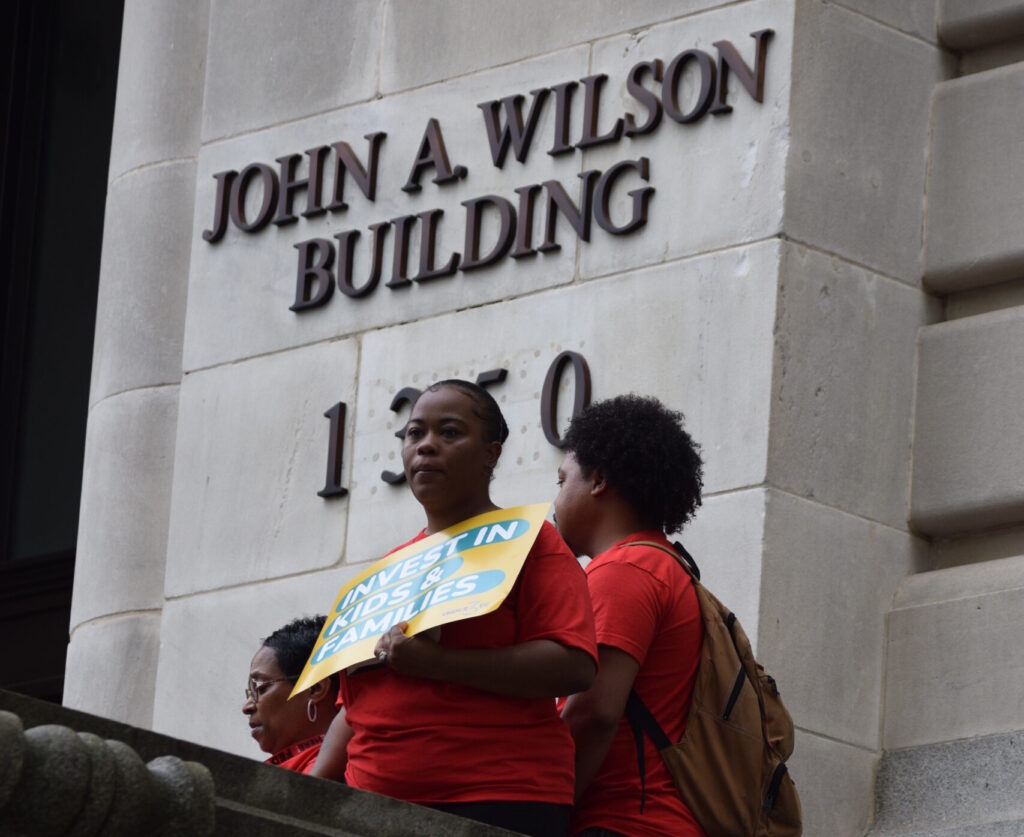
Before the vote, councilmembers debated a string of unsuccessful amendments, including one proposing a tax on the wealthy to raise revenue for programs and one pitting the Access to Justice Initiative and the Child Tax Credit against each other. During the meeting, community members continuously yelled “Shame” and other protests at councilmembers for cutting programs for low-income residents.
At the hearing, Parker, who voted no on the final budget, proposed implementing a graduated tax on “high amounts of wealth-generated income” in order to fund additional programs. The amendment would have instituted a 1% charge on capital gains over $150,000, 2% on gains over $350,000, and 3% on gains over $500,000, plus flat charges for some of the highest earners. The additional funds would have paid for 101 new Permanent Supportive Housing (PSH) vouchers for individuals and preserved the Child Tax Credit. The amendment failed 7-5, with Parker, Lewis-George, Ward 6 Councilmember Charles Allen, Ward 1 Councilmember Brianne Nadeau, and At-large Councilmember Robert White voting yes.
Parker said the council needs to find a way to raise revenue to avoid choosing between funding critical programs that benefit low-income residents.
“This is a small ask for those that have the most among us to give a little so that we can extend a lifeline to those in greatest need,” Parker said in defense of his amendment.
Prior to the budget vote, some councilmembers and local community organizations had hoped the council would restore funding for programs benefitting low-income residents. In a newsletter following the first budget vote on July 14, Nadeau wrote she was glad the council added funds to provide 180 housing vouchers for families, but the council needed to provide vouchers to individuals as well. Parker’s failed amendment would have funded an additional 101 PSH vouchers for individuals.
The $30 million in cuts came as a result of an amendment proposed by Council Chairman Phil Mendelson, which he said he did “under duress” from the CFO, who said the budget would be “unbalanced” without such an amendment. The amendment passed unanimously, with some council members decrying the CFO’s oversight over the council and others taking it as a sign the city needs to get serious about overspending.
“I think we are all in a position where we do not like the amendment we have in front of us, but we understand where it is coming from,” Allen said.
To make up the difference, Mendelson’s amendment cut $10 million from the Housing Production Trust Fund, $2.9 million from the Emergency Rental Assistance Program (ERAP), and $1 million from the Housing Preservation Fund. The previous version of the budget had infused the Department of Human Services with $30.6 million, with $6.6 million going to ERAP, $6.1 million in funding for 160 new Targeted Affordable Housing vouchers for families, and $941,000 in additional funds for 20 PSH family vouchers. While the vouchers remain intact, total funding for ERAP will only increase $3.7 million on top of the mayor’s original $5 million allocation.
During the vote, Ward 2 Councilmember Brooke Pinto and Parker also proposed an amendment to reallocate funds from the Access to Justice Initiative, which provides legal assistance to low-income residents, to the Child Tax Credit, which is not funded in the budget. Pinto eventually withdrew the amendment after a lengthy discussion, as some council members derided the potential cuts to legal assistance, and Parker said the council needs to make tough spending decisions in a tight budget year.
“This body has not proven serious about cutting spending,” Parker said. “We can’t have it both ways. We can’t fund every pet project and say we are not going to raise revenue.”
Some community organizations expressed outrage the council did not do more to raise revenues — citing Parker’s failed amendment — in order to fund more programs. During the budget vote, Mendelson ordered the chamber to be cleared of members of the public as they continuously interrupted proceedings, yelling that the council was “killing the poor” due to the lack of funding for social programs.
“Over and over again, we hear councilmembers say that ‘Now is not the time to raise taxes on the wealthy,’” Tazra Mitchell, chief policy and strategy officer at the D.C. Fiscal Policy Institute, said in a press release. “If an unprecedented transfer of wealth from the poor to the rich is not the time, when is?”
The biggest change in the final version of the budget came from the passage of a “compromise” on Initiative 82, which, as passed by voters, would have gradually increased base wages for tipped workers to eventually match the city’s minimum wage of $17.95. Bowser’s budget would have effectively repealed the initiative.
At-large Councilmember Christina Henderson and Allen proposed the compromise, which would keep the base tipped minimum wage at $10 until July 2026 and then increase it slightly as a percentage of the regular minimum wage. On July 1, 2026, the tipped minimum wage will increase to 56% of the regular minimum wage, then to 60% in July 2028. After that, it will increase 5% every other year until it reaches 75% of the regular minimum wage. The amendment passed 7-5.
The original proposal in the budget would have set the tipped minimum wage at $8 per hour, down from $10 currently, and required employers to ensure employees make $20 per hour by covering what they don’t make in tips.
The budget will now go to Bowser’s desk for her signature.
This article originally appeared in Street Sense’s July 30, 2025 edition.