When President Donald Trump announced the federal takeover of law enforcement in D.C. in August 2025, he called on officials to clear encampments and eliminate visible signs of homelessness. County officials in Maryland and Virginia worried the effort would drive people experiencing homelessness to the surrounding areas, where homelessness has increased in recent years.
Now, following six months of increased federal law enforcement and National Guard deployment in D.C., some organizations supporting people experiencing homelessness in Maryland and Virginia report that while the takeover may have caused a small uptick in people seeking their services, the economy and cost-of-living crisis remain the main drivers of the increase in demand they have seen over the past couple of years.
At least a few people left D.C. for the surrounding counties following the takeover. Two of six encampment residents Street Sense followed in the aftermath of the takeover said they left D.C. for Virginia. “It was feeling pushed, feeling forced, feeling like I didn’t count as a person in D.C.,” said Jesse Wall, one of the residents. Jeff Padgett, meanwhile, told Street Sense he moved to Virginia after outreach workers warned him the Trump administration might direct harsher crackdowns against encampments in D.C.
But city data didn’t indicate a large exodus. Weeks after the takeover started, D.C. took a census of people sleeping outside, similar to the annual Point-in-Time Count. The census findings were similar to the most recent count, recording over 750 people sleeping outside.
While outreach organizations outside of the District say they may have seen slight increases in their number of clients since last summer, they expressed more concern about the growth they have been seeing over the past couple of years. They cite economic conditions and the rising cost of living as the main reasons for the climbing numbers, in line with national trends of affordable housing shortages driving up residential prices, making it harder for people to pay rent.
Shepherd’s Table, a social services provider in Silver Spring, does not ask its clients questions about where they are coming from and why, said executive director Jan Weetjens. But from what he knows, he said it is “a coincidence” and “not a new phenomenon” that Shepherd’s Table is seeing more need in the wake of the D.C. takeover.
The organization recently had to discontinue its Beyond the Table program, which began during the COVID-19 pandemic and delivered meals to community sites in Montgomery and Prince George’s Counties, due to too much demand. “It’s mainly the economy,” Weetjens said when asked about what he thought was driving the rise in clients.
But that doesn’t mean the takeover hasn’t had an effect. Edward Dana, a Shepherd’s Table community member who has experienced homelessness, wrote via a text message that the takeover and Trump administration policies “make it harder to receive service.” Dana also expressed concerns about potential interactions with ICE or “having all your things thrown in the trash.”
Before the takeover, the homeless population in D.C. and its surrounding areas had been growing since 2021, according to each jurisdiction’s annual Point-in-Time (PIT) Count, as reported by the Metropolitan Washington Council of Governments. Loudoun County, to the west of D.C. in Virginia, saw the largest percentage increase in homelessness at 215%, from 80 people in 2021 to 252 people in 2025. Montgomery County, which borders the District to the northwest, saw a 162% increase, from 577 to 1,510 people. Other nearby counties saw smaller increases over the last four years, such as 58% in Arlington County, 13% in Prince George’s County, and 8% in Fairfax County. While D.C. has a much larger unhoused population than any of these jurisdictions, the District actually had the smallest increase in homelessness over the past four years.
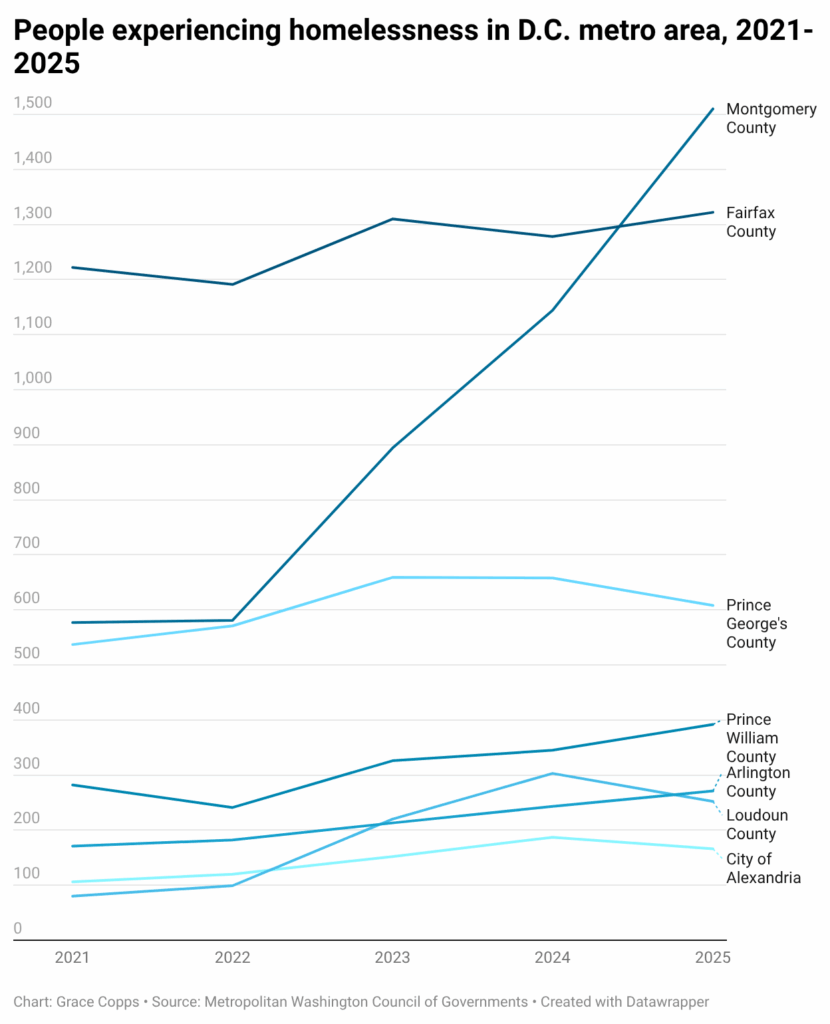
Some counties saw slight decreases in their homeless population from 2024 to 2025, according to their local PIT Counts. Prince George’s County’s homeless population shrank by 8%, from 658 to 608 people. Loudoun County recorded a 17% reduction, from 303 to 252 people. Other counties, however, still saw increases. Montgomery County’s homeless population increased by 32% from 1,144 to 1,510 people, and Fairfax County saw an increase from 1,278 to 1,322 people.
Tara Ruszkowski, executive director of the Lamb Center in Fairfax, echoed Weetjens’ thoughts about the economy driving the surge in regional homelessness over the past few years. The Lamb Center recorded 202 more visits in August and September 2025, the first month of the takeover, than in the same time period in 2024, Ruszkowski said. But the numbers dropped in the following months, and there was no evidence of a clear or sustained impact. She said the Lamb Center’s distance from transit lines could be one possible reason why encampment clearings and crackdowns on homelessness did not increase demand for its services more this fall.
More broadly, though, Ruszkowski said Fairfax County has seen a “significant” expansion of its homeless community since 2019, amounting to an approximately 27% increase. Ruszkowski cited a lack of affordable housing as the main reason behind the increase.
“With a high cost of living, people can be just one paycheck shy of losing their apartment, of losing their place to live,” she said.
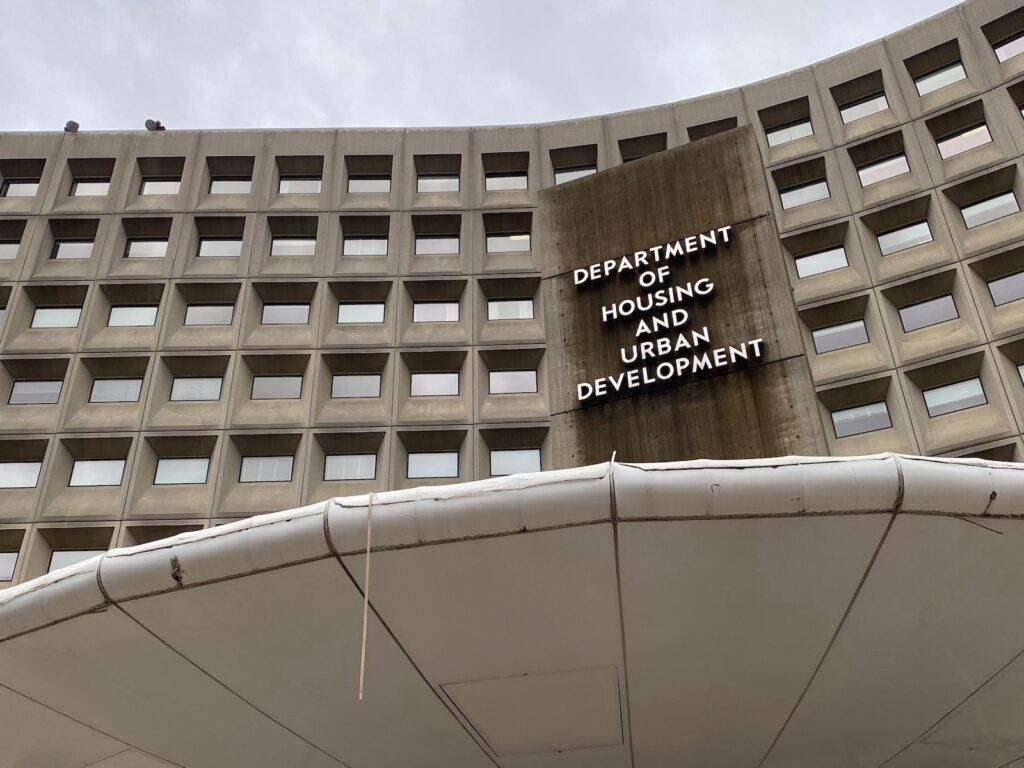
This increase in need could soon run up against a shortage of resources. Towards the end of 2025, the U.S. Department of Housing and Urban Development (HUD) proposed a dramatic change in guidelines for funding services meant to support people experiencing homelessness. While a federal judge issued an injunction in December preventing these changes for now, there’s uncertainty about whether outreach organizations and local governments will be able to fund operations and keep people out of homelessness. The Metropolitan Washington Council of Governments’ board of directors voted unanimously to ask Congress and HUD to maintain the expected funding for 2026, when the federal government decides on new guidelines.
Both Weetjens and Ruszkowski expressed concern over the loss of funding for homeless services. “One of the things that I’m concerned about, really, is the shift in rental assistance, that policy. I expect that will affect our numbers,” Weetjens said.
Ruszkowski said she is worried about any policy that would move resources away from permanent supportive housing, as the HUD funding guidelines suggest. She called the policy “the most effective solution for permanently ending homelessness.”
What resources are available can also affect where people experiencing homelessness seek support. Dana said that some people may go to different jurisdictions because they believe they have better options; for instance, he’s had bad experiences at shelters in D.C., including witnessing abuse, that make him feel safer living outside than in the city’s shelters. For accessing housing, he prefers the system in Arlington, where he says it is easier to get a voucher than in D.C. or Maryland, which both can have long waitlists. Anecdotally, he thinks these differences could cause some of the increases in surrounding counties.
“There has been an increase of D.C. residences [sic] moving outside of the District to receive better housing support services that meet them where they’re at,” Dana wrote.
This article originally appeared in Street Sense’s Feb. 11, 2026 edition.