D.C. recently opened a new resource for youth experiencing homelessness, but some in the homeless services system say it’s not all good news.
In February, SAMU First Response, an international humanitarian aid organization based in D.C., opened a drop-in center in Capitol Hill aimed at youth ages 18 to 24 who are experiencing homelessness or are at risk of homelessness. The center, which will provide a safe space for youth during the day and access to resources, is partially supported by D.C. city funding — funding another day center says it sorely needs.
D.C. has historically supported three main youth drop-in centers — Zoe’s Doors in Brentwood, the Latin American Youth Center in Columbia Heights, and Sasha Bruce Youthwork in Capitol Hill. This year, while the city added SAMU to the mix, Sasha Bruce lost its contract, putting the drop-in center’s operations at risk.
“Do not let our drop-in center close,” Deborah Shore, the founder and executive director of Sasha Bruce, said at a recent oversight hearing. “We saw 793 youth last year. There are more than enough young people who need supports, and Sasha Bruce provides a foundation for youth that has proven itself and that is worthy of your devotion.”
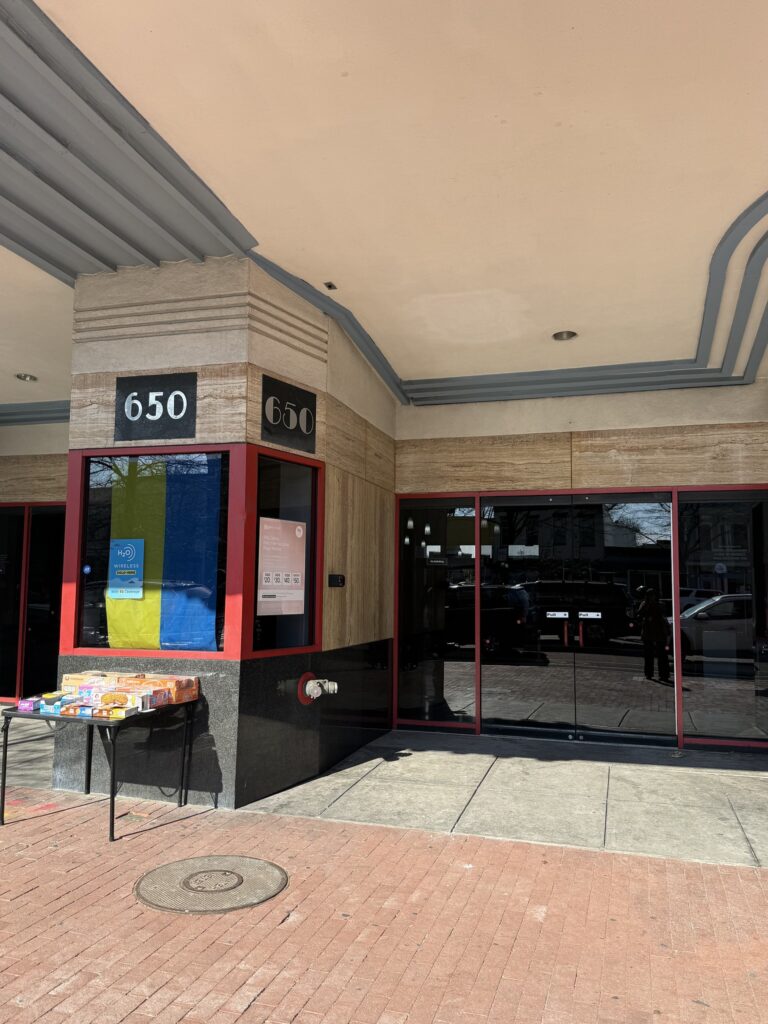
Drop-in centers both offer people experiencing homelessness a respite during the day, when shelters may be closed, and help connect people to other services, like housing or benefits. SAMU’s new drop-in center, at 650 Pennsylvania Ave. SE, offers meals, showers, laundry, case management, housing resources, educational and employment programs, and mental health support, according to the organization’s and the D.C. Department of Human Services (DHS) Instagram pages.
Street Sense was not able to tour the new center’s space, which is located on the second-floor of a mixed-use building mostly containing medical offices. The center is open from 9:00 a.m.. until 7:00 p.m. on Mondays, Tuesdays, Thursdays, Fridays, and the third Saturday and Sunday of each month. On Wednesdays, the center is open by appointment. SAMU did not respond to a request for comment on the center’s first month of operations.
SAMU is headquartered in D.C. and works around the country and globe, helping vulnerable populations through crises. Though the organization has not worked on D.C. youth homelessness before, it helped lead the city’s response to the buses of migrants that began arriving from Southern states in 2022, and, according to its webpage, operated respite centers in D.C. and Montgomery County. Many migrants who arrived in D.C. from 2022 to 2024 were ineligible for homeless services, but faced some of the same challenges as people experiencing homelessness.
In a December Instagram post announcing the new center, SAMU wrote it “aims to expand access to year-round, youth-friendly spaces where young people facing housing crises can access specialized resources and supportive services to move toward stability and well-being.”
Controversy with funding for Sasha Bruce
At a Feb. 26 D.C. Council oversight hearing for DHS, which oversees the city’s homeless shelters and day centers, people associated with Sasha Bruce Youthwork, a nonprofit dedicated to serving unhoused youth in D.C., raised concerns about the loss of city funding for its drop-in center.
Shore, who has worked as the founder and executive director of Sasha Bruce Youthwork for more than 50 years, expressed her disappointment in DHS’s decision to award the contract that previously supported Sasha Bruce’s drop-in center on Barracks Row to another provider. Shore said she disagreed “deeply” with the decision and took “issue with the decision-making process.” According to her, DHS did not clearly explain its reasoning for not renewing its contract with Sasha Bruce to run the drop-in center, which has been operating for 12 years.
In an email to Street Sense, a spokesperson from DHS wrote grants are issued on a “competitive basis” to encourage “innovation” and give “the opportunity for agencies to fund entities with the best ideas to address their goals.” DHS recently conducted the first “competitive grant process” since the 2018 fiscal year, according to the spokesperson, and assessed applications on “the merit of their proposals based on the requirements outlined in the Request for Application.” From this process, three drop-in centers were selected to receive grants: Latin American Youth Center, DC Doors, and SAMU.
Youth who testified at the hearing in support of Sasha Bruce’s drop-in center emphasized how they felt Sasha Bruce’s staff and resources helped them when no one else would. Devin Williams, a Sasha Bruce client, said that it is “easy to be forgotten” and feel like “just a number in the system” at larger centers, with it taking “months” to receive services and case workers who “may not even remember your name.” “But not at Sasha Bruce,” William emphasized, calling Sasha Bruce “more than a program, it’s family.”
“They talk to you like real people. Like mentors. Like somebody who actually wants to see you win,” Devon Young, another Sasha Bruce client, said of its staff. “They keep me motivated to stay on the right path.”
Young, and the several other youth who testified, urged the city to make sure the drop-in center that had been so crucial to them could remain open.
“Sasha Bruce helped me remember that I am not my mistakes,” Young said. “Without it…I don’t know where I’d be.”
Even without the city’s funding, Sasha Bruce’s drop-in center, at 741 8th St. SE, is still operational. But Shore said youth looking to go to a day center have been told the center, known as “The Bruce” was closed, and instead directed to the new center. “We learned because youth came pouring in the first days of the new center’s opening to ask why we closed,” Shore said.
At other times, Shore said, DHS officials told gatherings of youth the drop-in center was closed, and operators of the Child and Family Services Agency’s Warmline were told to no longer refer people to Sasha Bruce, confusing long-time users of the center. “This puts into their already troubled world even more mistrust of those in charge,” Shore said.
Currently, DHS lists Sasha Bruce on its website as one of four youth drop-in centers. It’s open Monday, Tuesday, Thursday and Friday from 8 a.m. to 6 p.m., and Wednesdays from 8 a.m. to 12 p.m., and by appointment in the afternoon.
During the second part of the oversight hearing, held March 6, Ward 3 Councilmember and Committee on Human Services Chair Matthew Frumin said he was troubled by the testimony from Sasha Bruce staff and youth, and wanted to work with DHS to make sure the organization still had a role in the homeless services system, even though it was too late to change the decision made about the contract.
In response, DHS Director Rachel Pierre said, “Sasha Bruce remains a very strong partner to us in this work” and “our relationship with Sasha has not ended.”
Frumin said he would look into advocating to give one-time city funding to Sasha Bruce to help keep the drop-in center open this year, but he was not sure if the council would be able to find the money in a tough budget year.
The uncertainty surrounding youth drop-in centers comes as advocates demand more support for youth experiencing homelessness. In her testimony, Shore also urged the council to stop, as it has in the past, DHS’s proposals to not increase funding for programming aimed at unhoused youth.
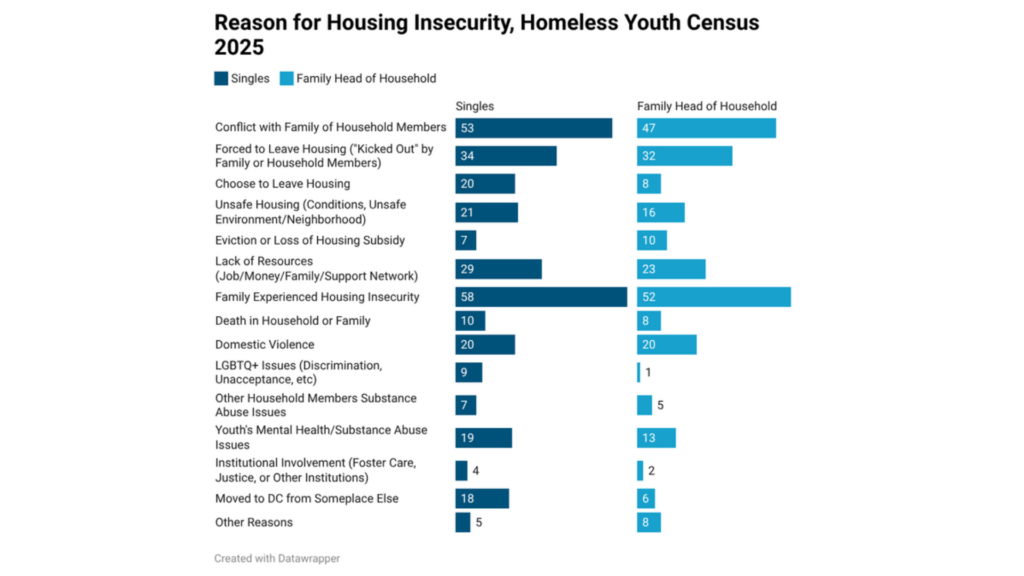
According to the 2025 Point-in-Time Count, the most recent available, nearly 500 people between the ages of 18 and 24 were experiencing homelessness in the city on one night. Pierre said about 250 youth had exited homelessness in fiscal year 2025, with about half exiting to permanent housing. Though there was a discrepancy between DHS’s exit numbers and the council’s, Pierre said for DHS, the numbers are “increasing” and “improving.”
Regarding the future of DHS’s strategy to help young people experiencing homelessness, Pierre said DHS was looking into increasing the number of youth shelter beds by 70 (there are currently 500 beds in the system), but wanted to make sure the beds are in demand. The DHS spokesperson wrote the agency is “planning a new grant solicitation to increase its youth shelter capacity.” According to Pierre, the city is also looking more into “specific” youth-homelessness strategies that will fit into Homeward D.C. 3.0, the new plan to end homelessness, rather than a stand-alone plan for youth.
“We serve youth with severe trauma histories,” Flo White, a case manager for Sasha Bruce, said in her public witness testimony at the DHS oversight hearing in February. “When a young person with high levels of trauma finally finds a place they trust — that is when the real work begins.”
This article originally appeared in Street Sense’s March 25, 2026 edition.