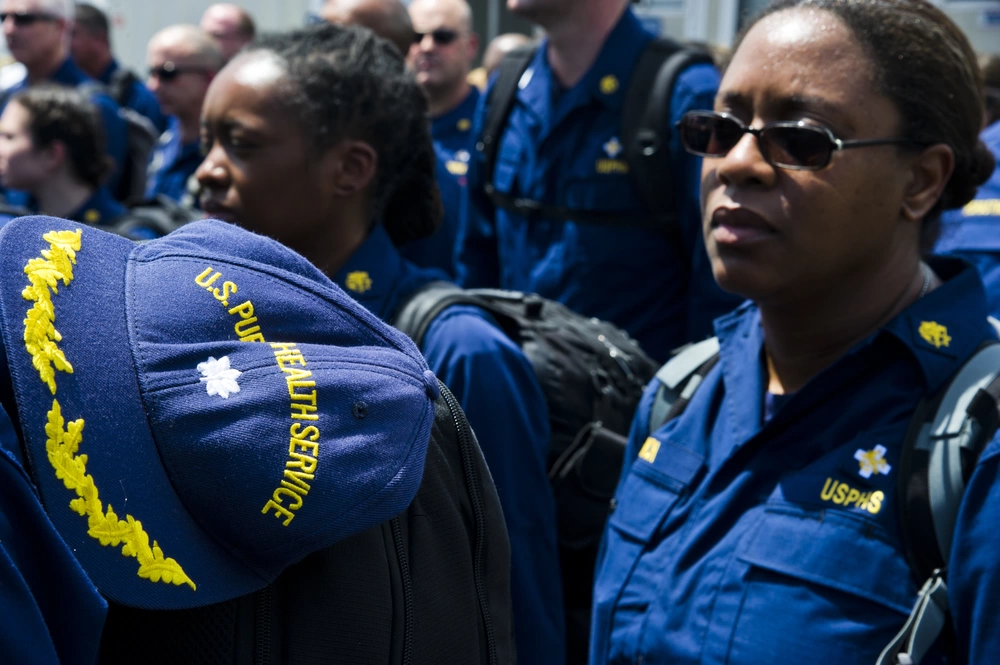
Since mid-September, unusual small groups of uniformed health care providers have been spotted around D.C., speaking with people experiencing homelessness. They aren’t part of the city-funded encampment team or one of the dozens of local outreach organizations normally seen on the streets. Instead, they’re from one of the eight uniformed services in the country — the Commissioned Corps of the United States Public Health Service (USPHS).
According to outreach workers and meetings of homeless service providers, a team of nearly 20 USPHS workers was deployed to work with the city’s Department of Behavioral Health (DBH), in partnership with the Department of Human Services and outreach groups, to engage with individuals experiencing homelessness. Since late September, Street Sense has seen groups of corps members six times, often near encampments or service centers. In two cases, Street Sense saw the teams drive away in unmarked vehicles.
The teams of federal health care professionals are a novel and likely temporary addition to the city’s homeless services system, raising questions of what purpose they serve, and whether they may be related to increased federal presence in D.C. following the takeover earlier this fall.
Since the expiration of the executive order that enabled President Donald Trump to federalize the city’s police force, many federal agents, including about 2,450 National Guard officers, have remained in D.C. According to the city’s Attorney General Brian Schwalb, they may stay in D.C. through the summer of 2026, if not longer.
It’s unclear if the USPHS’s presence is part of the aftereffects of the takeover, but some people familiar with the homeless services system find it strange. USPHS corps members, who are primarily trained health care providers, are usually deployed to address public health emergencies such as disease outbreaks or the aftermath of natural disasters. Street Sense was not able to identify another time members aided in a major city’s homeless outreach.
Outreach workers say they have been told the USPHS teams are on 30-day deployments. Street Sense was unable to verify when the deployment started or how long the corps will be in the District, as no government agency, including DBH and USPHS, answered specific questions about the partnership.
Under normal circumstances, the city has several outreach teams that routinely identify and offer help to people living outside. Outreach workers say many of the people the corps is meant to engage with are already connected with service providers in the city. While they say more support would be welcome, for some people experiencing homelessness, it may take months of relationship building before they trust an organization enough to connect with its services — something more consistent local providers say they are best-equipped to do.
“We’re not going to turn down extra help or professional expertise,” Andy Wassenich, director of policy at Miriam’s Kitchen, said. “But let us hire them on a permanent basis. We know our population, and we can help them get to know our population and maybe make a difference.”
The USPHS is one of eight uniformed services in the U.S., along with the six military branches and the National Oceanic and Atmospheric Administration Commissioned Officer Corps. Members can be recognized by their navy blue caps and jumpsuits of the same color with yellow USPHS emblems.
The over 6,000 corps officers operate across the country and abroad. A relatively small and obscure group, the USPHS’s stated mission is to “advance our nation’s public health,” according to its website. Officers primarily include trained health care providers such as physicians, nurses, dentists, therapists, dieticians, and pharmacists. Other officers may be veterinarians, engineers, or scientists who work in public health-related fields. Aside from city agency-led trainings, it’s not clear what prior experience corps members have with responding to homelessness.
Typically, corps members are dispersed within 36 different federal agencies, including the Indian Health Service, the Centers for Disease Control and Prevention, and the Food and Drug Administration. In 2015, the corps’ deployment and response to the Ebola outbreak in West Africa earned the group a Presidential Unit Citation.
The USPHS’ deployment to D.C. comes in the wake of heightened federal scrutiny of visible homelessness in D.C., including Trump’s month-long takeover of the local police force. This crackdown resulted in federal and municipal agencies clearing at least 24 homeless encampments in the District in August. Street Sense reporting found these closures made it difficult for people to stay in contact with the services they regularly accessed as they were shuffled around the city, sometimes ending up much further away from resources.
Throughout the takeover, outreach workers questioned what support the federal government could offer the city’s homeless services system to help achieve its goal of moving people off the street. The federal government did not, for instance, open shelters for people experiencing homelessness.
The federal takeover added to existing strains on the city’s homelessness services system, including a long-standing shortage of social workers, calls for more resources for service providers, and more non-congregate shelter options, among other issues. According to the 2025 Point-in-Time Count, an annual snapshot on the state of homelessness, there were 792 people experiencing unsheltered homelessness.
While the corps members expand the number of people doing outreach in the city, some outreach workers worry people may not trust them. They expressed concerns some of the people USPHS is meant to engage with may experience severe mental health issues, which can include delusions and paranoia. For them, the presence of unfamiliar uniformed officers, whether they’re from the FBI, National Guard, or USPHS, may be more harmful than helpful.
In the long term, Wassenich said he believes the city needs more holistic solutions to homelessness. He finds the idea of public health workers devoted to addressing the issue to be a promising start.
“I think some of it is rather well-intentioned. I don’t want to dismiss it out of hand,” he said. But he is skeptical corps members will be able to make much progress if they’re only working with people for a month.
“I think there are those of us who work in homeless services in Washington, D.C., and are like, ‘This is great. Give us the money to hire these same folks on a long-term basis,” Wassenich said.
This article originally appeared in Street Sense’s Oct. 22, 2025 edition.