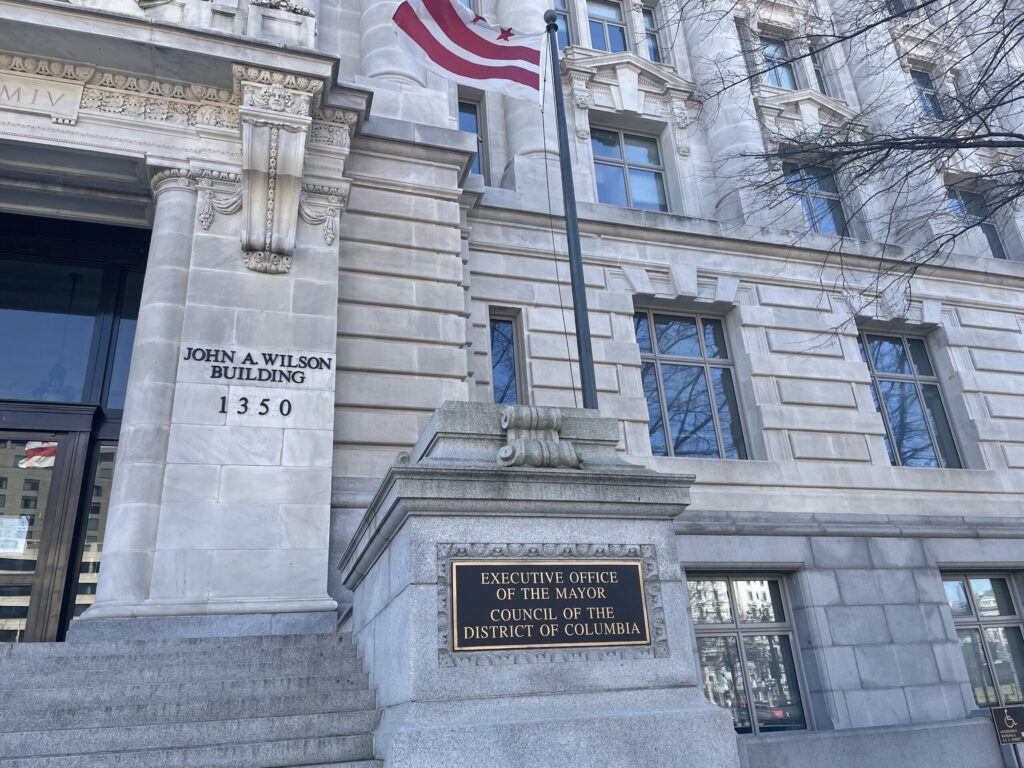
This month, Congress passed a disapproval resolution that locks D.C. into tax policies from the One Big Beautiful Bill Act, a blow to the home rule doctrine that allows the District to govern itself and to the city’s revenue. The potential loss, ahead of what’s expected to be a tight budget year, could mean coming cuts in funding for social services.
President Donald Trump signed the disapproval resolution into law on Feb. 18. It blocks the D.C. Council’s legislation separating the District’s tax laws from those enacted by the Republican tax bill last summer, which raised the Child Tax Credit to $2,200 for each child under the age of 17, while shrinking eligibility for the Earned Income Tax Credit (EITC). Additionally, it raised standard individual tax deductions, eliminated taxes on tips and overtime, and added tax breaks for businesses.
D.C.’s Chief Financial Officer Glen Lee estimated in a late 2025 memo that decoupling D.C.’s tax laws from the federal changes would increase the District’s tax revenue for the 2026 fiscal year by nearly $179 million. But with Congress’s reversal, D.C. may lose $658 million in tax revenue over the next five years.
In November, the council passed the D.C. Income and Franchise Tax Conformity and Revision Temporary Amendment Act in response to the federal legislation. The Temporary Amendment Act would have separated D.C.’s tax laws from the new policies, preventing massive revenue losses and putting a portion of the saved revenue towards the creation of D.C.’s own Earned Income Tax Credit (EITC) and Child Tax Credit (CTC). The pair of tax credits was projected to reduce child poverty by 20%, according to the D.C. Fiscal Policy Institute, a research center focused on the impact of the city budget and taxes on its communities. Without them, middle- and low-income families could be at risk of losing new financial support systems at a time when many D.C. residents are still coping with mass federal layoffs and the cost-of-living crisis.
As D.C. is a federal district, not a state, all bills passed by the council are technically subject to congressional review.
In a letter to congressional leaders dated Feb. 2, Mayor Muriel Bowser and D.C. Council Chairman Phil Mendelson wrote the resolution was “an intrusion on the District’s Home Rule authority” and would disrupt D.C.’s tax collection, which has already begun, by requiring D.C. residents to re-file their taxes in accordance with federal provisions. On Feb. 24, D.C. Attorney General Brian Schwalb argued in a legal opinion Congress could not overturn the law, saying lawmakers had missed the deadline to do so.
The D.C. Fiscal Policy Institute said in a statement that “If DC were a state, this kind of federal interference wouldn’t happen,” citing “at least ten other states” that were allowed to decouple from the tax reforms and 18 others that have laws requiring “full state legislative approval before any federal tax changes are adopted.” The institute raised concerns about how the loss of tax revenue might affect the portions of the city’s budget that had been dedicated to social services, particularly those combating child poverty.
The unexpected revenue loss, the second in a year after the 2025 fight over $1 billion Congress prevented the city from spending, means D.C.’s funding for various social services programs is now facing an uncertain future. Last fiscal year, the District collected around $200 million more in tax revenue than expected, $51.5 million of which the council had designated for a list of priorities. The list included the Childcare Subsidy Program, which covers part or all of the cost of childcare for families accepted into the program; the Housing Production Trust Fund, which finances affordable housing; and the Emergency Rental Assistance Program. In light of the mandated changes to D.C.’s tax policy and a growing budget, Bowser is not authorizing this allocation of the excess funds, according to WAMU.
The District’s upcoming budget was already projected to be tight. In a meeting with the council earlier this month, Bowser told council members that health care and child subsidy programs might need stricter eligibility restrictions. According to City Administrator Kevin Donahue, maintaining the current operations of D.C.’s programs and services would cost up to $1.1 billion more in revenue than the District can afford.
In a letter to the mayor, Councilmembers Brianne Nadeau, Christina Henderson, Charles Allen, and Janeese Lewis George wrote about their concerns that budget cuts “present clear threats” to the “humane and dignified safety net” on which “tens of thousands of residents” rely. They stated, “The safety net is at risk of being dismantled and in desperate need of corrective action.”
This article originally appeared in Street Sense’s Feb. 25, 2026 edition.