In early May, a small group of homeless services advocates traipsed through D.C.’s Wilson Building, bearing strange gifts for the city’s leaders: small wooden banks in the shape of houses. The banks were empty, representing what advocates see as a lack of investment in ending homelessness in the city’s proposed budget. They want them full.
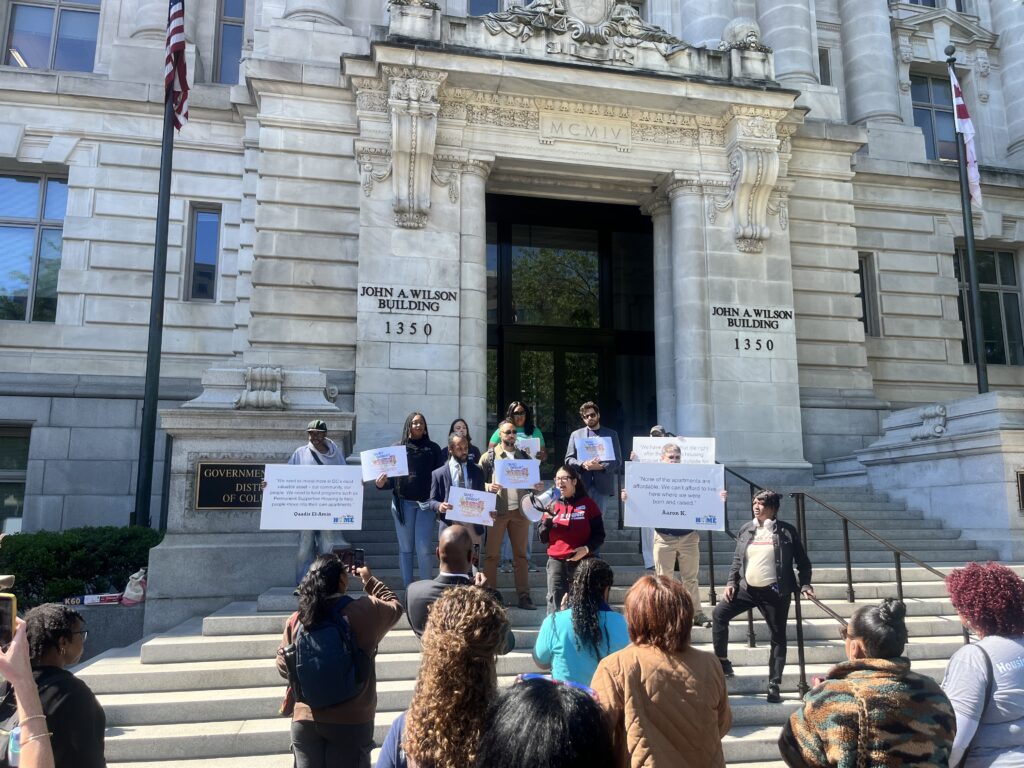
Following a proposed 7.5% decrease in the Department of Human Services’ (DHS) funding in Mayor Muriel Bowser’s fiscal year 2027 budget, the agency has projected cuts, including to pillars of D.C. homelessness services. Advocates, led by the Way Home Campaign, have decried these reductions, testifying at an April 30 budget oversight hearing and holding a rally at the Wilson Building.
On May 12, before going inside to deliver their house-banks, a group of about 40 people gathered, calling on the D.C. Council to reverse cuts to homeless services and add funding for new vouchers to bring people out of homelessness. While lawmakers have been insistent it is a tough budget year and the city has to make cuts to valuable programs, advocates from Miriam’s Kitchen, Everyone Home DC, the Fair Budget Coalition, and other groups argued D.C. can find ways to fund programs important to its residents, including through a wealth tax.
At least some councilmembers agree. During a May 19 budget discussion, Ward 1 Councilmember Brianne Nadeau suggested D.C. add a tax on income earned from investments, based on a 2025 report from the Institute on Taxation and Economic Policy. It found adding a 2% local tax on wealth already reported and taxed by the federal government could generate $120 million. The tax would apply to income earned from interest, dividends, and capital gains for households making over $250,000, and would impact 9% of D.C. taxpayers.
Other councilmembers suggested alternative ways to raise revenue. Ward 3 Councilmember Matt Frumin brought up both a temporary increase to the income tax and a tax on second homes. Council Chairman Phil Mendelson, who is generally opposed to tax increases, said he had found an additional $420 million in revenue the council could add to programs. More formal proposals are expected in the coming weeks.

Advocates who testified at the April 30 hearing hoped any additional money could be used to reverse cuts to core programs supporting people who are homeless and those at risk of homelessness, including Temporary Assistance for Needy Families (TANF), the Emergency Rental Assistance Program (ERAP), and Permanent Supportive Housing (PSH) vouchers.
A substantial number of public witnesses raised concerns regarding the capacity limits of PSH. Bowser’s budget doesn’t add any PSH vouchers, meaning those in need of housing through the program will have to wait. PSH is set to lose over $4.4 million in funding in FY27, raising concerns for current voucher holders. According to advocacy group the Way Home Campaign, the cuts could put up to 200 households currently receiving PSH at risk of losing their housing. DHS is still working to secure the $15 million necessary to maintain all current PSH vouchers, officials said at a May 6 hearing.
Even if all existing vouchers are protected, advocates argue there’s a high unmet need for PSH vouchers. The Way Home Campaign identified at least 1,284 individuals and 782 families it says would benefit from the voucher, and is asking the council to add vouchers to cover those households.
The group also wants the city to reverse cuts they say would mean fewer services at day centers, including the elimination of Shirley’s Place, a day center run by Everyone Home D.C. According to the group’s website, the center served nearly 10,000 meals in 2025. In the May 6 hearing, DHS officials said the center was doing great work, but the city has three other drop-in centers, so DHS made the difficult decision to cut funding.
Advocacy groups also rang alarm bells about shrinking resources for at-risk populations within the homeless community, including victims of domestic violence and D.C.’s youth.
Advocates for survivors of domestic violence noted homicides and domestic-violence-related crime have spiked, despite the overall decrease in crime in the District. These advocates emphasized those at risk of homelessness are at greater risk of experiencing domestic violence and funding for programs supporting victims must be maintained. Programs specialized for assisting survivors of domestic violence are projected to lose $685,000 in funding.
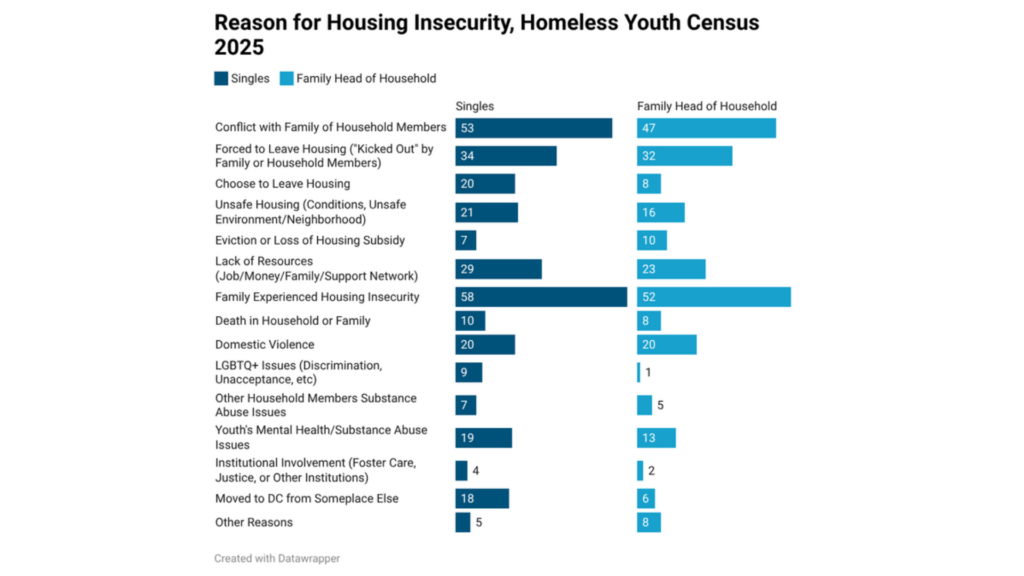
Youth homeless funding, meanwhile, is projected to take a $2.3 million hit, Rachel White with D.C. Action explained at the May 12 rally. This includes cuts to programs preventing youth homelessness like the Pass Program and the Strengthening Teens Enriching Parents Program alongside cuts to permanent supportive housing, transitional housing, drop-in centers, and workforce development. The decrease will mean 28 fewer beds for youth, according to the Way Home Campaign.
Flo White, a case manager at Sasha Bruce Youthwork and a former homeless youth, emphasized the challenges youth face, including often waiting six to nine months to be placed in a housing program and a lack of familial support. White worries youth curfews will criminalize young people in search of housing.
“When you cut funding to youth homelessness programs, you are not just cutting numbers on a spreadsheet. You are cutting access to safety,” White said. “It looks like young people sleeping outside, young people being forced to choose between unsafe situations in the streets, and it looks like increased exposure to violence, exploitation, and long-term trauma.”
D.C. residents also spoke out about cuts to programs for low-income residents, like food assistance and eviction prevention.
Currently, TANF is projected to lose over $16 million from its cash assistance program. This means TANF benefits, which are already dropping for some families this year, will be entirely eliminated for families who have been on the program for more than five years in October 2027. Public witness Monique Jackson, who relies on the program for housing payments and basic needs, said TANF is designed as temporary aid, and those receiving TANF are truly in need of the assistance. People qualifying for TANF are also limited in other sources of financial support.
Even though the program doesn’t provide for the full needs of families, Jackson said D.C. families like hers rely on TANF. As the mother of a young son working on her education following the loss of her job due to budget cuts and health issues, Jackson said she “could not envision” the harm that would come to her and her son if the program is cut.
“Any cuts will place me lower below the poverty line than I already fall in,” Jackson said. “Cuts to TANF would tremendously affect me and my family in a truly devastating way.”
Additionally, ERAP, which covers rent for low-income residents in cases of emergency, is expected to be cut by $1.6 million. The program has been successful in preventing evictions, according to Philip Johnson, a legislative advocacy fellow to the United Planning Organization. However, ERAP has been a target for cuts for years, with the council often coming in to restore funding the mayor cut.
Johnson testified that without proper ERAP funding, more expensive systems such as homeless shelters, emergency rooms, and the court system will bear the brunt of the consequences of growing evictions. He said the program requires $30 million, because the city has failed to provide an adequate alternative system for the program.
“Prevention is cheaper than a crisis response,” Johnson said. “If ERAP is not for low-income residents facing eviction, where is the funded alternative?”
The council is meeting over the coming weeks to develop its budget recommendations, including any new taxes. A first vote on the budget is expected on June 9, at which point advocates will learn if their banks, now sitting in councilmembers’ offices, will remain empty.
Annemarie Cuccia contributed reporting.
This article originally appeared in Street Sense’s May 20, 2026 edition.