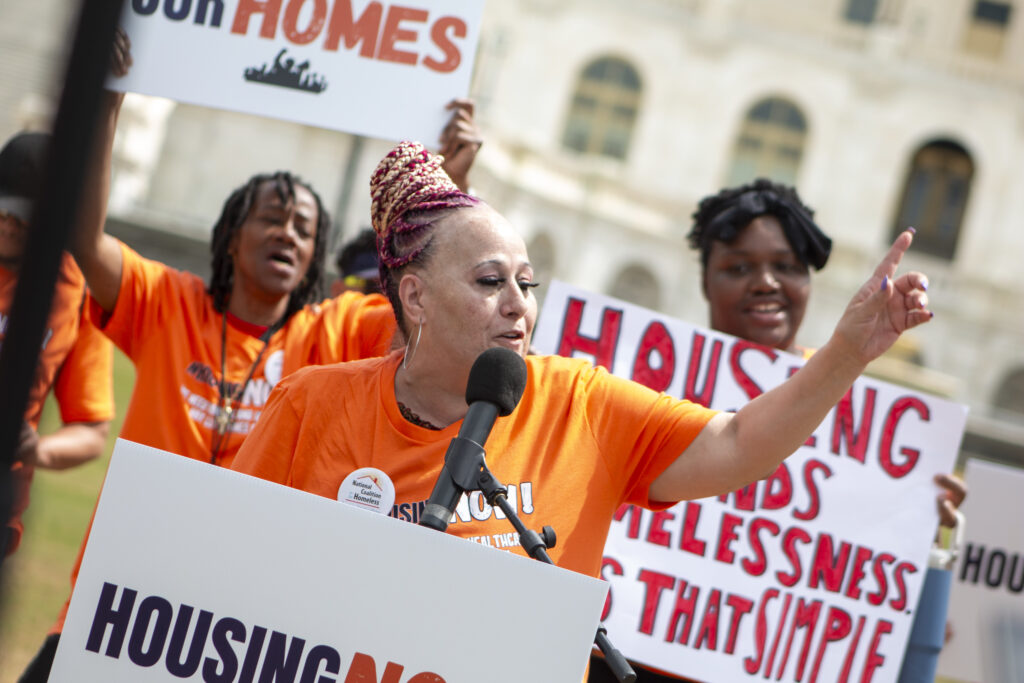
The National Coalition for the Homeless held its annual Lived Experience Leadership Conference Nov. 17 through Nov. 19 in Cincinnati, Ohio, bringing 1,000 advocates and service providers together for one common purpose: to find ways to end housing instability.
This is one of the most important conferences I attend every year. All of the participants have lived experience or are still unhoused. Every single person brings a unique perspective to the table. The National Coalition for the Homeless is one of the oldest coalitions centered on ending homelessness and has been around since 1982. The organization fights for the rights of the unhoused and against policies that endanger the unhoused community. Its biggest contribution is advocating to use individuals with lived experience in every aspect of their work. Check out its website at nationalhomeless.org
The speakers bureau was created by Michael Stoops in 1992 to bring a human perspective to stories of overcoming barriers. They also fight to change policy and have a contract with the U.S. Department of Housing and Urban Development (HUD) for technical assistance projects to write policy.
At the conference, there are individuals from all 50 states, and each state has different concepts and policies in place to protect and provide resources for those still unhoused, and we all learn from one another. There were organizations in attendance, such as UpSpring from Kentucky, which is using the in-the-meantime strategies, such as tiny homes and safe parking, where people experiencing homelessness can park and sleep overnight.
The Minnesota Coalition for the Homeless made a lasting impression on me because it tackles homelessness from a federal and local level simultaneously, with a multi-faceted approach. They do this with policy work and collaboration with job-ready centers and readily available resources.
In 2024, the United States had 771,480 individuals unhoused, according to the annual homelessness assessment report to Congress from HUD, an 18% increase from 2023. This includes those experiencing street homelessness and those in shelters. We are in a public health emergency. It’s a fact that an unhoused individual’s life is shorter than that of someone who’s housed, and I believe housing is a universal right, and housing is health care.
Addressing homelessness is crucial in the United States, as it can create mental health disorders due to the trauma of being in survival mode, along with adverse health conditions from the elements. Then there is the cycle of incarceration, which can start due to decisions made when a person is in survival mode.
At the conference, I had the privilege of participating in three different panels. The first panel was titled Resilience, Recovery, and Hope, and was about how we overcame our trauma and became of service to the unhoused population and have the jobs we do today.
I shared my experience of being unhoused for 17 years with co-occurring disorders and how I had other individuals who believed in me until I believed in myself. I also shared about being in a 12-step program, working through my traumas, and overcoming challenges in different stages of change each time until I was baseline and clean and sober.
I could then focus on my purpose and passion of helping and serving others in many different capacities on many different platforms. I am the assistant director of People for Fairness Coalition and on the Peer Mentoring Team, where I do outreach, and onboard unhoused constituents into the Homeless Management Information System, and advocate to get them matched to a voucher. I have their documentation ready, and I walk them to their keys. It’s such an honor to be a part of watching an individual get the light back in their eyes and find hope again.
The second panel was the LETA, Lived Experience Leadership Academy, and I spoke about how I wrote the curriculum for wellness and self-care and the different stages of change. My curriculum emphasized having a toolkit when triggered in any area of life and knowing what to do when things are breaking down. It helped guide attendees on how to best practice self-care by putting yourself and your mental health first, so that you can continue to function at baseline and survive emotions. Knowing your triggers is such a strength. Once triggered, using tools such as prayer and meditation, calling a friend, breathing techniques, or just sitting through the emotions and not acting on impulses, are so empowering. It’s important in this field of work.
Humanitarian is Criminalization was the title of the third panel. The Supreme Court in Grants Pass v. Johnson allowed cities to criminalize homeless encampments when there is no alternative shelter available. In some places, the Grants Pass decision effectively makes it illegal to lie down and sleep outside, even though people don’t have homes.
All three of these panels had other advocates from all over the United States, and it was so empowering and fierce to see other advocates and educators speak about national policy, bias, homelessness, and solutions. I thank God for the assignment to help others through areas I have been able to overcome.
This article originally appeared in Street Sense’s Dec. 17, 2025 edition.