By day, the Central Union Mission men’s shelter is a quiet refuge for those seeking emergency resources. But by night, a choir of voices rings out in unison against its red brick walls.
The Men of Valor choir is a small gospel ensemble operated through Central Union Mission. Under the direction of Chaplain Milton Matthews Jr., the choir is both a source of community and a musical outlet for men experiencing homelessness. Rehearsals take place almost every day, as long as there is a staff member available to take over Matthews’s other duties at the front desk.
Central Union Mission is a Christian organization that cites the mission to “glorify God” as the foundation of its services. According to Central Union Mission’s president and CEO Joseph Mettimano, no one is required to identify as a Christian or attend religious programming to access the shelter’s resources. However, “we find that most people do because having that spiritual foundation oftentimes gives them the wherewithal to work on all the other hard things in their life.”
The Men of Valor choir is part of the shelter’s optional Restoration and Transformation Program (RTP), though others can participate. The RTP is a roughly 16-month structured program that guides individuals through vocational training and spiritual programming, such as the choir.
Miambo Kufena joined the choir to “figure out what I could do more to advance myself in the [RTP].” Men of Valor has helped him connect with men who have endured similar experiences in ways he didn’t anticipate. “They give me a sense of awe to realize who the guy is beside me. It’s good to sing, and it’s hard to sing, but most importantly, the corresponding thing is us being together to sing that one melody,” he says.
Central Union Mission’s chapel, where the Men of Valor rehearse, is a large, open room adorned with posters of the shelter’s history and a sprawling, colorful mural of men rejoicing with Bibles in hand. Choir members sit on the ledge of a large stage at the front of the room, leaving the podium empty for the church service that will follow their rehearsal.
At about 5:45 p.m., an audience begins to trickle into the dozens of seats laid out in front of the stage. As more filter in, staff members pull open two panels of a collapsible wall, revealing an even larger cafeteria room where dozens more can sit.
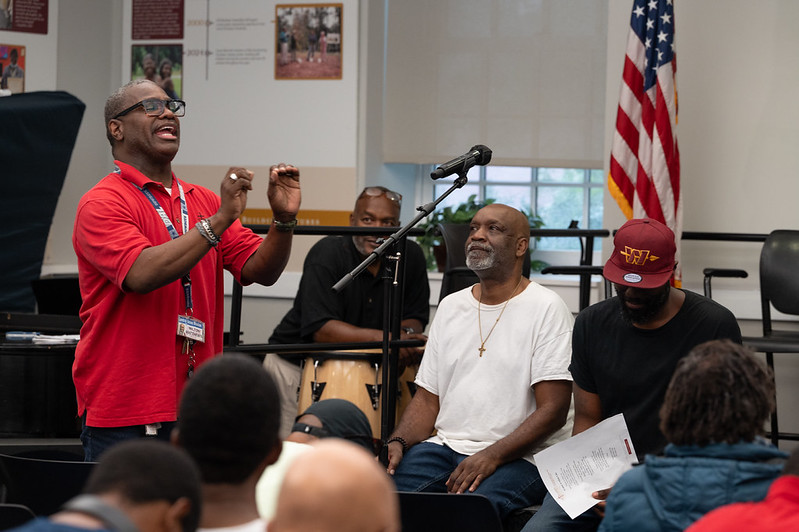
When asked about rehearsing before such a large audience each evening, choir member David Burrell jokes, “They have to be there. They have to come in there for church.” He doesn’t feel nervous.
Waiting for evening services to begin, attendees receive an energetic, 45-minute serenade with all the stops and starts of a typical choir practice. Some in the audience are attentive, while others scroll on their phones or have hushed conversations.
Central Union Mission first opened in 1884 as a center for Civil War veterans left homeless after the war. Its services have since expanded to include five properties across the DMV.
“I think a lot of people may not know this, but [Central Union Mission] is the oldest private social service agency in the District of Columbia. We’re 143 years old,” says Mettimano.
Today, the men’s shelter in the NoMa neighborhood, where the Men of Valor rehearse, provides beds, meals, and showers. Mettimano says the shelter also seeks to “permanently” lift individuals out of poverty through social workers, medical services, Alcoholics Anonymous and Narcotics Anonymous groups, and legal aid. According to metrics on Central Union Mission’s website, up to 170 men stay at the shelter each night. Twenty men completed the RTP in 2025, according to the shelter’s annual report.
The evening of July 23, almost 80 men are present in the chapel, but just six take part in the choir rehearsal. On a good day, all seven choir members participate in rehearsal, but member Vincent Powell, who is there that day, says work and other commitments can be an obstacle to their attendance. While he’s tried to encourage more men to join the group, “they just want to worship the Lord with us sitting down,” he says.
Despite its limited membership, the openness — and the volume — of the choir’s rehearsals make the music a collective experience for all present.

Before rehearsal begins, choir members shuffle through their sheet music as Matthews fires off riffs from the keyboard. Then, he pauses playing and leads the group in a prayer.
“…that you bless our minds so we might change the world, that you bless our ears so we might hear the notes,” he finishes.
The men launch into their first song, “Faithful is Our God” by Hezekiah Walker.
They run through a set of three gospel songs throughout the rehearsal. Intermittently, Matthews stops the group to correct intonation or articulation. He prompts the group to repeat a verse of “Faithful is Our God” in hopes of accenting the “ee-sus” in Jesus. During “Praise is What I Do” by William Murphy III, he dissects the “oo” in “do.”
“You can’t be handsome when you sing,” Matthews tells the men as they joke about the impossibly before, during, and after almost every song. As director, Matthews brings decades of musical experience to the Men of Valor; he also brings his own lived experience with overcoming homelessness and substance abuse. Matthews started his first shelter-based choir, called Friends of the Fellowship, when he was living in a shelter on Rhode Island Ave 30 years ago.
Raised in Washington, D.C., Matthews first started singing in church as a child. He soon found his confidence performing with a local theater company. When Matthews turned 18, he began singing on the nightclub circuit. He felt pride “standing in the footsteps” of his father, Milton Matthews Sr., a local R&B and gospel singer who had performed along the same circuit.
“After my stint in the nightclub circuit, I unfortunately got involved in alcohol and drugs really bad and ended up in a homeless shelter back in ‘96,” Matthews said. “And of course, everywhere I went, music followed me, so by that time I think I had sold everything except for my keyboard.”
While some in the Men of Valor have a musical background, ranging from Burrell’s time in church choirs to Kufena’s love for hip-hop and rap, it’s a “first experience” for others like choir member Preston Riddick.
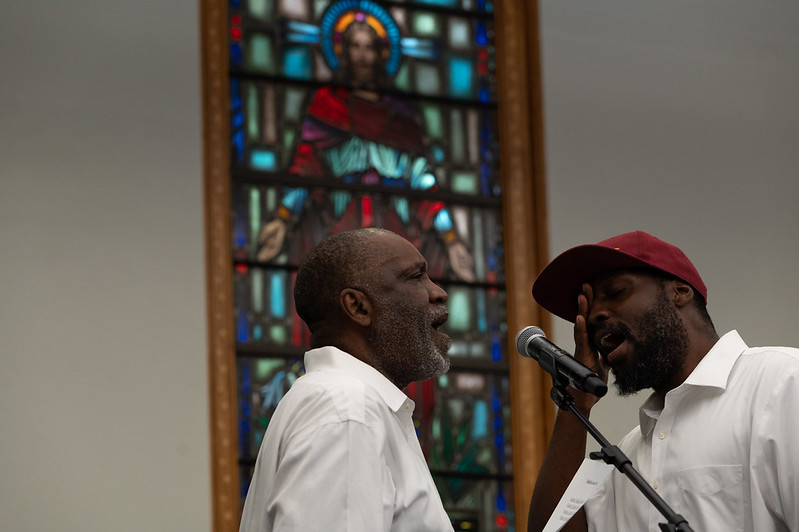
“He’s teaching us, he’s guiding us. And he’s just having fun,” Burrell says of Matthews’ leadership.
“He know we’re not professionals, so he just let us do the best we can, and he’s happy with that.”
On the other hand, Burrell says, “the brothers here ain’t gonna hold no cut calls; if you singing the wrong note, they gonna let you know about it. Maybe not at that time, but when they see you around the building, they’ll let you know.”
The relationships nurtured through the choir instill more than musical accountability in its members.
Powell cites “camaraderie with the brothers [from the choir]” as something that has kept him tethered to Central Union Mission. Two years ago, he left the shelter to move to Baltimore, but a conversation with Matthews about the choir was part of the reason he soon returned to D.C.
Based in a shelter, the Men of Valor face this dilemma frequently. Central Union Mission seeks to move guests through its programs and out of its system, with the hope they will no longer require its services. Members of the already small group come and go. To return often means they still rely on the shelter, though they don’t have to live there to be in the choir.
“They just recently started the choir back up [in 2024],” says Riddick. He remembers the difficulty of building up membership after the choir was re-established. “We had two guys. Once [one of them] graduated, he moved back home with his family. And another guy left and got his own place,” he says.
Riddick took an extended absence from the group to attend an addiction treatment program. Chronic homelessness has led him back to Central Union Mission multiple times over the years, and he came back to the shelter after graduating the program.
“While I was gone at treatment, [Andre Thomas] told me, ‘man we missed you in the choir! Cause we went to — we had a gig at Tyson’s Corner for Christmas.’ And I said, ‘oh, man.’” Riddick shakes his head, remembering his disbelief, then continues, “And he said, ‘we missed you because Matthews missed you doing your solo,’ and I said ‘oh, man!’”
Matthews is particularly touched to see choir members return to Central Union Mission after seeking treatment.
“I’ve seen them struggle in the time that they left and came back,” Matthews says. “But to see them come back and find their footing again, you know what I’m saying? And… sharing music with them and helping that be a part of their recovery, be a part of rebuilding their life. It’s priceless, man. It’s priceless.”
Mettimano is blunt when he says Central Union Mission is “not a so-called low barrier shelter.” Guests who are under the influence of drugs or alcohol will not be let in; they must be sober “when they arrive for the first time for an overnight bed.” Still, he clarifies, “most of the people who show up at our facility have some measure of addiction issues, and so that is not gonna prohibit them from coming in and joining the program.”
Through Catholic Charities, Matthews spent 90 days in a substance abuse treatment center in West Virginia before securing transitional housing in D.C. in the 1990s. There, Matthews reunited with his wife, now of 33 years. He returned to school and church, graduating from the University of the District of Columbia and obtaining his ministry license while working four jobs.
“I’m blessed to be able to serve men, help men get back on their feet,” he says. “I gave up on wanting to be a superstar a long time ago, but I realized that God could use my music to impact people… I often say if it weren’t for music, I would never have been born.”
Matthews recently fulfilled his dream of releasing a single, a gospel song titled “It’s Christ.”
“Chaplain Matthews, he’s a good director,” says Powell. “He motivates me, and he sings with joy. And he brings me out.”
When the rehearsal ends, choir members gather their sheet music and move from the stage to the audience as a chaplain arrives to deliver the evening sermon.
Burrell echoes Matthews on the importance of faith to his time in the choir. “I’ve always been a part of the church choir,” he says. For him, singing with the Men of Valor is “first and foremost [about] praising the Lord.”
Beyond the religious themes of their gospel repertoire, many choir members find solace in the hopeful messages of the music they perform. In addition to their pre-sermon rehearsals, the choir sings at special services and at celebrations like RTP graduations.
“Nobody Greater” by VaShawn Mitchell strikes a particular chord with Riddick. “That’s my favorite one, because see, I basically lost basically everybody. Basically, my partners, my family and everything. And I was all alone by myself,” he says. “Then I came here, and I start finding myself, and every time I hear that song, I get real emotional because it’s like it’s telling my story like ‘searched all over couldn’t find nobody.’”
“Be Encouraged” by William Becton resonates with Kufena. “It makes a difference in my life because I’ve been in and out of shelters and that gives me a type of awe to sing it out. And it makes me feel that I can actually release [my experiences] instead of just sitting,” he says.
Audiences have been touched by the music, too. Following the Men of Valor’s performance at Martin Luther King Jr. Library on July 16, a library staff member relayed a message to Matthews from a man who attended the performance. The man had experienced suicidal thoughts that morning. When the choir performed “Clean Up” by the Canton Spirituals, Matthews says the man “knew it was gonna be alright, because his mom used to play that song… and he said he took that as a sign.”
Matthews has high hopes for the future of the Men of Valor. “I’ve always envisioned a choir from this population, from this community, whether it be here or another organization, rising up and becoming a voice for the city,” he said. “And singing in platforms where people’s hearts are encouraged.”
This article originally appeared in Street Sense’s August 26, 2026 edition.