Another Street Sense vendor passed away recently, and I just hated having to see another vendor’s face on an issue’s cover, knowing one day, God forbid it’s any time soon, it’ll be mine. I just hope they’ll use a photo of me that shows me out in the community, full of life and smiling.
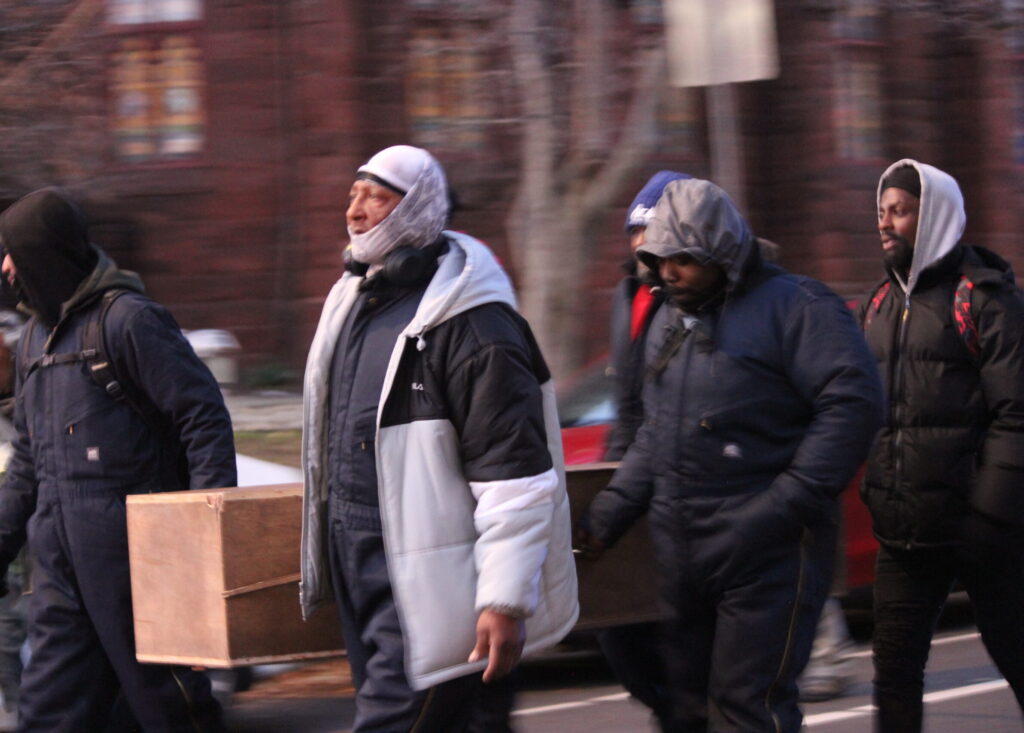
I’ve been in the street paper movement for 29 years, including both in D.C. and in Cincinnati, but experiencing these deaths makes it seem longer. I’ve had to process way too many passings and attend too many memorial services for the unhoused. You’ll never get used to it, and it weighs heavily on you, whether you were close to the individual or not. I can’t get it out of my head, for fear of it happening to me or someone I care about. Once, I went to a service, went up to say goodbye, and as I walked around the “casket,” I noticed they were literally laid in a cardboard box with a piece of tie‑dyed materiel draped over it. When the unhoused go unclaimed, it’s like they were swept away by some kind of tsunami; only the next day, no one will come searching for the unhoused person, and definitely no one will mourn them. Their name won’t be in the local newspaper or mentioned on the Six O’Clock News.
In The Beatles’ song “Eleanor Rigby,” the lonely and friendless lady had a much better send‑off than the unclaimed bodies of homeless individuals. At least she had Father McKenzie to bury her in a churchyard with his personal prayer for her soul’s rest and salvation. Most of us in our homelessness will leave this world much in the same way we walked around in it, unnoticed and unappreciated as a fellow child of The Creator.
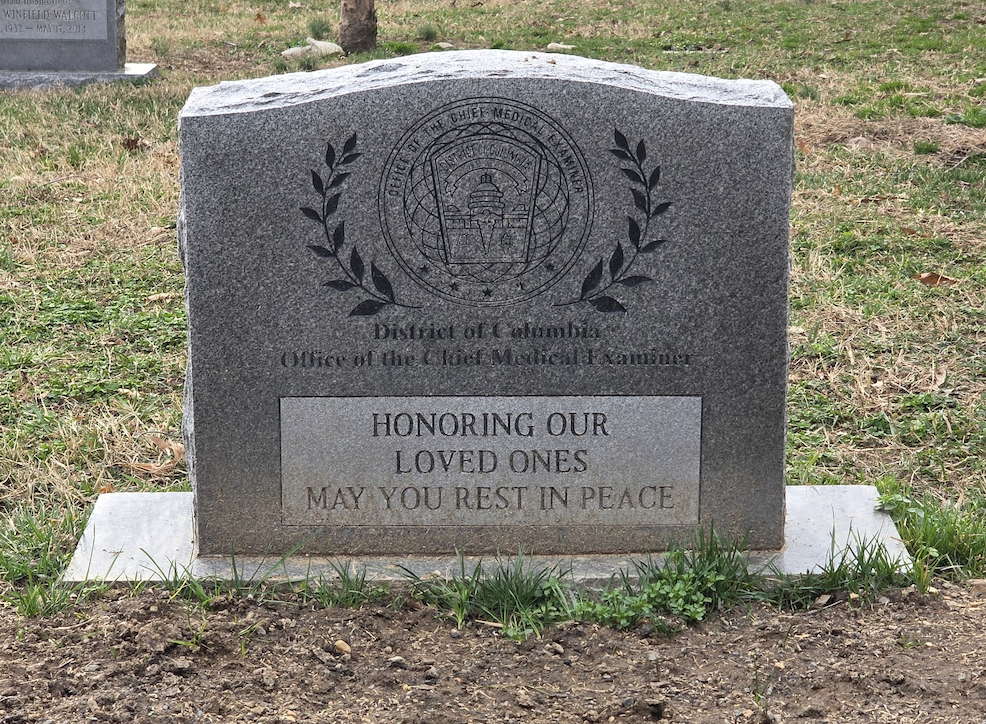
When an unhoused person dies in D.C., unless family claims their body, it is held by the medical examiner for 30 days. At one time, they were buried in a version of Potter’s Field. Now, the city cremates all unclaimed bodies and places them in a common grave site in Congressional Cemetery in Southeast. It’s just blocks from where I grew up and went to grade and high schools, but I never had been in. It’s near the D.C. jail, in the corner of what’s now become an upscale, membership‑only dog park. Not exactly a place of honor. It appears each time there’s more remains to add, they just turn over the soil and rake them in. There is no signage to guide you there. I just happened to bump into a staff member after someone snitched me out. They put me in a golf cart for the journey to the furthest corner of the property. There it was at the end of a row, in the rear of the cemetery, with nothing significant about it. I was underwhelmed by the very small place given to the souls who had passed on alone.
I surely have some old buddies in that basically unmarked grave, but no idea how many are there because the headstone just says “D.C. Medical Examiner” on it, like that city official is buried here. This grave deserves all the reverence given to something like The Tomb of the Unknown Soldier by the community of homeless advocates. At least place a short little decorative barrier/fence around this solemn space to discourage Lassie from taking a piss on my brothers and sisters. In death, the world continues to turn its back on us and allows us to be pissed on, too.
Look, I understand none of us are going to get out of this sometimes crappy existence alive, but the constant premature deaths leave me permanently saddened; the sun will never shine as bright, even if I didn’t know them. Because I knew exactly what they experienced being chronically unhoused, how and why it cut their lives short.
“All the lonely people, where do they all come from?” Well, they came from the same beginnings everyone does; it’s just their lives happened to take a left when everyone else’s turned right at a crucial point, that’s all it was. And most, unlike myself and others, had no safety net to break their fall.
Why some uninformed housed individuals think someone would choose to be homeless is beyond me. It leaves you beat up so bad physically, it’s almost as if you’ve been in combat or in one car wreck after another with no personal injury settlement to help you through. Mentally and emotionally, it leaves you with a chronic condition that resembles what my WWII veteran dad and his friends used to describe as “shellshocked.” Most of us “veterans of homelessness” suffer from a form of PTSD. Add in that we expect to be rejected, laughed at, and most times, we feel so undeserving we self‑sabotage. So, all the encouragement towards positive thinking is sometimes wasted, and our negativity affects our willingness to follow through with a lot of health‑related issues.
In my opinion, this accounts for part of the reason why those of us having experienced homelessness typically pass away much sooner than the average person in America. The Centers for Disease Control and Prevention says that for Black men, the average life expectancy at birth in 2025 was 70. For Black women, it’s 78, white men, 76, and white women, 81. But how much sooner do the unhoused die in comparison to those who have never experienced being homeless? Some studies now say 20 years sooner on average. One study even says the average age of death is between 50 and 56 for a person currently experiencing homelessness.
There are a lot of reasons why those experiencing or having experienced homelessness are dying younger. I truly understand, so I reached out to my friend and mentor, Donald Whitehead, who is the executive director of the National Coalition for the Homeless, to get his take. We talked at length about both our journeys and the lack of the kind of support needed to see a change in those numbers. The support that would show up in a heartbeat if this were happening to another group of people.
First of all, we in the community of people experiencing homelessness are slow to address our health issues or don’t address them at all. That comes from not being able to trust anyone, making it more difficult to recover from the conditions we find ourselves in. Trusting another person to help us is crucial to addressing our health issues, and it’s hard to trust anyone after seeing what we’ve seen and having to live in humanity’s darkness for so long, knowing humanity sees us suffering. After a while, that’s all we know, that darkness of life. We’ve become accustomed to those conditions, not comfortable at all with them, as a lot of people think. And for some, we may not even care about dying when we’re dead already, based on the way we’re treated. There’s a story I could tell you about being on a bus one day, but I won’t.
There’s no way anyone with an ounce of sanity would sign up for being homeless. No, we just learn how to adapt to the worst settings humanly possible while surviving until the angels choose us for a miracle if we haven’t had all of the hope kicked out of us. We literally learn to live each day as if it is all we’ll get, knowing that for any one of us it could be. And that’s what makes us this band of brothers and sisters who understand those nights of wandering around and trying to figure out just where it’s safe to sleep or rest. Get that decision wrong, and it’s very possible we could not wake up the next day.
Slowly noticing what was happening right around me at Street Sense, I wrote some issues ago about turning 75 and the fears involved with my own health challenges. I was blessed with recovery, having gotten sober again just in the nick of time to start addressing some pressing health scares, and have been housed a long while. But what about those who are still struggling with an unstable housing situation? How are they to adequately address their serious health issues or any illness when they don’t know from one day to the next where they will be?
Since 2021, the Street Sense vendor force has lost 17 precious souls, 11 of them well before the age of 60, and some in their 30s and 40s. This matches the trend one study was seeing with the unhoused passing somewhere in the range of 50‑56 years of age.
Is this picture getting clearer about a shorter life span for the homeless? And how, in a Random Act of Kindness based on nothing I’ve done other than getting sober when I did, have I been blessed with the gift of a much longer life? I now suffer from a serious case of survivor’s guilt, and it still hurts each time one of us leaves early. I asked Donald for an official quote, and here’s his position on the phenomenon.
“It is very disturbing to hear about the untimely deaths by our brothers and sisters. It speaks to the need for unmet needs that exacerbate homelessness and lead to premature, preventable deaths. The average life span of a person experiencing homelessness is 20 years less than a housed person. We are the richest country in the world, and no citizen should lack affordable housing or adequate health care. We must do better,” he said.
As Donald and I continued to talk — both working hard not to debate, but think of solutions — we quickly agreed on this: the lack of hospital beds. We know, having worked for a suburban county south of D.C., because we had none of those beds at all.
There’s one shelter in D.C., Christ House, that has all hospital beds with a medical staff, and it stays full. What a beautiful world it would be if each shelter had at least sick beds with visiting medical professionals checking in regularly. When I would take my clients living on the streets to the emergency room, before I could point my car back in the direction of the beltway, they’d be discharged. Why? Because hospital corporations now own all the community hospitals. I can’t help but think of a seriously ill, unhoused person living in the elements, at a bus stop, or sleeping on the ground without proper nutrition and rest, trying to recover from serious ailments.
And another thing my fellow advocate and I agreed on: if this phenomenon were present in any other population group in America, there’d be a study, a commission or two convened to look into it overnight, and of course, the accompanying media circus of congressional hearings. But for the unhoused folks in D.C., like Eleanor Rigby, nobody came. Ah, look at all the lonely people.