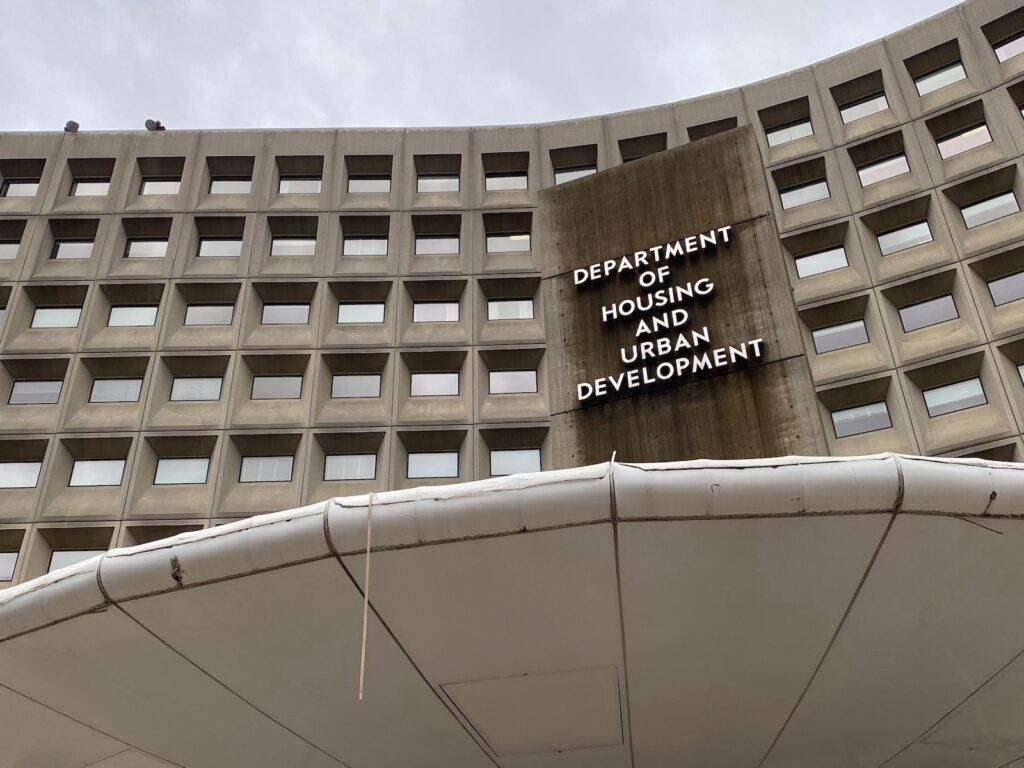
The U.S. Department of Housing and Urban Development (HUD)’s latest attempt to shift federal homelessness funding away from permanent housing has been blocked by the courts.
On Aug. 7, a U.S. district judge dismissed HUD’s new 2026 Notice of Funding Opportunity (NOFO) guidelines for its Continuum of Care grant, the largest pot of federal funding for homelessness, after a lawsuit brought by local governments, states, and the National Alliance to End Homelessness (NAEH) against HUD earlier this summer.
The 2026 NOFO, released on June 1, would have set aside $1.3 billion of the federal grant solely for temporary and supportive programs, which would shift money from permanent housing and could result in roughly 97,000 people experiencing homelessness, plaintiffs argued. The Trump administration has criticized housing first programs, including permanent housing, and attempted to slash funding for homelessness assistance grants, instead prioritizing “less effective programs,” according to plaintiffs.
“Communities across this nation — in states both red and blue — rely on the federal government to support smart, strategic, lawful, and evidence-based funding opportunities to support their efforts to end homelessness,” Ann Oliva, CEO of NAEH, said in a press release about the ruling. “This decision further reinforces that this administration has repeatedly failed to meet that responsibility.”
NOFOs are public documents federal agencies use to announce their intentions to award discretionary grants. Nonprofits, states, and local governments applying for funding must shape their programs off of guidelines in the NOFO. In her ruling, Judge Mary McElroy of the District Court of Rhode Island said the 2026 NOFO must be set aside in its entirety, meaning HUD cannot use it to determine funding for this year, but did not grant the plaintiffs a permanent injunction, which would have stopped HUD from using any of the policies, like reserving money for temporary housing and treatment, in a future NOFO.
The ruling focused on the agency’s procedures, not the policy itself. In her decision, McElroy noted there is a framework that allows HUD to create incentives and set aside funding for its priorities. However, the framework requires HUD to engage in a public notice-and comment process, which HUD did not do in this case.
The decision comes after McElroy also dismissed HUD’s 2025 NOFOs. The 2025 NOFOs would have capped funding for Permanent Supportive Housing (PSH) to just 30% of federal homelessness funding, a cut NAEH projected would force 170,000 people nationwide, including almost 1,500 D.C. residents, out of supportive housing.
PSH vouchers allow local housing authorities to address chronic homelessness by providing vouchers for recipients to live in an apartment and receive supportive services. Participants in the program pay a maximum of 30% of their income toward rent. In D.C., participants must be residents of the District, have at least one year of documented chronic homelessness, have a chronic disabling condition, and have limited income-earning potential to qualify.
The future of PSH funding remains unclear. The ruling does not prevent HUD from attempting to make changes to federal homelessness funding, but HUD will have to issue another NOFO to do so.
This article originally appeared in Street Sense’s September 9, 2026 edition.