My experience with harm reduction is from when I found out I was HIV positive. I learned about harm reduction and started going to support groups, and learned to use harm reduction tools. HIPS and the Women’s Collective taught me tools I used to live a better life and learn how to advance lives, and build my self-esteem and confidence. I learned how to be a positive woman and talk about my situation, how to talk about HIV. I learned how to tell everyone I am HIV positive and I don’t care if anyone doesn’t want to be my friend, I love myself.
We should teach people harm reduction services. HIPS has served the DMV community since 1992, for over 30 years. I talked to Johnny Bailey, HIPS hot spot program manager, about harm reduction in the city.
This interview has been edited for length and clarity.
Dominique: Good morning. I have some questions for you, but I would like you to start and give me your background in harm reduction. What degrees do you have?
Johnny: I have a social work degree, but I always say it was the 30 years of fucking up that was more productive towards my career than the four years of college. My background in harm reduction is survival. But yes, I have a social work degree. I see my niche here as being the social worker at a public health organization.
How long have you been at HIPS?
I’ve been at HIPS for about five years. I started as an outreach coordinator, but that’s not what I did, because I started right before the pandemic, and my job was to get people together in a room, do focus groups, coordinate with other organizations to do things together, and that all kinda flew right out the window. So I jumped into being out in the van like every day, in direct outreach mode, and then I slowly got back into coordinating stuff.
Let me ask you this first, how do you define harm reduction? I know how I define it, but my definition could be totally different.
I mean, it’s meeting people where they’re at and celebrating positive change. It’s what it is, it’s reducing harm.
We all sat down to agree on a collective definition once for D.C.: Harm reduction refers to a range of public health policies designed to lessen the negative social and/or physical consequences associated with various human behaviors.
Does harm reduction save lives or help people?
Absolutely, that’s not even like an ideal, that’s a statistically proven thing. Like when HIPS started doing the needle exchange, the transmission of HIV through intravenous drug use went down by like 98%. Thousands of overdoses are reversed every year. And that’s such a small fraction of what happens, so it absolutely, provably saves lives.
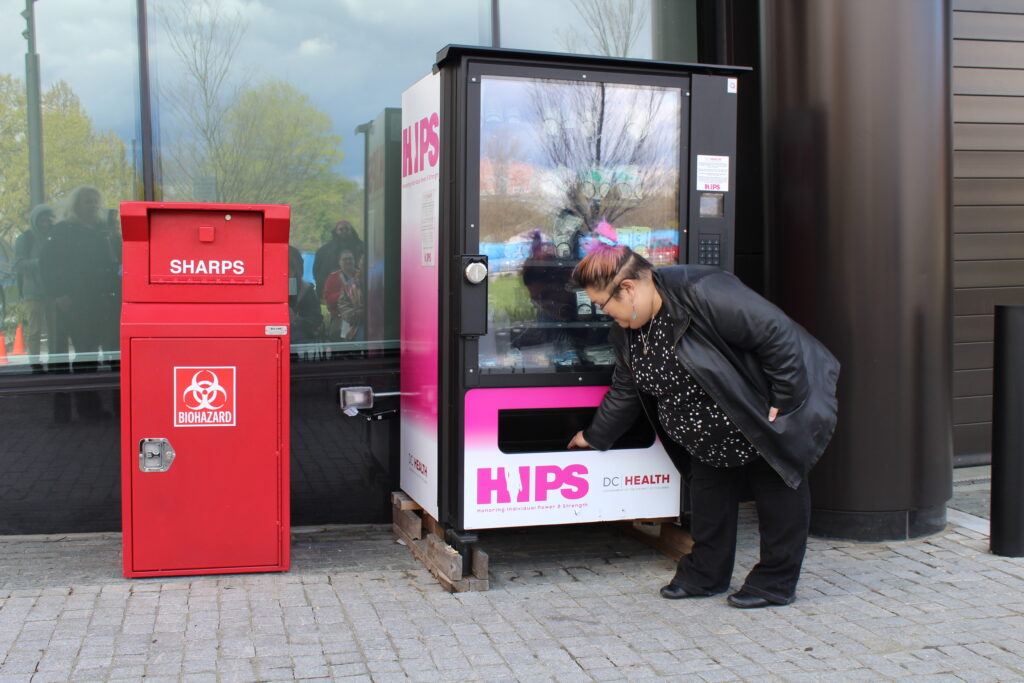
The harm reduction vending machines were a great idea, they allow people to have more autonomy. Some people do not feel secure going to a facility or talking to someone on a street corner, which is valid, cause there are a lot of reasons why someone wouldn’t feel secure doing those things.
Does harm reduction play a part in mental health?
Yes, harm reduction is holistic. Everything about a person works in conjunction with everything else about a person, so mental health is a part of drug use, and there are so many studies that show how mental health and physical and material conditions affect not only if they use drugs, but how they use drugs. You look at someone who is more mentally healthy, say, they’re more capable of handling something in a social environment than someone who has other issues. Mental health, housing, physical health, it all rolls in. We’re complete people, not just one aspect.
How do you feel about harm reduction and the unhoused, what’s your insight?
I guess within the unhoused population, you see the crux of what is harm reduction as we can do it. Because first of all, housing first needs to stop being a dirty word altogether, cause every study, anything you’ve ever seen shows people with housing have an easier time with mental health, an easier time with employment, an easier time with recovery, everything. So we want to try to shoot for that, but in the meantime, often harm reduction is the only thing that helps between those times.
I have 11 years sober, but I also came home last night and sat here and watched TV. Something that innocuous and boring is something that a lot of folks get out of rehab and they don’t have the ability to do. We get people out of rehab, we drop them off on a corner, a corner where people are selling dope, to an encampment. You gotta think about what you do to entertain yourself when you’re sober, these things aren’t available to you, you don’t have the money to go to a movie, or anything like that, and no one’s around. Very few people want to sit alone in a camp at night and be sober, I mean, it sounds like it sucks.
Do you believe in decriminalization for drugs? Like if a person has an addiction, do you think it’s okay to just lock them up and put them away, or is it okay to send them to treatment?
I think it’s okay to go to treatment, I mean decriminalization is the official position of HIPS. Personally, I’d have everything completely legalized and out cause to me, looking at the statistics, something like 82 percent of the people who died died not from an overdose, but from poison. They died from having an alien substance that was not necessarily what they wanted in their drug supply, and almost every one of those would be saved by just having the FDA inspect dope. It would save more lives than any other idea.
Drugs are neither good nor bad. They can be a tool, they can be a destructive force, they’re not good or bad, it’s how you use them and what you do. So if someone is looking to get help, then offer it. If someone is committing crimes, like violent crimes, deal with that, but the drugs themselves are neutral.
The reason I asked you that, is I feel like the city council and the mayor should give us a consumption site for clients and have people monitor them while they use drugs, because we’re both on the 7th and T project and you should see how many people be laid out in the street by the school, that’s why we having issues with the school. I wish we could get more money for harm reduction services, I wish we could push for the consumption sites, cause I believe in that.
I believe in the consumption sites as well, the larger issue though, especially in the current political climate, I mean the consumption sites polled very well, and many people within the D.C Council and politics want them, but the big thing is, we are already at this crossroads of losing home rule, and what will the Congress let us do, and right now I can only say the next four years, it’s not gonna happen.
A consumption site can look like a lot of different things. Most of them look fairly medical, it’s essentially a place where someone can go and use their drugs in a safe clean environment, and it would be staffed with folks who know how to handle an overdose, know how to deal with things, know how to trip sit, whatever is needed. It sounds radical, but if you stop and think about it, what is a bar? A bar is a place where people can safely go and do a substance that, as far as legality, legality is just what we decide is legal. I can say from personal experience alcohol did more to destroy my life than any other substance. So it’s somewhere between a medical facility and a bar, but the main points are off the street, somewhere safe, and trained people around you.
Speaking as an individual, I think a consumption site would solve a lot of issues. Places that have had consumption sites have had zero deaths in them. It also moves people off the streets and into a place where you can better give them services and they also aren’t as much of a problem for the folks who just, you know, there’s no conflict there, but politically speaking, it’s not where the country is at this year. I would love for our council to push it but I also understand it’s a delicate political balance. Congress likes to step in anyway, we gotta do what we gotta do and walk thin lines.
Do you think the city council should be doing more to help different organizations get more funding for harm reduction?
I mean, the answer to that is yes, but the answer to that is always yes. Even if they did more, I’d’ be saying yes, there’s just so much need that there’s no way. For the most part, our council does care and does try, and working in Ward 1 with Nadeau, she’s been instrumental in getting us in there, but I don’t know that I will live in a time period where more resources wouldn’t be needed.
If harm reduction service were to be cut, what would that be like?
People would die, it’s that simple. And also people would not progress in the same way. Studies show folks who work with harm reduction are more likely to stop injecting, they move to smoking, which is harm reduction. We’re proving ourselves effective and useful.
How do you feel about HIPS coming up on our 30th anniversary?
Great. This place has been around for as long as I can remember, I had involvement with it before I worked here. HIPS is a pillar for the city really, it means so much to have someplace like this, when people know where you work and everyone is like oh my god I love them.
Being a peer support I get that as well, when I tell people I work at HIPS, their faces light up
Yeah, being a part of something that means so much to so many is great, I learned so much from people above me.
They paved the way for us. I wouldn’t be the person I am today without HIPS and the people who helped me.
In 1993, it was a condom van driving around with candy talking to sex workers, and then a path came to move into harm reduction as a broader world, and wanting to work with every organization that works anywhere close to common ground, because people are whole people. You can’t just be over here working on one aspect of them, and HIPS has really grown in that. I’ve never had an employer I had nothing bad to say about.