This summer, I had beginner equine training which provided instructions for brushing, walking with a lead, and the overall handling of a horse. There was a mouthpiece and bridle which included headgear, lead or rein, and straps. The saddle and cover placement are crucial for riding, with emphasis on the importance of a cinch, billets, back cinch, and the connect strap. These are all key elements for safety as a rider, trainer, and lead person. Another instruction was to listen to the horse’s body language as well as yours. Like we do, horses have personalities, along with good and bad days. Each horse has its purpose, with levels of training from no to high experience, which is paired with a horse’s personality and behavior.
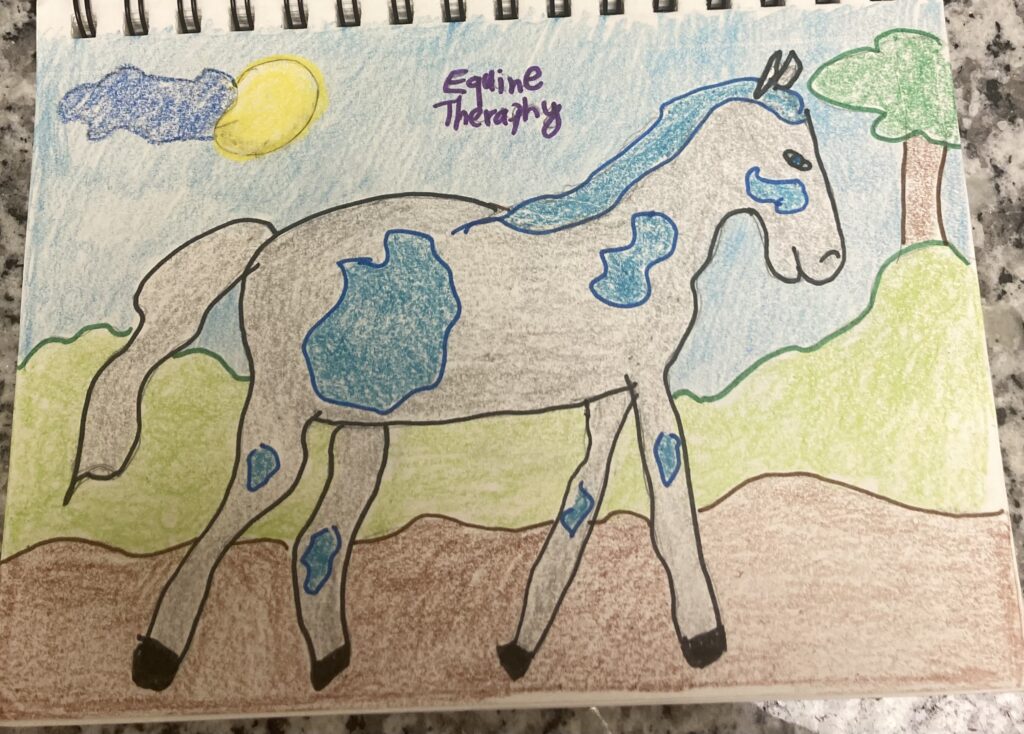
The training was beneficial, and I experienced an awesome encounter with a horse named “T.” She used to be a runner who is now retired with sore legs. I researched locations for equine therapy for myself. Some places have grants for certain groups of people and not for others. Some insurances may pay for equine therapy for clients with certain health conditions. The therapy is expensive, and if someone can afford it, it is the best investment for mental health.
When we were working with the saddle, “T” became concerned about us mounting her. As I held her lead, I caressed her head and reassured her we were just training and would not mount her. She calmed down and loved the pets on her head while she observed our behavior with her. When I stopped caressing her head, she booped my belly to continue with her pets. She was a lovely experience. I feel animals deal with their mental health, too. I know it may not seem real; however, with the little time I spent with “T” she let us know when it was time to end her training sessions. She wasn’t having any more walking and talking with saddle and billet instruction. So we led her back to her stall. The trainer paired each person with a horse that would work with us as volunteers. I thought this was a great observation on how the trainers acknowledge human and animal behavior, and compare our energies together.
In an EBSCO summary written by Nancy W. Comstock in 2024, some of the therapeutic uses of equine training are outlined:
“Equine therapy, also known as hippotherapy, utilizes horses as a therapeutic aid for individuals undergoing physical, occupational, or psychological rehabilitation. This approach can benefit a wide range of individuals, including those with physical disabilities like cerebral palsy, as well as those facing emotional and cognitive challenges such as anxiety, depression, and PTSD. The therapeutic interaction with horses helps improve physical abilities through the movement and dynamics of riding, while also fostering emotional connections that can enhance mental health.”
Even though I had one day of training, it was so beneficial to my mental health. My energy and emotions shifted, and this experience was an educational opportunity to address mental health. I couldn’t afford the therapy sessions; however, this inherited trauma brain allowed me to forget those who have continually created harm in my life. I guess joy and happiness were felt in a nanosecond. A volunteer experience is just as great as a therapy session. Any organization needs volunteers who are extremely dedicated and passionate about assisting in barn work, training, therapy sessions, and horse feedings, or other needs if asked.
Volunteers help run many locations within an organization. Individuals can sit on a board, and whether they assist or volunteer, I don’t know. The trainers I met during my session were phenomenal, especially the trainer with whom I worked. They were as gentle as our horse named “T.” Of course, everyone’s experience will be different than mine. An experience is according to how we embrace healthy therapy techniques, and others might not have the ability to do so without a caregiver’s assistance in repetitive sessions.
A study conducted by the University of Missouri, Columbia, and published in the Journal of Equine Veterinary Science in October 2017 found horses working with adults affected by post-traumatic stress disorder (PTSD) did not adversely affect the horses, and many horses who are older or otherwise who would have been euthanized may benefit from continuing to be of service. There is also an opportunity to adopt retired horses at reasonable prices and provide equine training as an owner. So, equine therapy also saves a horse’s life as well as a human’s life. That’s a win-win for mental health therapy.