When we last left Wendell, he had just discovered part of his mission in life may be to plant seeds that will grow into trees of knowledge abroad by delivering books on recovery he’d been collecting for years. Read the first part here.
Listening to my new friend speak of the roadblocks to recovery in Ghana, I remembered what we know as the 12-step process of recovery was born in the early 30’s, and by 1938, a book was published explaining how to recover. There were no TVs, mobile phones, internet, superhighways, or public transportation yet as we know them. Very few people could afford an automobile, and the roads outside of the cities were still very primitive. The daily gatherings some of us attend today started as weekly or monthly affairs in someone’s home.
As he was describing his country’s conditions, it sounded in every way like America in earlier times, as it related to being able to access the information needed for recovery. And how did it work here? They took the only solution available to them then, and it’s what we’d now call low-tech: simply reading a book and passing on the information obtained. Each one teaches one.
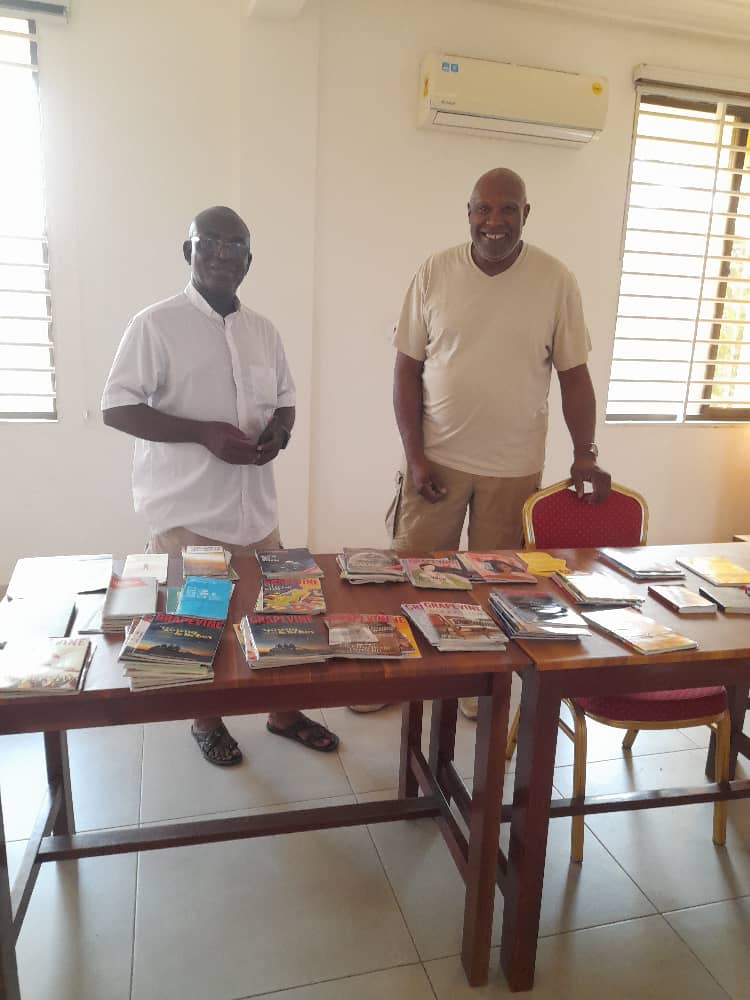
Those early books were hard to come by, and if you had one, you shared it. Well, that same strategy came to mind as the only thing that could work in my friend’s situation. Back before technology took over, we were told those who read the recovery books would be able to make the necessary changes needed in our lives. People have successfully recovered in isolation since the beginning with just the literature. And the same would work in this part of Africa. But there would be two parts to the delicate task. First, finding enough books, because the need was so great, and second, how to get the books to Africa. When I shared what I was thinking with my friend, he said, “You just get them, let me worry about shipping them.” Being relieved of what I thought was the most difficult part, I was off and running, towards what, I really didn’t know. I was thinking, “Yes, I can do this, it’s just getting the books.” Stay tuned.
So as soon as I returned, I shared what had happened in Ghana, the need, and my vision with everyone I knew. Using my sales training, I asked for referrals to groups, even about ones were no longer meeting in person or had died out due to the pandemic, and may have, sitting somewhere, large numbers of books. My friend and I worked up a poster asking for recovery book donations, and we shared it on our large international Zoom gatherings. This led to my collecting books in larger numbers than I ever had. When I spoke about it with people, some asked me about my timeline and how they could give. This led me to make several more calls to my friend to formalize the effort into a serious appeal for help, like you see on social media to feed or bring medical services to underserved communities overseas.
People today have become used to helping in a variety of ways, and I’m still stuck thinking, “You got books, what’s your address?” Which had me running around like a chicken with its head cut off (I’ve seen that.) In the days following, I’d drive great distances in the same day in different states for books. Meanwhile, others, more tech savvy, kept giving ideas on how one could more comfortably give that I hadn’t thought of, because I didn’t understand.
Some wanted to write me a check. Some inquired about electronic payments for books, and others asked, “Can I give you my credit card information?” And still others, “Take this cash, Wendell.” Some asked for the address in Africa or my address so they could mail books directly. But I finally stumbled on a method that could work for most people eliminate any possibility of the effort being taken as just another scam out of Africa, like the infamous “Nigerian Prince.” Donors could call in or go online and purchase new recovery books directly, without having to share personal information with me. And this blew the whole Johnny Appleseed of Books thing wide open. As a result of my fumbling and stumbling, I came across the gold standard.
It now seemed like every day, more people got wind of this little book drive. I’d be at the office, and my phone would ring from some strange area code, and someone else would want in. I’d refer them to the website or hand the phone to a worker in the office who’d call them back to take a donation, and then I would choose the books. At times, people sitting in the office buying books themselves would overhear my conversations and say, with their credit card still out, “Put us down for this amount.” It went on like this for about three weeks before tapering off. (I’m still receiving books in the mail; they’re in my trunk.)
Now my car was overloaded with books, and I feared some idiot would break into it only to find books on why they shouldn’t have broken into it in the first place. Now this venture began taking over my living room, starting in one corner and spreading across the floor. So, for self-preservation, I had to begin focusing on getting the books out. I could no longer wait as the load got bigger. We were close to 400 books, some from as far away as Canada, and since I am addicted to round numbers, it was suggested I stop before I set a crazy goal of a thousand books and move into a two-bedroom to accommodate the traffic. In Africa, we had talked about using a loose network of Ghanaians traveling to and from America to ferry the books, but not with this number. So, we began to check on the rates with airlines, with the uncertainty of shipping anything by boat to Africa.
Like I was taught, I reached out to a friend of our program, a mighty man of service, and asked for his help. Let’s call him John. He’d just retired from the Postal Service, and I needed his opinion, which was, “You got 4-6 big heavy boxes of books here, and Home Depot boxes aren’t going to do it. They’re affordable but won’t stand up to the way they will be handled along their journey.”
So, I got back on WhatsApp to Africa to apprise my friend of the latest of the many challenges and changes to the plan I was facing. I let him know the well was dry on my end, money-wise, because so many of my contacts were all in, and I just couldn’t ask them for shipping donations, too. He mentioned he had a relative in America he’d contact for help. After a lot of back and forth and many delays, I was app-ed $200 to get everything to Africa. I had to bring myself to understand what that amount represents to someone in Africa, several thousands of dollars, at least six months’ salary, so I had to make it work.
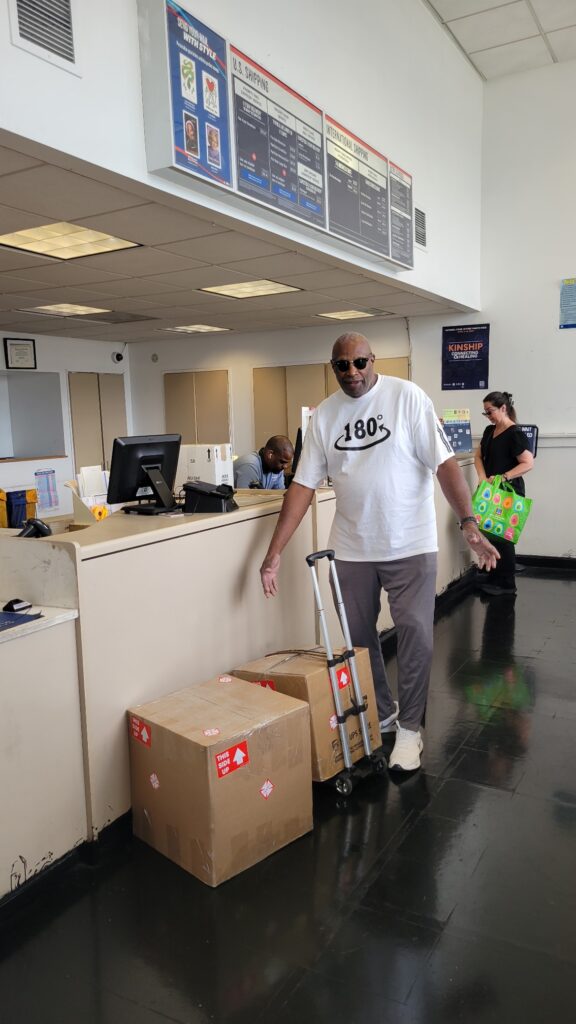
I got with John again, and he suggested a UPS store for the packing expertise, because the books would be of no use if they arrived damaged. We got a quote, and we were already over budget. Then we went to the post office, and they could only give us a minimum cost based on weight. (And it did get tricky on the actual mailing date.)
Then the universe opened, and then Sister’s Johnny Appleseed of Books received a blessing, that, if I had a lifetime, I’d spend it fighting to have her nominated as a saint. My friend said the spouse of one member of his group in Ghana before the pandemic was in the diplomatic service, and we could ship the books using their diplomatic post office, but more importantly, it could be shipped on a secure U.S. military flight with delivery in 10 days or so. Unbelievable that after all that we’ve been through, it’s happening.
I tell the story to the shipping store manager, who further discounts the packing. So now they wouldn’t be damaged by water or mishap. All the while I’m watching this tight budget shrink, which I know is going to include some of my own precious funds. We drop the books off, I get the call they’re ready, and head back out. My friend with her SUV helps as we head for the post office. After hand trucking the boxes in, filing out additional forms, and waiting in line, I find the boxes were overweight. The counter person can’t or won’t tell by how much, only that they are. And in a Random Act of Kindness, I call back to the shipping store manager, who says no worries, just come back, we’ll give you the additional boxes and repack at no charge. And in an hour or so, I’m back at the post office, full of anxiety these books will be like grown children who finish college and never leave. When it’s all said and done, I’m only out nine bucks. But once again, I learned so much about people and myself.
Wow, all along this process, I’ve run into the kindness of people who heard the story and wanted to be a part of getting those books in the hands of readers in Africa, whom they’d never get to meet or see read. And that’s the beauty of paying blessings forward and the pure spiritual mission of a ragtag person, who was a real person and not a myth. And how this nun, back in 1962, planted in me the seed that would become this wild idea in 2025 that maybe I could become “The Johnny Appleseed of Books.”
I think today I’ll drive by the school, park, and look up at that second-floor southeast corner window where the Sister used to stand, wave, and thank her for giving me the beginnings of a moral compass through the works she read to us those afternoons.
This piece is dedicated to Sister Margaret Marie, SSJ, Sisters of St. Joseph of Chestnut Hill, Pennsylvania.