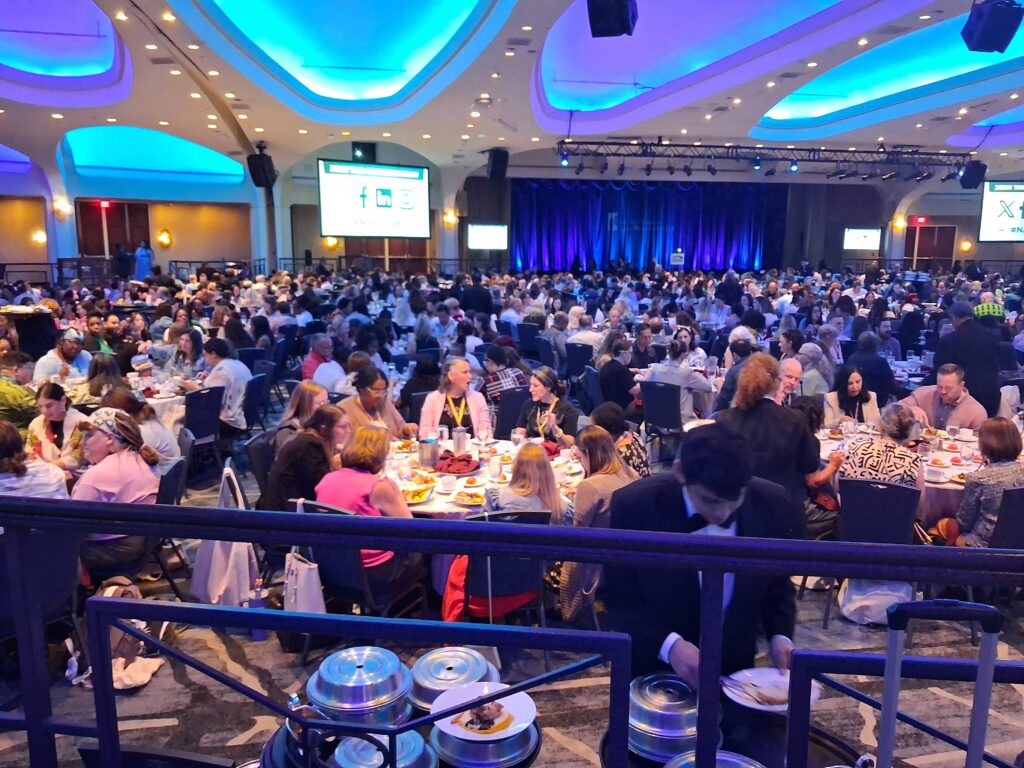
The 2026 National Alliance to End Homelessness (NAEH) Conference marked my sixteenth year in attendance. While we have come a long way in programs attempting to address the needs of people suffering from what we at People for Fairness Coalition, in our 18-year history, have come to call housing instability, far too many Americans remain unstably housed today.
One striking question raised during the conference was put directly to staff: Will we ever end homelessness when so many people work in the business of helping our unhoused neighbors? The poor will always be among us, and there will always be people in the business of helping. But that does not mean we should stop pushing for policies that would make that business unnecessary.
The conference was led by the remarkable NAEH CEO Ann Oliva, whose passion for people is evident in everything she does. Also present was Albert Townsend, long-time advocate and one of the founding members of People for Fairness Coalition, serving as NAEH’s director of lived experience and innovation. During our team’s interview with Oliva and staff, I shared my history of attending past conferences, always looking to advocate for policy that will end homelessness as we know it. Oliva acknowledged the focus under the current administration has shifted. The priority now is to maintain services and infrastructure currently under threat from the Trump administration’s Department of Housing and Urban Development. She was candid about our shortcomings in providing essential services, and about how Continuums of Care are failing to meet the moment for many of the communities they serve. Yet she affirmed we will continue to push for innovative approaches while keeping our eyes on the policies that would actually end homelessness with a new Congress that may be more willing to fund low-income housing at scale.
Our closing keynote was delivered by the equally remarkable Maya Wiley, president of The Leadership Conference on Civil and Human Rights. Her address left me with a line I have not been able to shake: poverty is being criminalized. As an at-large Poverty Commissioner in D.C., that statement landed with full weight. I thought immediately of the Cicero Institute and the policies it is advancing that do exactly that — criminalize our unhoused neighbors. When I raised this with Oliva, she was direct and clear: If an individual chooses to identify as Santa Claus and poses no harm to themselves or anyone else, that person should not be forced to enter any homeless service center involuntarily.
There were differing views among our team members on questions of accountability within services — particularly around low-barrier shelters. My own experience informs my position: There should be no barrier to entering a low-barrier shelter during hypothermia season or a heat emergency. But the services offered inside should be far richer for those willing to engage in self-care and programming that supports people working toward self-resolution of their health, housing, and wellness challenges.
Additionally, a significant portion of our team’s discussion centered on returning citizens — individuals leaving incarceration and entering what can feel like another institutional setting, often without a plan, housing, and real support. This cycle too frequently leads back to incarceration as people struggle to survive without a home. There was strong agreement across the group: we need concrete plans that include stable housing before individuals are released. One of the areas where this year’s conference genuinely inspired me was its focused attention on our senior population. An entire section was dedicated to innovative policies and service models for aging unhoused residents. Michele Williams, a board member of the National Coalition for the Homeless, introduced the concept of universalism — offering multiple pathways to housing security that fit individual needs, applicable to seniors, families, and beyond. Christy Respress, CEO of Pathways to Housing, spoke compellingly about how we improve service models under the current funding constraints, including shared housing.
A conversation with Kendall Clark, an outstanding advocate from Atlanta, gave me substantial food for thought around the federal senior housing voucher program. His perspective connects directly to our push for a universal voucher system for individuals on fixed incomes over the age of 55. The big questions the conversation raised are: what would it cost to fund a tax-based voucher system for seniors over 55? How do we structure that programming? And how does the emerging conversation around social housing for low-income residents intersect with homeless services and entitlement services (vouchers and subsidies) seniors already qualify for?
Perhaps the most important conversation at this year’s conference concerned civic engagement. The right of poor and unhoused residents to vote must not be taken from them; it must be made easier to exercise. This conversation has been driven with exceptional energy by Donald Whitehead of the National Coalition for the Homeless, who is building awareness around the right of unhoused residents to vote and the steps communities can take to support voter engagement among low-income and unstably housed neighbors. That includes access to identification — needed not just for voting but to obtain and maintain the services many residents depend on. For people who have come to believe they do not matter, these engagements carry a message: you do matter. Your vote counts. And if there is one thing you can do for yourself and your community, let it be this.
This year, more than ever, that message is urgent. People and communities are under attack. The ability to vote — and simply to live — is being criminalized by this administration. The National Alliance to End Homelessness, the National Law Center, the National Coalition for the Homeless, and advocates across the country must sustain our collective commitment: homelessness must not be criminalized. What we need is housing. Not handcuffs.
Editor’s note: Street Sense vendors and journalists were able to attend the National Alliance to End Homelessness conference through a partnership with the organization, which allowed reporters to attend for free and provided small stipends for travel. NAEH worked with reporters to set up interviews during the conference, but did not review any of the articles ahead of publication.
This article originally appeared in Street Sense’s July 29, 2026 edition.